![c9c233_296a56047d6d4e95a6a03217ab047e1e.png_srz_295_225_75_22_0.50_1.20_0[1]](http://matsutas.com/wp-content/uploads/2013/12/c9c233_296a56047d6d4e95a6a03217ab047e1e_srz_295_225_75_22_0-50_1-20_01.png) We just launched a new website with images and texts from Freetown, Sierra Leone. The site is a platform for both a photo exhibition: Pentagon (photos and texts from my fieldwork) and a film: Jew-Man Business (directed by Maya Christensen, filmed by Christian Vium and produced by me). The new website has been created by Hanna Berhanusdotter who has been an academic intern at NAI. Please have a look: http://www.economyofthestreet.com/
We just launched a new website with images and texts from Freetown, Sierra Leone. The site is a platform for both a photo exhibition: Pentagon (photos and texts from my fieldwork) and a film: Jew-Man Business (directed by Maya Christensen, filmed by Christian Vium and produced by me). The new website has been created by Hanna Berhanusdotter who has been an academic intern at NAI. Please have a look: http://www.economyofthestreet.com/
Tag: Sierra Leone
Fair investments? Swedish Governmental funds, land grabbing and human rights in Sierra Leone, by Tilde Berggren
According to a number of local and international NGO’s, journalists and researchers monitoring the situation on the ground, the large scale investment in Sierra Leone between Addax Onyx Group (AOG) and Swedfund, as well as a range of additional investors, is causing concern. The main concern is that the investment is contributing to poverty, decreased access to basic rights and may increase instability and anger amongst the local population. Swedfund is dismissing the concerns, arguing that the monitoring of the situation is sufficient and emphasizes that the project is in its start-up phase and it is therefore too early to measure impact. However, those monitoring the situation are many and conclusions based on their monitoring are coherent and consistent and can therefore not be dismissed.
Swedfund is defined as a bilateral Development Finance Institution, it is a development finance institution owned by the Swedish State. In 2011 Swedfund signed an agreement to become equity partner with Addax Onyx Group (AOG), committing EUR 10 million to an investment in Sierra Leone. Sweden contributed to create the largest private sector agriculture investment in Sierra Leone ever made. The purpose: to grow sugarcane and produce ethanol for the European market. The Swedish Government and Swedfund claims to be committed to comply with principles for businesses and human rights and to ensure that investments and aid contributes to ensure respect for human rights.
It is more a rule than an exception that negative impacts on the lives of ordinary people of large scale investments are ignored. In the majority of cases it is those that have access to information and the financial capital that are taking the lead in exploitation of natural resources while working for governments and multi-national corporations.
It is not unusual that businesses invest in conflicts and post-conflict affected areas where no or few accountability mechanisms exist and where corruption is the norm. To meet the rising demand for accountability of corporations, principles have been developed by international organizations such as the United Nations and the World Bank. The idea to ensure that the corporations be held responsible to some kind of reasonable standards in their pursuit of financial capital is good.
Because of the complicated nature of domestic and international law and the way it relate to multi-national corporations, an alternative to strict legal accountability has taken shape in non-binding international standards. These principles are non-enforceable and may in some cases rather hamper accountability and access to justice in countries without proper accountability mechanisms than helping to support them. Investment agreements may pave the way for abuse and violations of human rights provide huge financial gains for international investors and a select few of national political and economic elite.
It is the State that has the responsibility to protect its population against human rights abuses by third parties, such as corporations. It is important to distinguish the responsibility of States and corporations. States ratify legally binding conventions, meaning that they have a legal responsibility to respect and protect human rights. Corporations are merely legally bound by the agreement they have entered, be it with a state, another corporation or an individual. Corporations are bound by the domestic laws governing the state where they establish their business. Even if corporations are bound to “respect” human rights, as established in non-binding UN Human Rights Council and General Assembly resolutions, this is not, to date, a legal responsibility under international law, rather a moral and ethical responsibility.
A State does not violate its human rights obligations if proper accountability mechanisms, such as laws, policies and procedures for investigations, prosecution in a court of law and effective legal remedies, are implemented and enforced. In cases of human rights abuses committed by corporations, it is the responsibility of the State to prevent, punish and compensate when abuses occur, corporations are not attributed such authority.
It is not unusual that long term agreements are entered into between States and multi-national corporations. A corporation may declare in an agreement and in its general corporate social responsibility strategy that it intend to apply international non-binding standards such as the UN Guiding Principles on Business and Human Rights. A corporation may apply the processes established in these international principles and follow the standards in detail. Yet, the agreement between a State and a corporation may have severe impact on the human rights and lives of large numbers of people unless domestic standards and mechanisms exists to hold corporations responsible for abuse..
When corporations lease large areas of land, people that remain on the land can in the best-case scenario agree to limited or no possibility to continue using their land for income and food generating purposes. They might stay on the land without being able to use it or they might leave. They might also be offered to start working for a corporation if such possibilities arise. This often happens under unpredictable and dire working conditions and lack of alternatives to income makes it hard to opt out.
Take the example of the above mentioned private investment in Sierra Leone between Addax Bioenergy and the Government of Sierra Leone. Addax have leased 44 000 hectares of land, equivalent to 26 000 soccer fields from the Government of Sierra Leone. The land lease agreement is valid for a period of 50 years. 92 villages exist on the leased area, which is inhabited by approximately 14 000 people. Around 2000 work opportunities is estimated to have been created the past four years for these 14 000, 4000 were promised so far. The people living on the land are paid an average of 8 dollars per 1 hectare and family a year.
The overall lease agreement is entered into between Addax and local Chiefdom Councils. The lease sets out how, amongst other issues, the rent of the lease will be distributed between the central government, the chiefdom council, the local district council and amongst ”those adults treated as land owners”, (which means those people inhabiting the leased land). These adults are not legal land owners of the land; since they according to the laws governing Sierra Leone cannot own land. The Chiefdom Council agrees, in the lease, to “use their best endeavors” to ensure that the lease is signed.
The local land owners were also given a document called an ”acknowledgement agreement” in which they by receipt of an annual payment of 1.40 USD per acre of land, to be shared amongst family, acknowledged the validity of the lease agreement between the local authorities and the corporation.
In return the “landowner” agreed not to interfere with the company’s rights under the lease and they acknowledge the company’s rights to use their plot of land. The signing by the “landowner” on behalf of his family consolidates the free, prior and informed consent process, according to the corporation. The lease gives the corporation exclusive possession over villages, rivers, forests etc. that forms a part of the leased land.
If any conflicts arise on the lease they shall be resolved by arbitration in London, hence not by the national judicial system of Sierra Leone. Knowing the costs involved in arbitration, the chances that any local authorities, would contest any clause in the lease by arbitration in London, are extremely slim. If, however, the parties resort to arbitration, the right to appeal is waived by the lease agreement.
Keeping the above in mind, the process establishing the above lease and “acknowledgement agreement” has beencarried out in accordance with established principles by the United Nations on business and human rights and IFC standards. A large number of information sessions were held with the inhabitants of the land and the corporation. Several evaluations and assessments were made by the corporation. The corporation feels proud to inform that now, contrary to before, the land owners have a paper showing their registered plot of land. Note however the land owners are not the “owners” they are just called “owners”.
It must be stressed that the majority of the inhabitants in the staked out area have very low, if any education, and often they have not travelled further than to the district town Makeni. The majority of the people in the area live beneath the poverty line. This means that they barely have food for the day. When signing, or putting their thumbprint on the acknowledgement agreement, they could not grasp the large scale implications. The agreement was already established by their own local authorities. They received less than two dollars a year per acre for land they had farmed and resided on for generations.To them, giving up access to their cassava plantations and the use of a plot of land in exchange for the promises of a large scale investment most likely came with the idea of progress towards a better life. In their world, when the notion of jobs, roads, income, food, education and health arise, it is not difficult to sign such a document. However, they also knew that they did not have a choice, on their behalf, the local authorities had already leased the land and, as noted in the lease agreement ”used their best endeavors to ensure that the lease would be signed” and that the corporation be ensured to ”peacefully and quietly” enjoy the land without any interruption.
It is argued that benefits will come with the investment, but despite these, what the land lease agreement between the Government of Sierra Leone and Addax really implies is that 14 000 people no longer have rights to use the land, freely access areas to hunt and in some cases access clean water. They do however have access to rice. The corporation has established rice plantations. There are growing concerns by local NGOs that rice does not sufficiently ensure the nutrition needs of the inhabitants.
Hesitation to sign the acknowledgement agreement might have arisen if the inhabitants of the land had equal access to information and knowledge as the corporation and the Sierra Leonean Government. But for a person living far away from international business know-how it is virtually impossible to strategically understand the financial and long term implications of the agreement.
Perhaps they would have thought twice, questioned or demanded conditions had they had equal access to information. This is where the Government of Sierra Leone should have stepped in, to ensure that the human rights of the inhabitants of the land were protected. But the Government did not. The Government was the party that signed the lease agreement. The basic livelihood of 14 000 citizens was with a signature replaced with uncertain futures, as temporary laborers, at the whims of a large-scale investor with limited socio-economic concerns for the population. Surprisingly those working for the company and investors, such as the Swedish Government appear to have a very hard time understanding why the inhabitants now complain about the establishment of the corporation.
Without doubt the people did not have access to information about the overall consequences of the agreement. They did not know the implications of the clauses stipulating that Addax Bioenergy do not need pay corporation tax until 2022 and is exempted from paying duty on a number of goods and the overall implication of this on Sierra Leone. What if they knew that international firms shift profits to lower tax jurisdictions cost Africa $38bn (£25bn) a year? According to the Africa progress report 2013, by the Africa Progress Panel chaired by Kofi Annan, Africa lose through such tax loopholes, twice as much as the total gains from all donor funds. Perhaps there would have been hesitation in signing? Had it been that Sierra Leone was a country where abuse of power was not common, had Sierra Leone not been governed by a system of complex local and central power structures, in which high levels of corruption exist, had they known that research indicates that prospects of a better life increase only for those already having a good life when these kind of investments are made, perhaps they would not have signed any agreement.
Perhaps the inhabitants would have questioned the consequences for their country, for themselves and for the coming two generations. Perhaps they would have demanded that any conflicts between Addax and the Government of the lease agreement be settled in a local court where they could access justice, instead of in a court of arbitration in London. What will happen when the illusions of newfound prosperity fades and the 14 000 people start requesting for the indications of a better life they had when they signed the agreement?
Anger against corrupt local leaders was part of fuelling the conflict in Sierra Leone. Thus, feelings like those existing before the war may again arise. Increased malnutrition, lack of water and food may create cleavages between local communities and ethnic groups. Signs of anger and protests against the corporation have already occurred. People are starting to question the agreements they signed. . The corporation, the investors, the Sierra Leone government are justifying the situation by referring to compliance with international principles established for human rights and business. Addax Bioenergy followed many existing principles of corporate social responsibility. However, fairness and equality in access to knowledge and information did not exist. If the Government of Sierra Leone does not represent the people then investing countries like Sweden must step in and take responsibility. It is not justifiable to support investments in a country when accountability systems are not in place, corruption is known to be rampant and human rights violations are not tackled by the state.
The Africa Progress report 2013 released 10 May, indicates that the establishment of corporations may improve the overall financial situation of a country, but not the situation of the poor; instead they rather tend to increase the gap between poor and rich.
According to the United Nations Special Rapporteur on the right to food, countries with weak land governance increases the risk of large-scale land deals turning in to actual “land grabs” where free, prior and informed consent of affected communities is not sought and human rights violations often occur.
Evidence shows that few jobs are created by biofuel-related investments relative to other sectors and where small-scale farming is replaced by large-scale and heavily-mechanized monocultures. Many of the former land users’ end up jobless and landless according to the Special Rapporteur.
The case of Sierra Leone, supported by the Swedish Government’s aid scheme and implemented by Addax bioenergy is justified by compliance with the processes stipulated in the principles for business and human rights.. What is not noted by the Swedish Government, the Government of Sierra Leone and Addax is that compliance with international standards for businesses and enterprises, does not exclude responsibility for human rights. States must comply with legally binding human rights law. There should be a scrutiny of the ways corporations and donor countries use the principles of human rights. States with natural resources must be held accountable for allowing investments, prone to result in human rights abuses, establish when legal conditions and accountability mechanisms does not exist. Corporations and donors must take moral and ethical responsibility. Responsibility cannot be avoided by hiding behind processes established in principles of business and human rights.
Tilde Berggren is a human rights lawyer having worked the past eight years with policy development at the United Nations headquarters in New York, including with the High Commissioner for Human Rights and the Special Advisor on Gender Issues, with human rights monitoring and reporting in the UN Mission in Sierra Leone and with Civil Rights Defenders in Kosovo and Macedonia.
According to a number of local and international NGO’s, journalists and researchers monitoring the situation on the ground, the large scale investment in Sierra Leone between Addax Onyx Group (AOG) and Swedfund, as well as a range of additional investors, is causing concern. The main concern is that the investment is contributing to poverty, decreased access to basic rights and may increase instability and anger amongst the local population. Swedfund is consistently dismissing the concerns, arguing that the monitoring of the situation is not sufficient and not carried out in detail, hence not trustworthy and does not illustrate the overall situation. Swedfund on their side emphasize that the project is in its start-up phase and therefore it is therefore too early to measure impact. However, those monitoring the situation are many and conclusions based on their monitoring are coherent and consistent and can therefore not be dismissed.
Comparing elections in Sierra Leone and Ghana (guest post by Jonathan Bhalla)
Multi-party elections were a prominent feature of Africa’s political landscape in 2012, with twenty-three countries conducting polls – whether presidential, legislative or municipal. News coverage in the mainstream media has, at times, been framed in clichés and stereotypes. On the eve of the Sierra Leonean elections, the BBC published an article which opened: “Sierra Leone may be about to prove it has grown up”. The preoccupation is often with little more than who is likely to win and whether there will be violence. Rapid and diverse political transitions taking place across the continent are seldom reflected upon in any depth.
I have a longstanding interest in the politics of Sierra Leone, and so followed the elections on 17th November 2012 closely – albeit from a distance. I found a number of striking similarities with the polls in Ghana, which took place a few weeks later on 7-8th December, particularly interesting.
”Ampa Ampoh!”: Sierra Leone after the announcement of the 2012 election results (guest post by Mimmi Söderberg Kovacs)

SLPP rally with candidate Maada Bio. Courtesy of Mimmi Söderberg Kovacs
Late in the afternoon of Friday 24 November, as the sun was setting over the busy streets of downtown Freetown, the National Election Commission (NEC) of Sierra Leone called a press conference to announce the results of the Presidential Elections, ending a week of uncertainty and speculations. As anticipated by many, the sitting President Ernest Bai Koroma of the All People’s Congress (APC) secured a second term in power with almost 59 percent of the votes cast, thereby avoiding a run-off against the main opposition leader, the former military junta leader Julius Maada Bio of the Sierra Leone People’s Party (SLPP), who received 37, 4 percent. None of the other candidates were able to secure more than 1,5 precent, confirming the growing polarisation of the political landscape in post-war Sierra Leone. The turnout was high, with a national average of 87 percent. Continue reading
The Waiting Continues in Sierra Leone (guest post by Johanna Söderström)
Now, a few days after the election on November 17, everyone is waiting for the National Electoral Commission (NEC) to announce the final results. Rumors of when NEC is going to announce the results spread like wildfire across Freetown, where people are eagerly anticipating the results. Whether via radio, tv or text messages each press conference by NEC is believed to be the big one, where the results will be called by NEC’s chairperson Christiana Thorpe. But so far everyone is still waiting.

SLPP supporters giving the red card to APC – “you are out!”
Soldiering Democracy: the 2012 elections in Sierra Leone (guest post by Maya Christensen)
“We want a transparent election with no violence” was a statement shared by people in the streets of Freetown when they went to vote for the presidential and parliamentary elections yesterday (November 17). With no cars allowed in the street and with the threat of being arrested if gathering in groups or if engaging in any form of political campaigning, Freetown street life was marked by an unusual quietness. Before daybreak people were queuing waiting for the polling stations to open and voter turnout was reported high all over the country. With the exception of a few incidents, the election has been reported generally peaceful so far. Continue reading
50 years.
Charles Taylor will spend the rest of his life in prison (unless someone decides to assist his escape again :)) for aiding and abetting war crimes in Sierra Leone. As a comparison Issa Sesay, one of the senior commanders of RUF, was sentenced by the same court to 52 years. Most commentators have raised words of optimism saying that the trial will send signals to other warlords that they will eventually be dealt with if they don’t “behave”. Maybe so, but I doubt. Anyone who decides to lead armed incursions or make military coups is quite aware of the stakes and prepared to take the risks. After all it is a prerequisite that they gamble rather offensive with their own life by leading such endeavors. However what may be the outcome is that a set of future military leaders (and some currently in power) must think twice with whom they form alliances and be aware that it should rather not be someone who is on bad footing with the mighty West.
Two short observations to be made: firstly, I guess we will see some shifts in political alliances on the Liberian arena. They may not happen overnight, and they may not be directly visible to all observers – after all Liberian politics by and large happens behind the scenes. And secondly, I hope that Charles Taylor will spend some of his time in jail writing, or narrating to others, his proper version of the Liberian civil war. What else should he do with all his time?
Gerhard Anders has also written some closing remarks on the Taylor saga:
The impact of the judgement against Taylor: A dispatch from Sierra Leone and Liberia (Guest post)
by Gerhard Anders, Centre of African Studies, University of Edinburgh
Representatives of international organizations, humanitarian NGOs and Western governments have hailed the guilty verdict against Charles Taylor as an important milestone in the global fight against impunity. With this judgement the Special Court for Sierra Leone, established in 2002 at the request of the government of Sierra Leone, concludes the international effort to hold accountable those ‘bearing greatest responsibility’ for war crimes committed between November 1996 and 2002 in Sierra Leone. In the streets of Freetown, most people greeted the news of the judgement with an indifferent shrug whilst critical voices where heard in parts of neighbouring Liberia. In contrast to the self-congratulatory praise by humanitarian activists and Western governments, people in Sierra Leone and Liberia hold much more differentiated views on the trial against Charles Taylor. To a large degree these are shaped by the current political and economic situation in both countries. Continue reading
On Sporadic Radicalism
Last week I participated in the third Marrakech Security Forum which this year focused on “Issues and security consequences of transition in North Africa”. It also included several panels on the consequences for the Sahel region, as well as the problem of drugs trafficking in West Africa. In this well-ordered event organized by Federation Africaine Des etudes Strategiques/Centre Marocain des Etudes Strategiques there were participants from some 50 countries, about 120 men but only 10 women, clearly indicating the male biased interest in the security business. Participants came chiefly from the MENA region but to quite some extent also from francophone Africa south of the Sahara. It was a crowd of senior diplomats, high rank militaries and professors. It appeared that everyone was a director of one institute or another other. There were naturally also a number of Europeans and Americans. Many of the more than hundred, too brief, presentations were quite general statements on the political situation in North Africa and in the Sahel region. Interestingly U.S. officials and academics choose to humbly downplay the U.S. role in Africa in the years to come, except for in a few strategic countries. French officials raised concern over the situation in Algeria and also talked about the situation in the Sahel as “war” and showed concern for the increasing interconnectedness of militant Islamist groups in the region and all the way down to Nigeria. Participants from Africa South of the Sahara gave quite divergent views on the possibilities of an “African spring”, but the Sahelialists were equally afraid of developments around AQIM, Boko Haram and other radical groups. Continue reading
‘war as a violent mode of participating in today’s global economy’: reading danny hoffman’s war machines
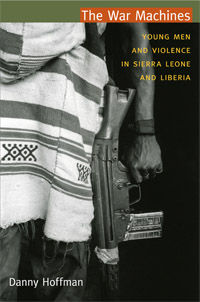 Below is my review of Danny Hoffman’s fantastic book The War Machines: young men and violence in Sierra Leone and Liberia recently published by Duke University Press.
Malaria in insecure spaces. The first time I heard of Danny Hoffman was at an international conference and it was a fantastic story. Some of the senior academics shook their heads at the risks he had taken, blaming it on his “youth”, but I was rather impressed. My reading was that surviving this situation was dependent on his skillful building of trust and mutual respect with his research subjects: rebel soldiers. Hoffman had caught a serious stroke of malaria whilst being in the deep Sierra Leonean bush with rebel soldiers. He was saved by rebels who carried him across the border to Liberia for medical attention; clearly risking their lives, but thereby saving his. Continue reading