Category: Images of Africa

Ethnography and journalism in times of war

This text is a slightly adapted keynote/film introductory note I gave at a conference when the Department of Media and Social Sciences at the University of Stavanger celebrated its 50th anniversary, April 28, 2022. After the speech, our film Jew Man Business was screened.

In many ways, ethnography is akin to journalism. The researcher or journalist visits a somewhat unfamiliar place and tries to understand what is happening. In my research, I have focused on understanding civil wars: why people fight, how they survive, and how they rebuild their lives in the fragile aftermath of conflict. Foreign correspondents, stringers, documentary photographers, and documentary filmmakers often go to the same places, speak with some of the same people, and ask similar questions. In this talk, I will share some of my experiences from the ethnographic fieldwork I have conducted over the past 25 years. I will also present a shorter film we made to contrast with the many journalistic works and documentaries on civil wars in Liberia and Sierra Leone. Although I believe some journalists are careless and sometimes question their ethics, rather than a critique, this talk aims to find common ground between modern anthropology and journalism.

I have studied civil wars since I first got stuck in one in 1996. It was in Liberia. At the time, I was conducting three months of fieldwork in neighbouring Côte d’Ivoire, focusing on refugees from the ongoing civil war in Liberia. As I had subsequently intended to study refugees returning to Liberia, I seized the opportunity to travel overland to Monrovia, the Liberian capital, with an NGO vehicle. There had been no fighting for some time. However, on the way down, we encountered innumerable checkpoints manned by young, sometimes very young, rebel soldiers from various military factions. Approaching Saniquellie in Nimba County, we were stopped at a checkpoint by a group of young soldiers.

Saniquellie 1996

They were all smiles. I couldn’t resist stepping out of the white car and asking for a photo. They happily posed. At the time, I didn’t realise it, but the yellow T-shirt with the print “patience my ass” became significant for my research on child and youth fighters, as it turned out that many joined war factions in a more voluntarily fashion than media and other written accounts suggest. They were frustrated by the system, experiencing social blockages or a sense of social death. They were running low on patience. For many, fighting was a “patience my ass” move, a way of forcing themselves out of the margins and into the centre of society. In hindsight, it was a move that, for a clear majority of rank-and-file soldiers, did not succeed.

My primary focus during a one-year field study in 1997-98 in Monrovia and Ganta, Nimba County, was on what motivated young people to join rebel groups and the tactics they used to reintegrate into civil life.

However, the year before that, I became stranded in Monrovia and had to be airlifted out of the country. Two days after the encounter at the Saniquellie checkpoint, the war reignited. Had I known what I know now, I would have recognised the apparent signs of troop build-up and the movement of personnel, though travelling as civilians and unarmed, along the road we took. I would have understood the increased tension at the checkpoints. The following year, when I returned to Liberia, a young man, whom I knew from a refugee school on the Ivorian side of the border, told me he had seen me, and even attempted to catch a ride with our vehicle when he was moving along the road towards Monrovia to once again fight in the war. I did not see him, nor was I aware of the troop movements. I was a naive newcomer to war.

The day after I entered Monrovia, rebel forces clashed in what became the worst fighting in the capital during the entire civil war. It was gruesome, and from the balcony of a downtown flat I was stuck in, I could see mainly youths shooting at each other. I would say that most soldiers were between 16 and 21 years old.

After two days of intense fighting, a pause occurred, and I managed to make my way up the street to the US embassy. Inside, however, it was not much safer. Rebels jumped the poorly guarded walls and fought each other on the premises. When I went for a shower, I looked out the window and, to my surprise, a rebel soldier was hiding, pressed up against my window. When he saw me, he raised his finger to his mouth, “Shhh.” I closed the curtains and let the warm water rinse my body, as if the war was not there. A few nights later, we boarded a helicopter. I had a Liberian child on my lap, and he peed in his pants as we left Monrovia. Rebels were shooting at us, and a machine gun at the rear of our helicopter returned fire—bullets directed towards a pitch-black capital. We were mainly expats, but there were a few Liberians with American citizenship.

This highlights my privileged position. When conditions become difficult, people like me can usually find a way out. No one at the U.S. embassy was aware of my identity or the reason for my visit. Neither did they appear particularly interested, but they still allowed me in. The colour of my skin acted as my passport. Most Liberians, however, remained on the ground, fighting for their survival; tens of thousands lost their lives in the weeks that followed.

When I returned to Monrovia eight months later, elections had taken place. Charles Taylor, the warlord of the most significant rebel movement, had won convincingly and was installed as president. A reminder that democratic elections do not always guarantee democracy.

I began to spend time with former youth soldiers in downtown Monrovia. They were pretty excited to discover that I had been in Monrovia during the previous year’s war. If only in a cursory way, I had experienced their war, and it turned out to be a vital door-opener. I asked them about their whereabouts the previous year. As they were among the groups controlling the downtown area, they shared stories of how, whenever there was a lull in the fighting, they were approached by Western journalists. Some of them had been guides for these journalists. From the start, the journalists only dared to walk a few blocks. They stayed on a line, guarded by the rebel soldiers. They took photographs of the same few objects, the same ruins, and sometimes the same human remains. And they were fed the same few stories. Given the limited access, I have always wondered what it truly means to report unbiased and balanced news from a place like this. Is it even remotely possible?

Many of the soldiers who guided the journalists came to regret this. Indeed, they had been given tokens for their work, but journalists often promised them that upon their return, they would help them get on with their lives, pay for an education, or merely buy a mattress they could sleep on. The group I came to work with lived in a concrete shell of an old factory. During the rainy season, it got cold, and a foam mattress between them and the cold ground would make all the difference. However, few journalists ever returned, and not a single one kept their promises. Broken contracts between them and journalists made my work difficult. Why would they trust me? And from my point of view, what stories would they feed me with?

Rebel guides took the photojournalists on a safari-like walk through the urban wasteland when there was no fighting. To visualise war, the ex-combatants I worked with recalled that they were at times asked to perform active war. Many photographers and filmmakers were not on the front lines; instead, they stayed at a hotel near the U.S. Embassy, which was considered a safe haven. It was simply too dangerous out there. Instead, they worked post-fact by recreating scenes. Rebel soldiers assist them in staging the war for the cameras.

I cannot say how frequently such acts happened, but when I mentioned this fact a few years ago while giving a lecture to a group of UN peacekeepers, one participant in particular nodded in agreement. Later, he sent me a PowerPoint presentation that had circulated among his colleagues, which included 15 slides with “rigged” photos from fighting in Monrovia. Here are some:

Many poses or fighting styles mimic those seen in action films and are, quite frankly, not very effective in real war. In the background of the first picture, you can see other photographers taking photos. One is directed towards the same rebel soldier, whilst the other is taking a photo of a guy pointing his gun directly into the ground.

Another interesting point is that soldiers often appear very young—sometimes too young to handle a Kalashnikov, given its weight and strength. A boy around 13 or 14 might be able to hold a lighter Italian or Israeli machine gun, but not these types. This is what experts have told me. A more plausible explanation for the photos is that many of the younger individuals in the frames were Children Associated with Armed Forces (so-called CAFs), but not actual fighters. They performed various support roles for older soldiers. They cleaned and carried guns when there was no fighting. Therefore, during lulls in the battle, they posed with guns in front of international photojournalists, reinforcing stereotypes of child soldiers being exploited in African civil wars.

On the streets of Monrovia, I heard numerous stories of children trying to survive by telling violent tales to journalists. One was a young boy, whom I also saw in several news reports. As a reflection of the world’s absurdity, I saw him on a printed card from an international aid agency working against the war. It showed him on the ground; he looks stressed and agitated, as he displays his “warface.” In his hands, he holds a Kalashnikov. At the time, everyone in downtown Monrovia was familiar with the boy. He was poor and homeless, living day to day. Yet, everyone agreed that he never fought. Nonetheless, he mastered the art of telling his war story through words and body language.

Several of the guys whom journalists had approached told me that it was the journalist, or more probably the local fixer of the journalist, who arranged weapons for the photo shoots. They hired it from an ill-paid soldier or the like, thereby becoming an intricate part of a post-war economy.

So, if we go back to the pictures, we can’t simply conclude that they are genuine. The third picture in this batch is definitely not. It has been used to illustrate child soldiers in the media, predominantly on social media. Still, it is taken from a fiction film called Johnny Mad Dog, directed by Jean-Stéphane Sauvaire. He has made several fiction movies that are very close to being documentaries, and in this film, he trained local youth to become actors.

A few years ago, I collaborated with Clair MacDougall, a journalist who had lived in Monrovia for many years, on a project about some of the actors in this film and how they navigated Monrovia in the aftermath of the Johnny Mad Dog movie, rather than the war itself. One of the main characters, who never fought in the war, often portrayed himself as a former child soldier—another unusual legacy of a fictional film. In the end, we never managed to write up the research, but this case is another clear example of how young people invent rebel personas to cope in the post-war period.

Images travel! In another weird twist, an image from the film (on the right-hand side) became the cover of a book from Brazil.

I wrote to the author to ask him about the background of the image, and he had found it in a local gallery. While requesting permission to use it on his book cover, he never considered asking the artist where it originated. He took it for granted that it was from a favela in Rio de Janeiro.

I will return to Liberia soon, but first, I want to discuss the fieldwork I did next. After finishing my PhD, I moved there and started spending time on this street corner in downtown Freetown, the capital of neighbouring Sierra Leone.

Pentagon Corner 2005
Israel Corner 2005

One corner of the intersection was called Pentagon, another was named Israel (second picture), and the Pentagon residents carried out their more legal activities in Pentagon—mainly washing cars—while they engaged in illegal activities, such as selling and taking drugs, in Israel. A third corner was dubbed Baghdad. Overall, a rather striking reminder of world politics.

I spent two years hanging out on that street corner—any hour of the week, any time of the day. Ten to fifteen people, mostly former combatants, became my main interlocutors. Since then, we have stayed in touch. I have followed them through their post-war traumas, understood their war dilemmas, and seen how they have struggled to survive and reconnect with society. They once said they felt stuck and believed they would never progress, but now I meet a group of middle-aged men, many of whom have children and stable jobs. On the other hand, many of them are no longer with us. The post-war period proved to be almost as perilous and uncertain as the war itself.

I risk losing you here, but I want to discuss ethnography, anthropological work, and the danger of appearing anecdotal. I mentioned I worked with 10-15 people. That’s not many. Can you truly generalise from such a small group? Can it be compared to a survey of 2-3000 former combatants? Reflecting on the two years of street ethnography, I would say that my sample included far more than just 2-3000. Roaming the streets with Pentagon guys visiting all parts of the town, and taking my old, battered jeep to remote interior areas, where we visited their families and old combatant friends, I suggest that the material I have gathered carries more weight than just 2-3000 one-off interviews. It has both breadth and depth that surpass what most quantitative research can ever envisage. And now, it spans twenty years as well, as the cherry on top. On the contrary, I question some of the findings produced by quantitative researchers regarding the civil wars in both Liberia and Sierra Leone. Quite often, their findings do not add up.

When I began my ethnographic fieldwork with the Pentagon guys, I recorded life story interviews with them. After two years, I followed up, but most of their responses had changed. Once they got to know me and realised that I could be trusted and would not misuse their stories, they became more open and adjusted their narratives to something closer to “truth”. Besides the usual scientific rigour, ethnographic fieldwork relies on three main pillars: time, trust, and a good contextual understanding – the latter partly gained by reading historical and sociological books; however, these are scarce when it comes to small African countries. Gaining a profound knowledge of history and contemporary society requires being there. Understanding the sociology of war takes time; there are no shortcuts to this complex subject.

When researching sensitive areas such as participation in rebel armies, acts of killing, maiming, raping, pillaging, and destruction, it should be pretty clear that those you speak to may not readily admit to having committed such acts. Instead, they are more likely to share their victim stories. My “claim to academic fame” is the concept of victimcy. I define it as a tactic or agency of presenting oneself as a victim. When I began my research on child soldiers in Liberia, I met many young people who were surprisingly willing to discuss their wartime experiences with me. Some of them, like Benjamin Bonecrusher in Ganta, told me long stories about how brutal he was during the war, but as time went by, and I even became friends with his dad, he agreed that he had never fought. Benjamin and his peers were on a mission to gain an education, and they often pretended to be combatants, while in reality, they were not, to evoke sympathy and help them move forward in life. Others, of course, did fight.

When I first spoke to former combatants, their accounts of how they joined were very similar. They had either been forcibly taken by rebel soldiers at gunpoint or faced a choice: shoot a relative or an elder in their village, or join the ranks. More often than not, they were then loaded onto the back of a truck and taken away from their villages. They received brief training before being sent to the battlefield. It all seemed rather straightforward. Indeed, it fit so well with what I already knew—what we in the Global North believe to be true. Every single person I talked to had been forcefully recruited.

Over the next few months of my fieldwork, however, the stories began to shift, and in time. Stories changed gradually, and they rarely acknowledged that what they first told me was false. But there was no need to. It is easy to understand that you will not, in front of a total stranger, blurt out that “I killed and maimed and I volunteered to do so.”

In the end, not a single person I worked with maintained their stories of being forcefully recruited. Yet I still do not suggest that all people readily joined the carnage of war. Because they did not, but if they were forced into battle, it was instead due to structural forces. This is what I have been busy uncovering in my research. Part of the reason stems from a deep societal roar of dissatisfaction leading to a “patience my ass” move, and I am paraphrasing the yellow T-shirt, where you try to topple a dysfunctional system. Or you fight your way out of the margins. But many joined to protect what is theirs— their family’s, their kin’s, or their community’s.

I searched my photo archive for a series of pictures but couldn’t find them. The photos are again from the Pentagon street corner in Freetown, on a muddy stretch of road. A young man poses in a smart white suit. He looks pretty out of place. In the second photo, I photograph him from behind, and then it becomes clear that the back of the suit is entirely missing; it’s held together with a single string. Research is like that; it is often not as it first appears, and sometimes, what you don’t see at first is the most important.

To me, this highlights the value of ethnography. We often say that anthropologists understand what people do, not just what they say they do. First and foremost, people do not always want to disclose everything to a stranger or researcher immediately. Why would they? However, there is another aspect: research participants themselves often overlook aspects that we are interested in knowing. It often takes time to put words to experiences, and sometimes it takes a considerable amount of time. I believe you have all experienced this. When participating in a survey, there are questions you can’t fully relate to or even understand, but you still tend to tick a box. Do you prefer not to tick the “I don’t know” box? I tend to avoid that. I often wonder about these results, and I think this applies to much of a survey’s interview material.

A few years ago, a survey agency phoned me and asked if I could spare 20 minutes to answer some questions. It was one of those surveys about media behaviour, advertising, and consumption, etc., etc. I replied, “Yes, but is it okay if I lie?” The person on the other end of the line got very upset. I guess she would have been more than happy if I had just answered the questions and lied quietly here and there. Ignorance is bliss.

What you see is not always what you get. Remember the guy in the suit.

Kroo Bay 2006

What does this image tell you?

I have worked extensively with photography over the years. I have also taught visual anthropology and sensorial ethnography, although I do not consider myself a visual anthropologist. The film Jew Man Business, which I will show in a few minutes, bears the subtitle “a documentary,” a designation we added to indicate that the film does not conform to the norms of visual anthropology. However, the film is intended to tell a different kind of war story – or perhaps more precisely, a post-war story. It is a response to the numerous documentaries made about the civil wars in Liberia and Sierra Leone, specifically, but also across the world.

Film language is inherently based on simplifications, narration, and images that can be related to; otherwise, it would not communicate effectively with the audience. Our “Northern-produced” documentaries on Liberia and Sierra Leone depict their wars, but with images adapted to fit our imagination. In many ways, such documentaries are extensions of colonial and missionary accounts. It is the strange and the violent—the oftentimes “uncivilized” and the ungodly. The plastic mask in this image—the last image—is most likely first sold in a European shop, carrying a set of meanings that transform in an African setting. It doesn’t matter that it is used in a carnival in Sierra Leone. We imagine the image elsewhere: as part of a brutal war, fought by people with logics and means radically different from ours.

The simplicity of the African ‘other’ also appears in ideas about dancing. Africans dance in rain or shine, or play, for that matter. One of the most experienced Swedish Africa correspondents noted in a report on the war in Liberia that “When there are no ongoing battles, they play war.” On the screen, there were images of young Liberians shooting at each other. These images, like those I showed earlier, were acted out, I argue, but they didn’t “play” because a sudden playfulness overcame them; they performed in front of a Northern media audience, hoping to gain some financial benefit from it. 

The exotic often featured in documentary and journalistic media, as well as in many academic writings, blocks our understanding of what truly happens on the ground. In our film, we aimed to focus on the familiar rather than the exotic. We sought to portray our experiences of former combatants and street dwellers as deeply human, or perhaps even superhuman. Therefore, by employing tropes such as love and hope instead of aggression and despair, we introduce new perspectives to the audience, I hope.

Yet, having said that, it still largely depends on the audience. When I have shown the film to African audiences, there have been many laughs. However, when it has been screened for Northern emergency and development workers, there is instead a lot of “å det är så synd om dom” – feeling pity for them. Considering your backgrounds as journalists and media scholars, it will be interesting to see how you react.

Development for somebody else, by Alexander Öbom

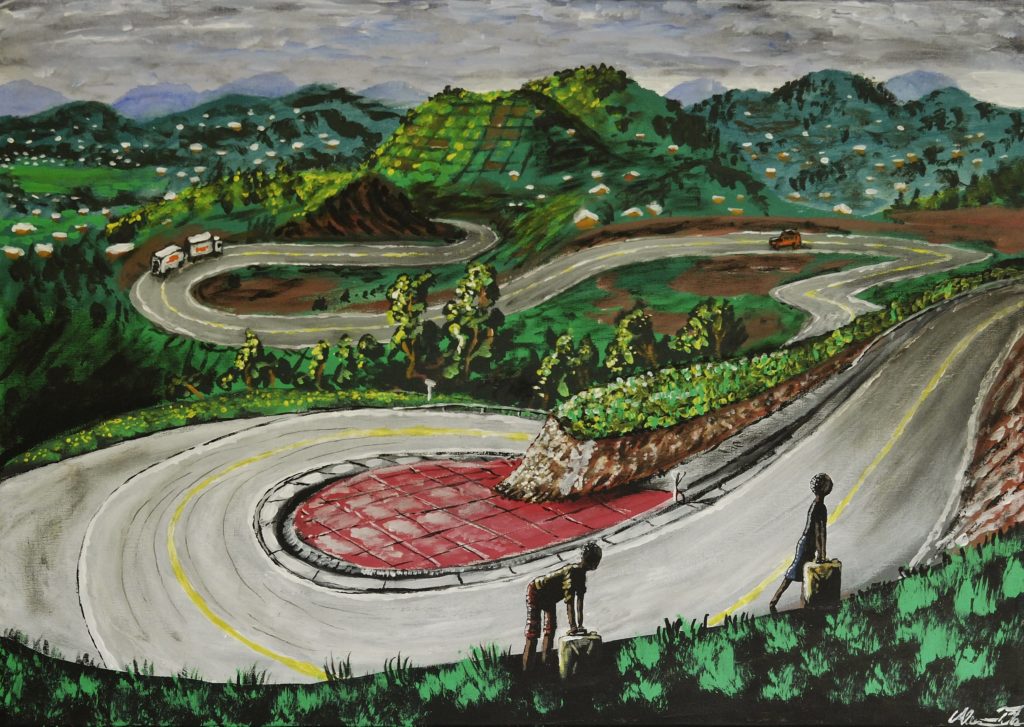
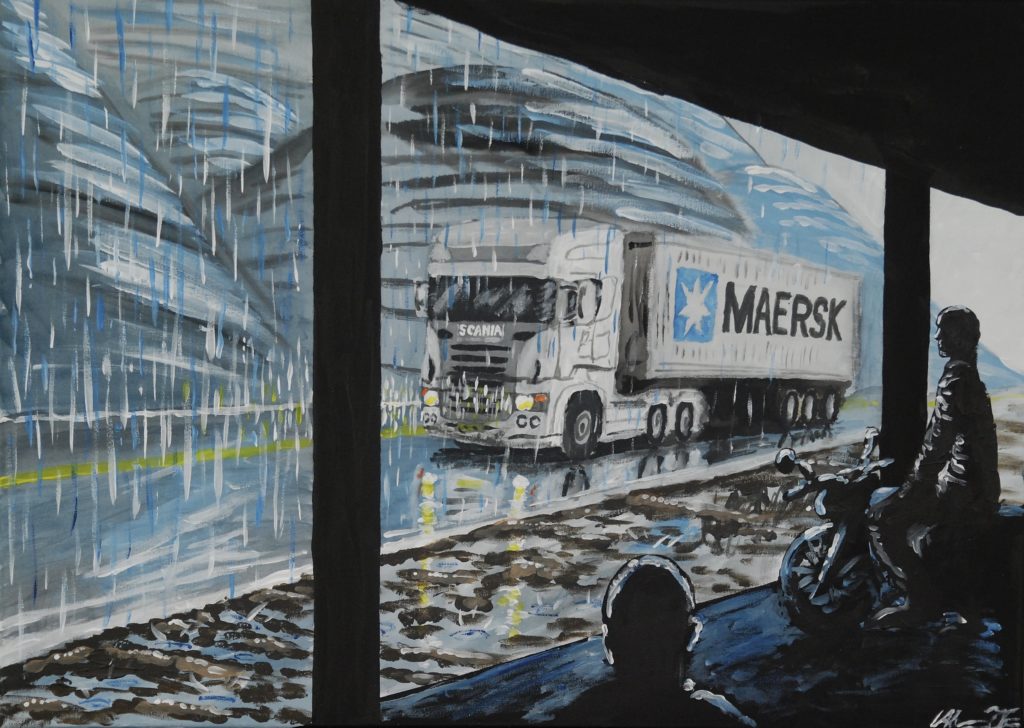
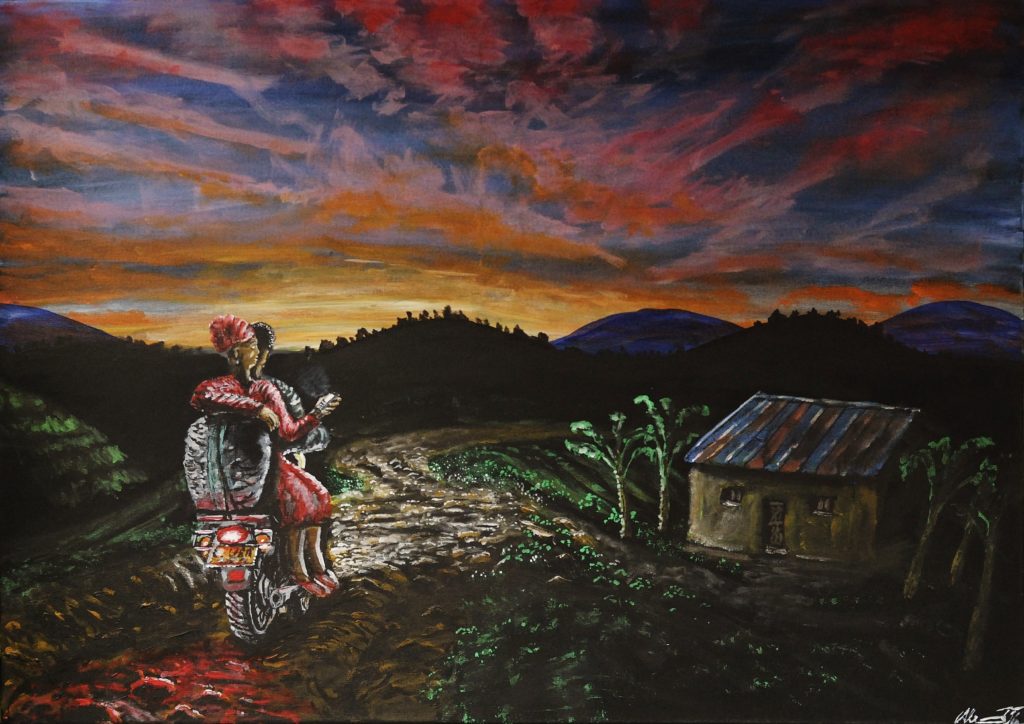
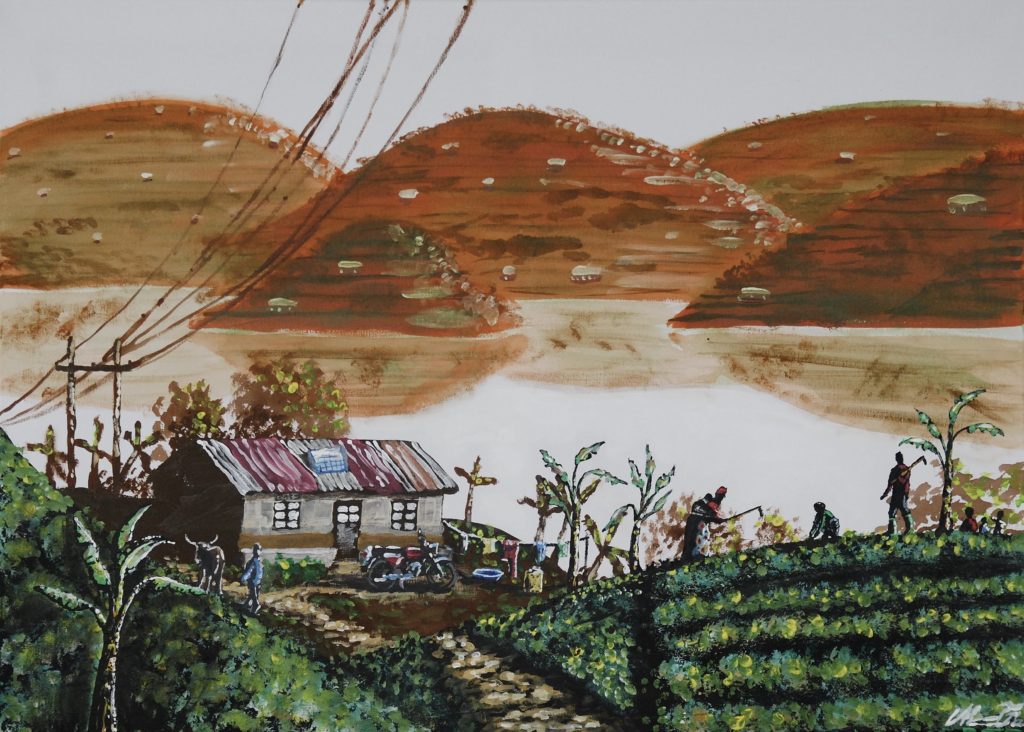
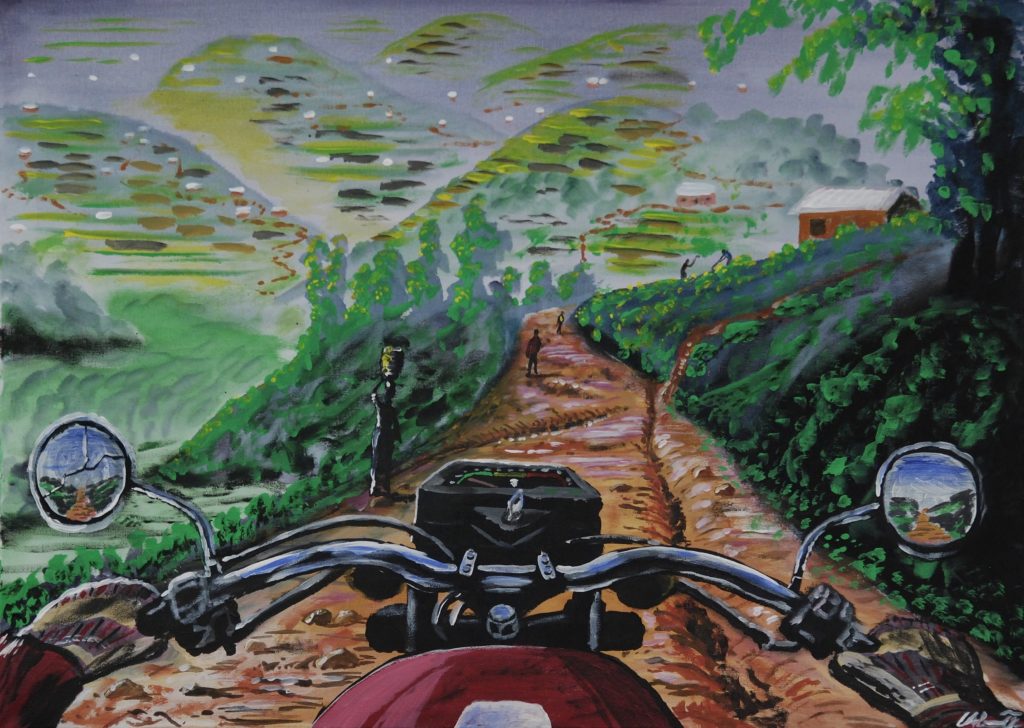
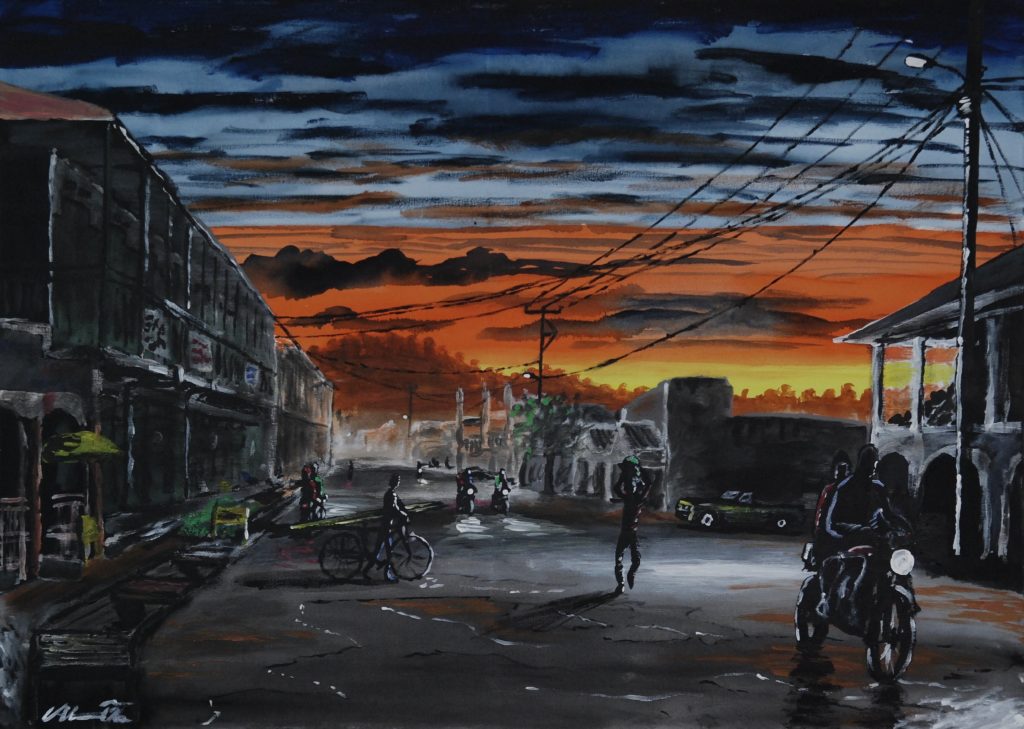
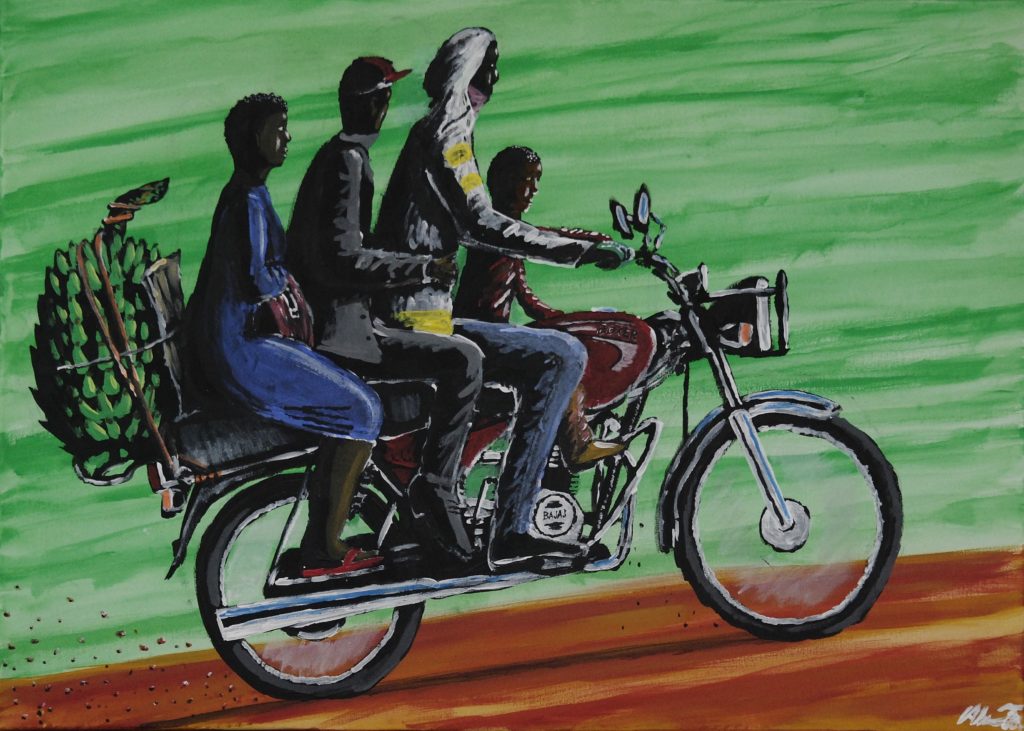
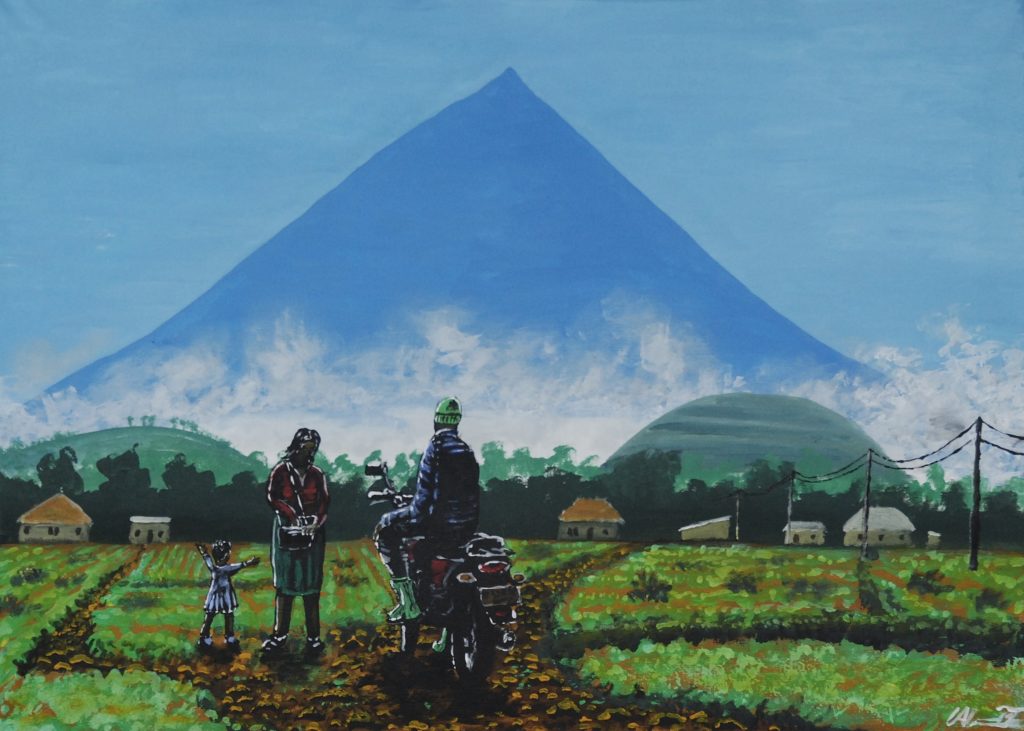
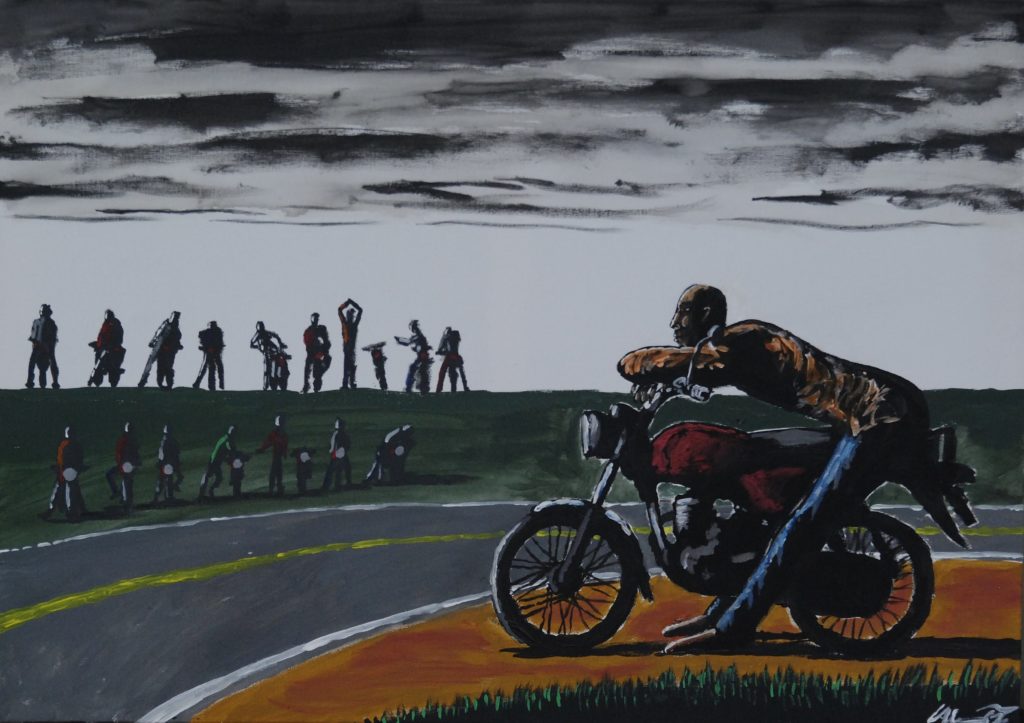
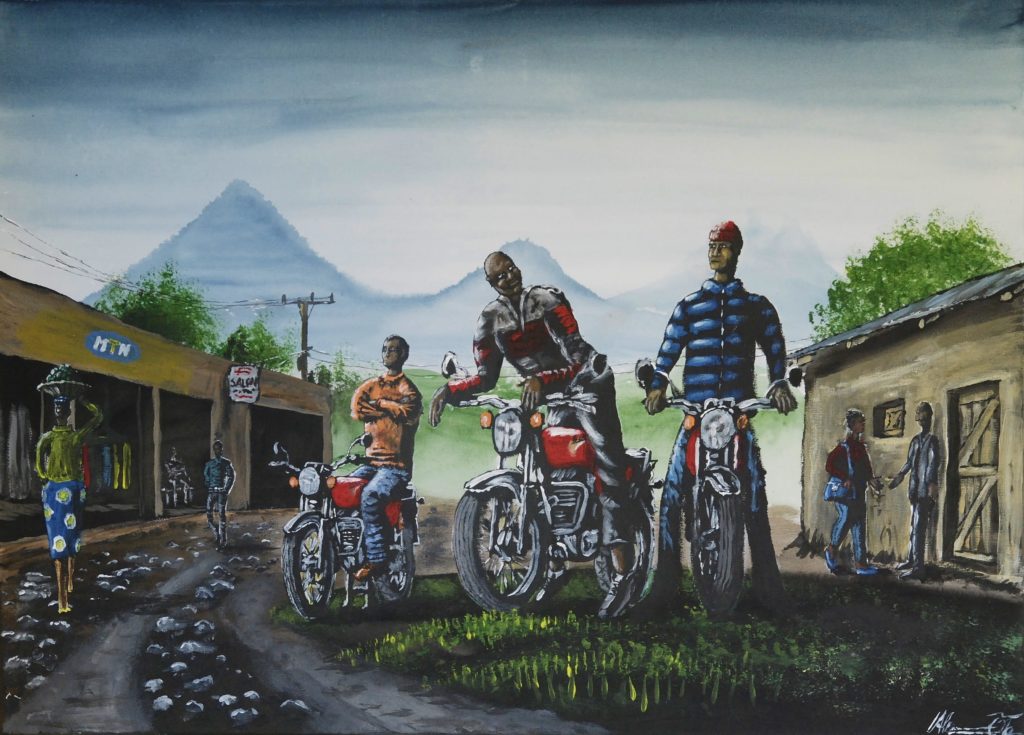
Motorcycle-taxi driving: one of few new jobs in Kisoro district. Drivers often rent their vehicle from someone else, who can afford to buy it.

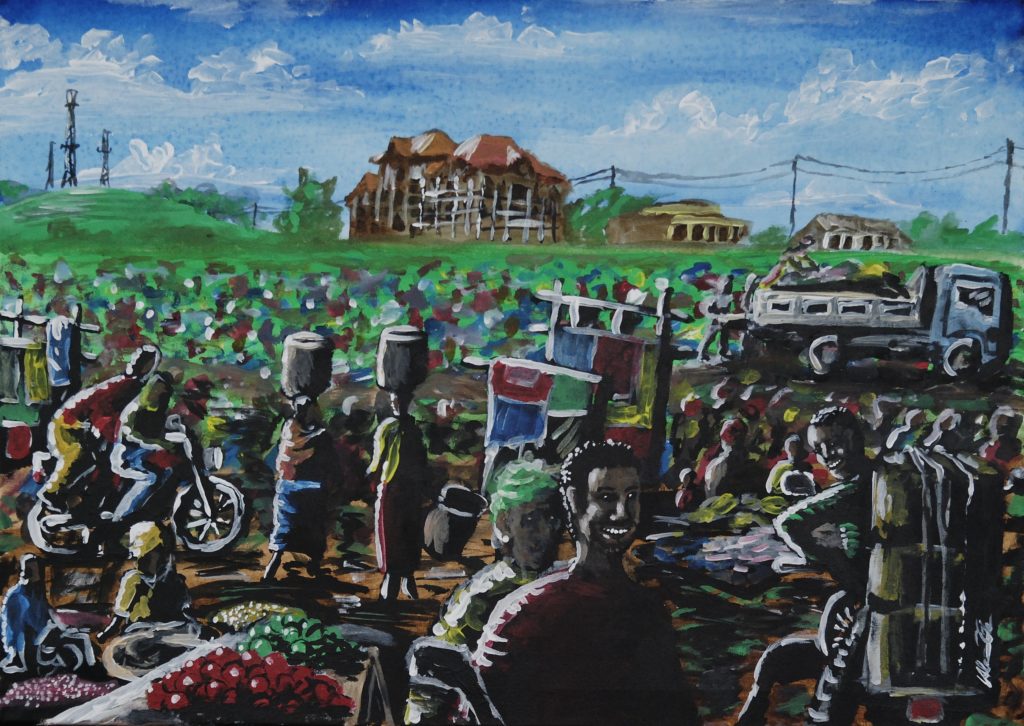
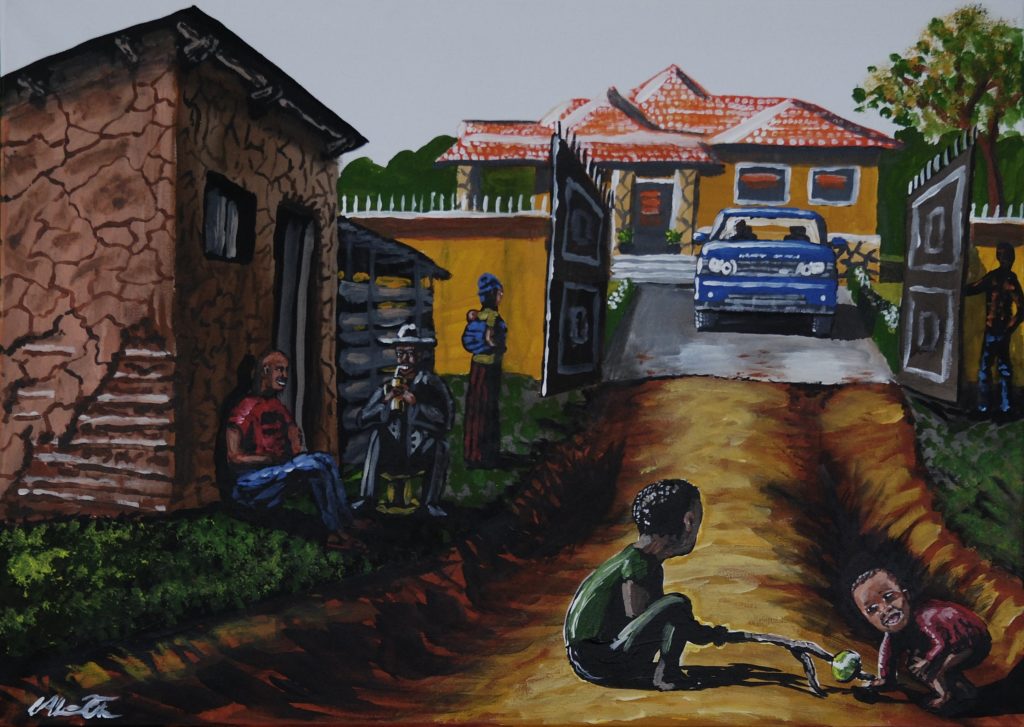
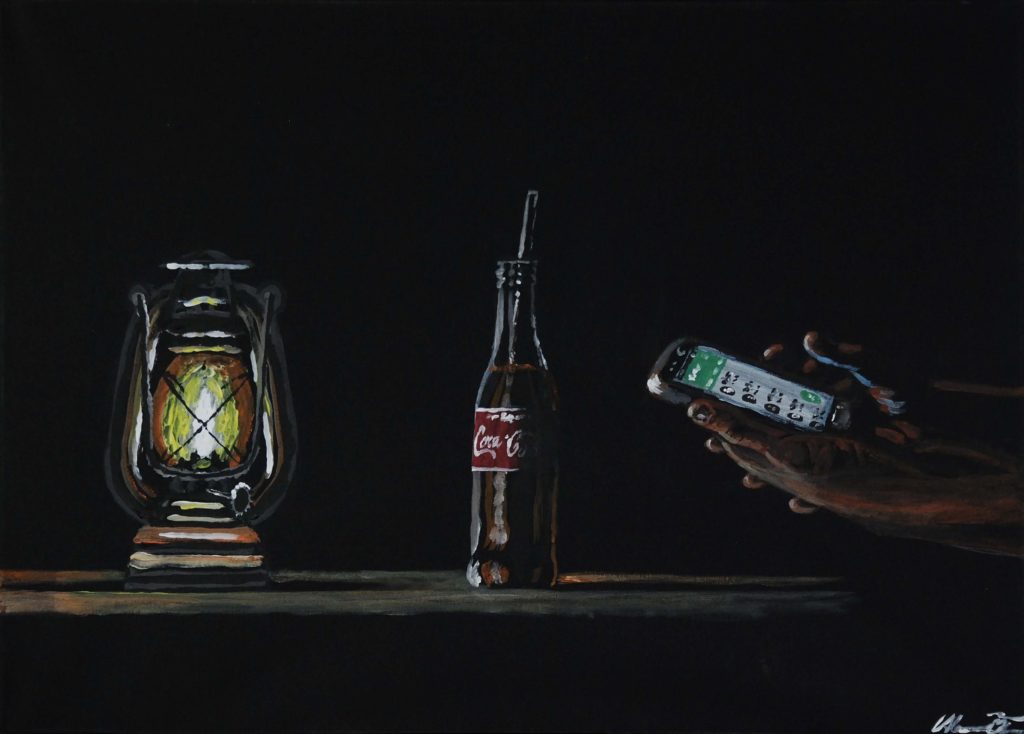
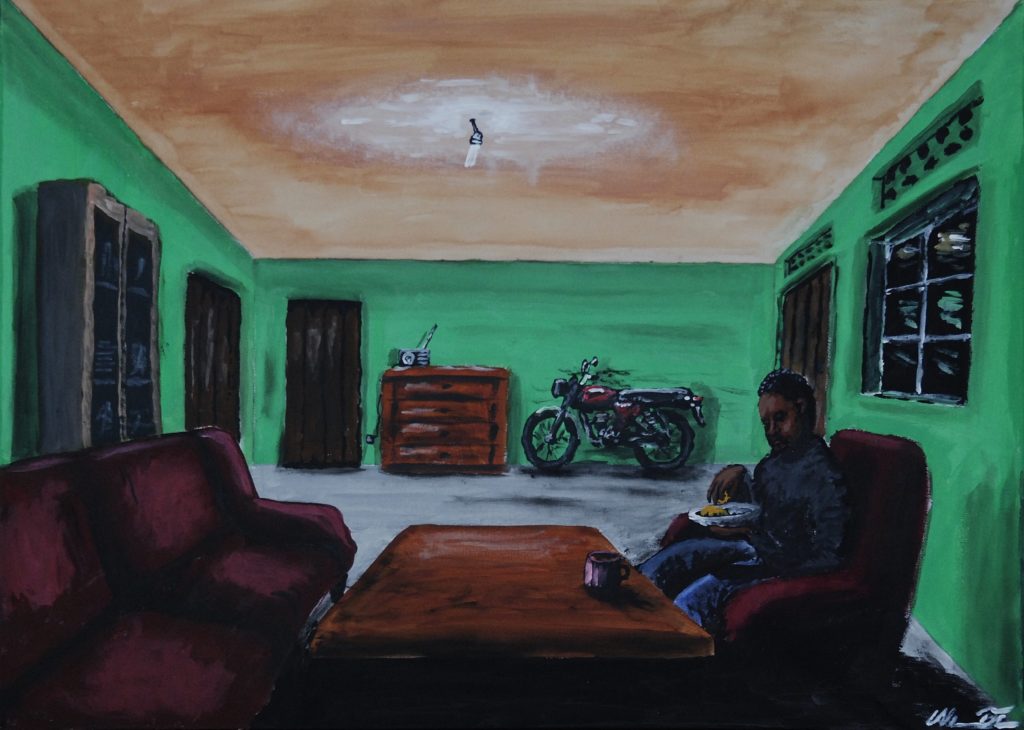
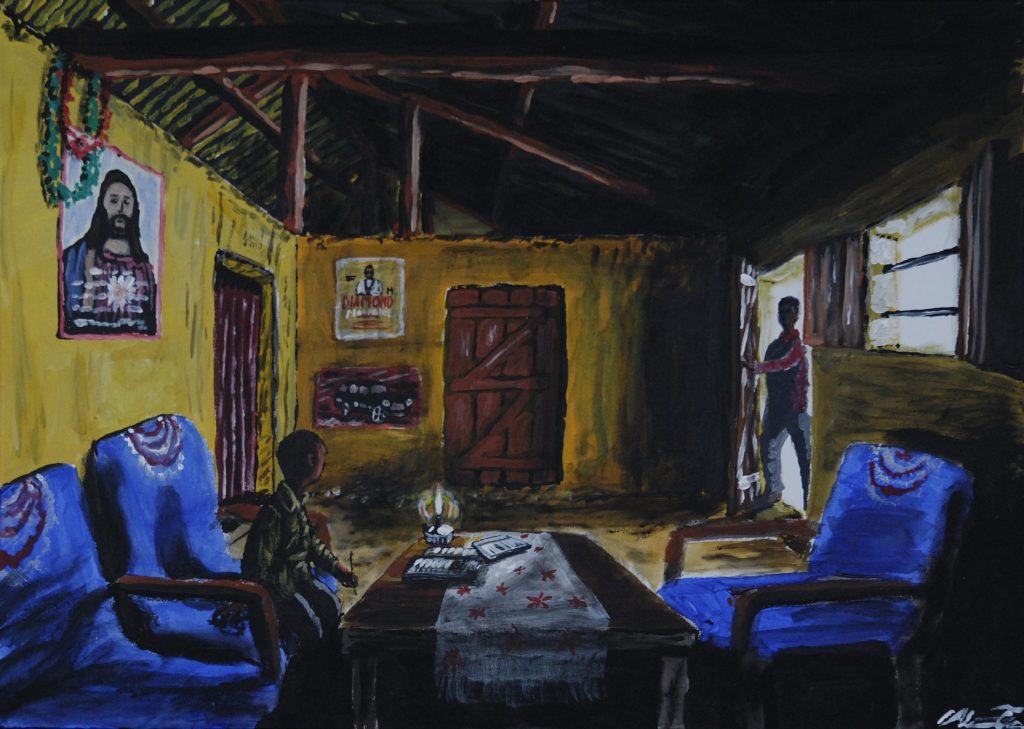
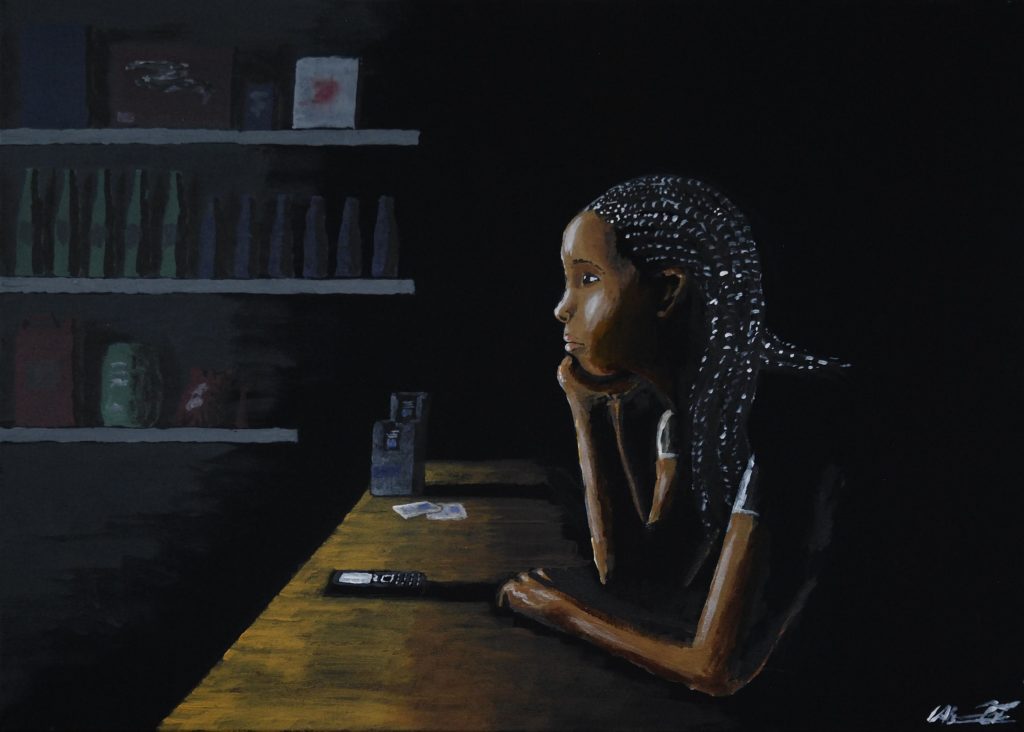
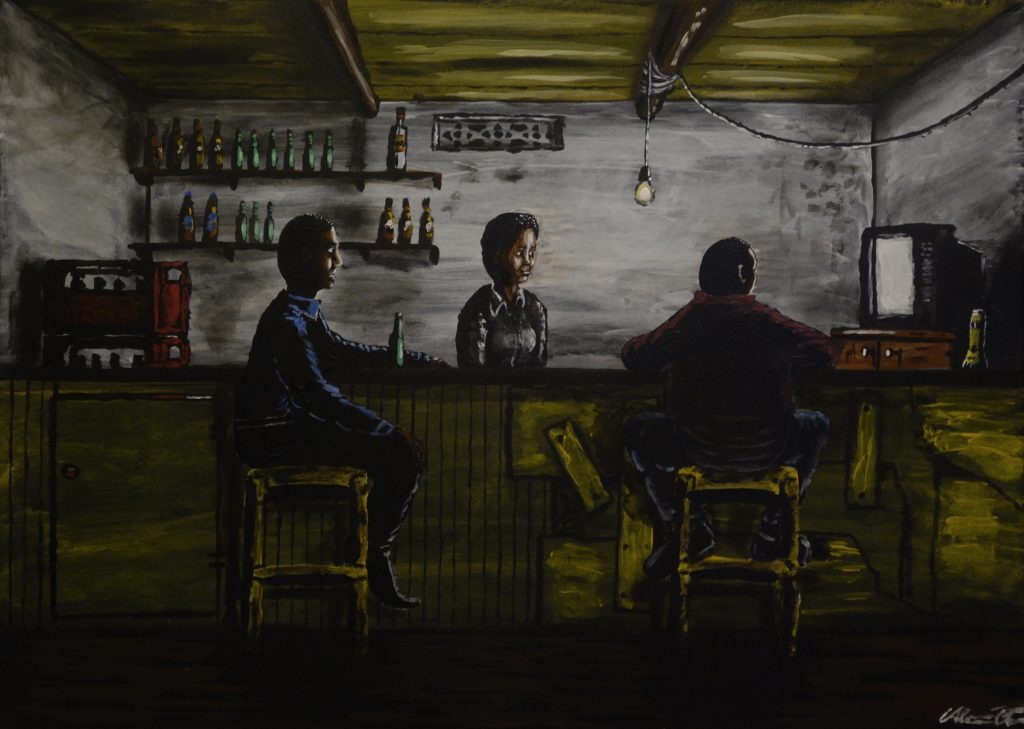
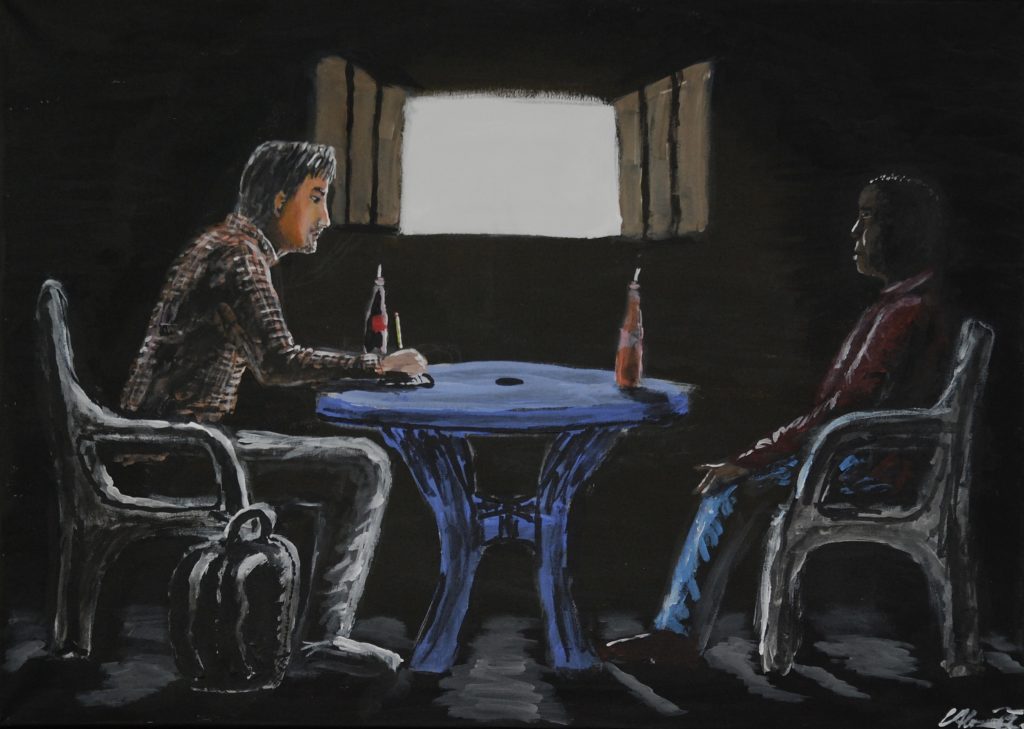
Alexander Öbom graduated from our international master program in cultural anthropology. His acrylic paintings presented here, inspired by local artistry, offers a unique way of representing and describing the field. His thesis is available online here

Blog editors comment

Motorcycle-taxi drivers in the district of Kisoro, in southwestern Uganda, talk about “development” which takes place in their society, but which they do not perceive as their development. Rather, it is a development carried out by others, mainly for others, while these drivers and many other locals feel that they only get the leftovers from it all.

A small network of asphalt roads has been constructed in the district since 2007, and the place has become a tourist destination for a growing number of foreign visitors who travel to the area´s national parks to catch a glimpse of gorillas. Simultaneously, new service jobs, in hotels, shops and on motorcycles, have popped up.

During my fieldwork in the area, in 2017, many motorcycle drivers described how the new roads were constructed by foreigners, local businessmen or unspecified others. These roads were also sparsely trafficked, and mostly by trucks transporting goods and by tourists, rather than by locals. Evictions of local people from national parks and establishment of new hotels had benefited foreigners, while being largely disadvantageous to locals like these drivers themselves.

Motorcycles were imported from India on the new roads. The so-called ‘Boda Boda’ motorcycle-taxi system was often portrayed as one of all these leftovers – a poor job and a poor taxi service which had recently been established in the area instead of better jobs and transport alternatives, which were only available for people with lots of money. The purpose of my painted acrylic pictures is to illustrate these experiences visually without disclosing identities. These illustrations have given me the posibility of adding and combining issues from a large number of photos and also working with feelings that is rarely contained in a photo.
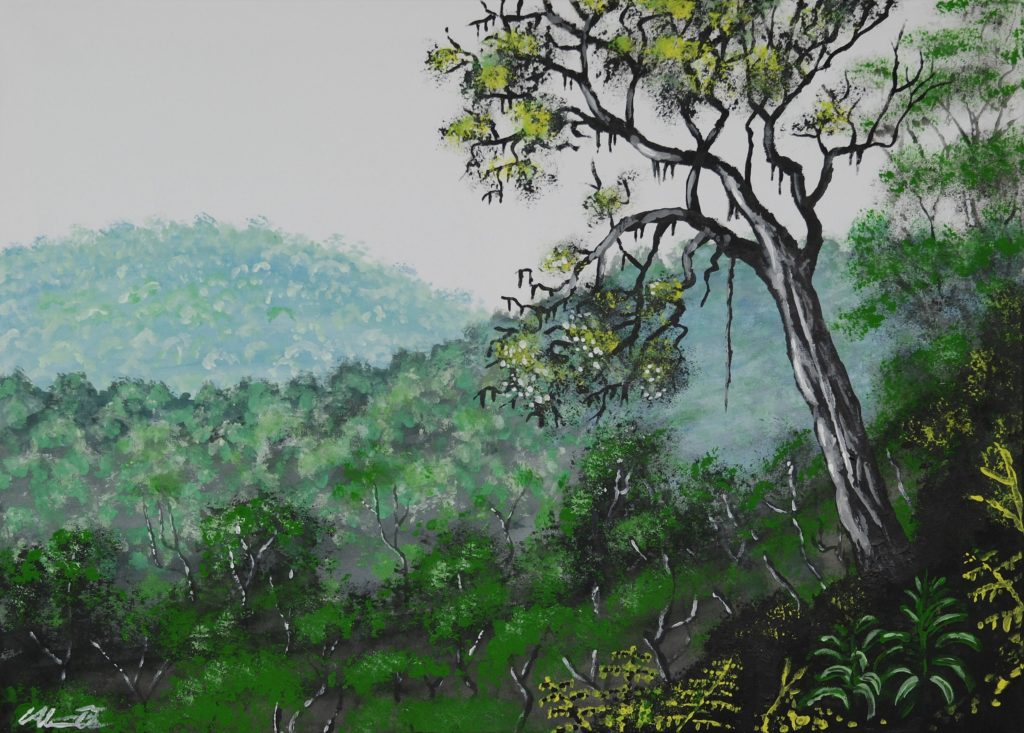
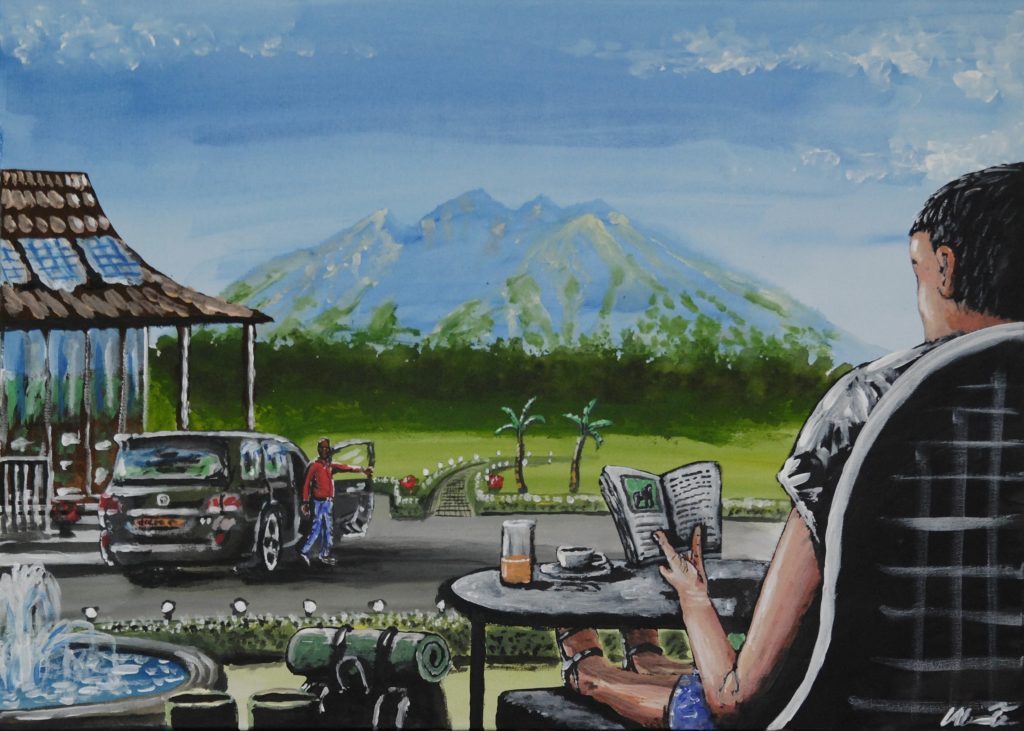
People in Kisoro had dreams and clear ideas about what they wanted, not seldom derived from information and inspiration reaching them through screens – on smartphones and TV:s – screens which made an external world which seemed to prosper very visible. But even if inspiration flowed into the area, opportunities did not follow. A real development should provide industrial jobs, replace subsistence farming, and eradicate poverty, in many Boda Boda drivers opinions, but this development had mostly brought economic inequality, and the relatively few and not very well paid informal jobs which it had provided for ordinary people, meant many households nonetheless depended on subsistence farming, as a complement to these jobs, with an ever-growing competition for the land, as a result. And most roads which locals used extensively, walking, or riding on a Boda Boda, between their farms and their jobs, were left unpaved and in poor condition. It all resembled scholarly descriptions of how various so-called developments in the global South have become very uneven in the era of economic neoliberalism (see, for example, Leys 2005:111-116).

Some people had worked as Boda Boda operators for about a decade, but when they started, they used bicycle-taxis, and motorcycles were rare. A few of them said the recent shift to motorcycles had had a negative effect on their personal economy, as motorcycles are more expensive to buy and to run. Their price implied that many operators instead had to rent their vehicles, and pay substantial weekly fees to the motorcycle owners. Although many saw the shift to motorcycles as a step toward modernity, and although most customers who I talked to portrayed it as a positive change, many drivers framed it as a bad one. Yet still as customers prefered motorcycles, drivers felt they had no choice but to use them. It has been contended that “the Boda Boda transportation system allows rural and remote populations to connect with a broader social and economic network” (Gamberini 2014), but many people in Kisoro district felt that these vehicles, as a result of economic restraints, had not provided them with much new mobility. Glorification of bicycle times was only one of many responses and examples of nostalgia which circulated. Other nostalgic stories were related to the recent shift from high quality mobile phones to low-quality budget phones, the district’s deteriorated fishing industry and the liquidation of the country’s public transport systems in favour of informal transportation. This resonates with anthropologist James Ferguson’s use of the term abjection, which refers to people feeling that they have lost something valuable in society which they had in the past (Ferguson 1999:237-238), and it resembles nostalgic feelings found in other African settings (Trovalla & Trovalla 2015).

It would be wrong to say that there existed only negative attitudes toward the transformations taking place – many people appreciated the recent changes – but ambivalence was common, and a feeling of being partially excluded from Kisoro’s development, partly included but in not so beneficial ways, were present among many. Unfortunately, this does not seem to be a very unique feature; as many scholars have pointed out, people in various places, not least in Africa, often feel somehow excluded from a modernity of others (Mains 2007, Utas 2003:151, 252). As Kisoro’s development seemed mostly focused on other people it was perceived as highly limited, but not only limited – in a sense that more of the same would be a solution – it was also perceived as a distorted form of development.

A lack of alternatives had brought many men to the motorcycle-taxi job, and as a result, drivers experienced evermore competition, which implied that they had to spend enormous amounts of time just waiting for customers, while simultaneously waiting for a development for them – which they hoped would come, eventually – rather than the development for somebody else, which they currently experienced.

Alexander Öbom has a background in journalism. He is currently a self-employed artist and a research assistant at the Swedish University of Agricultural Sciences (SLU). He has traveled extensively in Uganda and neighboring Rwanda during the last seven years.


Litterature

Ferguson, James 1999: Expectations of Modernity: Myths and Meanings of Urban Life on the Zambian Copperbelt. Berkeley: University of California Press

Gamberini, Gian Luca 2014. Boda Boda: The Impact of A Motorbike Taxi Service in Rural South Uganda. Helvedius Group of Columbia University.

Leys, Colin 2005 [1996]. The Rise and Fall of Development Theory. In Edelman, Marc & Haugerud, Angelique (eds.) 2005. The Anthropology of Development and Globalization: From Classical Political Economy to Contemporary Neoliberalism. Oxford: Blackwell.

Mains, Daniel 2007. Neoliberal Times: Progress, Boredom and Shame among Young Men in Urban Ethiopia. American Ethnologist 34:4, 659-673.

Trovalla, Eric & Trovalla, Ulrika 2015. Infrastructure as a divination tool: Whispers from the grids in a Nigerian city. City 19:2-3.

Utas, Mats 2003. Sweet Battlefields: Youth and the Liberian Civil War. Dissertations in Cultural Anthropology. Uppsala University.

Freetown – tangible progress, by Mats Utas

New roads and through fares, broadened streets, less traffic congestion, paved streets, a toll road making the exit out of the city much easier.

Thousands and again thousands of new houses being constructed, literary littering the hills around Freetown, and strewn out around stretches of road where their used to be forest and scrub.

The sound of generators, that once was a fundamental rhythm of the street, has silenced. During one of the few blackouts we drove through dark streets and I asked a longtime friend of why there were no lights in the windows. He simply stated that people had gotten used to the presence of electricity so they no longer maintain their generators. They tossed away their embarrassing Kabbah Tigers – a 100 USD generator named after the president at the time. Darkness still overcomes Freetown once in a while, but most nights when I am here the city is dressed in light.

It has been ten years since I last visited Sierra Leone

The first morning after my arrival it is cleaning Saturday. People clean their backyards but also public areas. Cars are not allowed to ply the streets up until noon. Smoke and the smell of burnt plastic dominate airspace. I enjoy the sounds of Wilberforce village an older part of the city that has received a good brush-up and now appear rather middle-class. A radio is playing E get Cro Cro a tune by Sierra Leonean musicians Manzu avec C-Bolt popular in 2004-05. Cro-cro in Krio (as well as in Nigerian pigeon) means rashes and although the song is mainly a cautionary tale over deceases a prostitute has, cro-cro was back in my days most often mentioned in relation to how filthy the city was. Cro-Cro, just as cholera, typhoid fever and the likes, is an outcome of a filthy city. Yet with a variety of cleaning efforts Freetown is much cleaner today. By stating that I am not saying that all is good. But, just as with the availability of power and the paving of streets, it has improved greatly over the past ten years.

Between 2004 and 2006 I did a two year long fieldwork centering a street corner in downtown Freetown. It was a quite messy area both socially and infra-structurally. Many of the guys I worked with were former combatants struggling to make do in the post-war realm. The more legal part of the income they made came from washing cars. The street corner was unpaved and in the dry season within minutes red dust covered newly washed cars. In the rainy season roads turned to muddy stretches and gutters were overflowing. Today the street corner is paved. Many of the guys from my fieldwork still hang-out on the corner, but to a much lesser extent. They are no longer dependent on the infrequent and ill-paying carwash business, but have jobs elsewhere in the city. They no longer live rough in the streets. Thus looking in the back mirror they were not as stuck as they themselves felt at the time. Life to most is still not easy, wealth is not available in abundance, but it is important to point out that they have maneuvered out of the hazy social death they at the time believed they would remain in.

Back in 2004-06 our discussions were dominated by topics centering the civil war, but also an equally violent aftermath. We talked about death, about drugs, about crime and about bare survival. Today we talk about children and we talk about relations. I want to repeat that life is still not easy for a majority of these guys. And quite a few are no longer with us having at a far too early age passed away – most recently Ebola took its toll. Yet still there has been progress. And in their faces it is hard to see that ten years has past. Their facial expressions signals newfound dignity and quite a bit of health. Rounder faces, clearer eyes. They made it this far.

Freetown is far from problem-less. The growth of the city is creating new emergencies. The shaving of the lush green hills surrounding Freetown is not just making the city look less attractive, but it destroys delicate eco-systems, creating ample space for catastrophes like a mudslide in August 2017, killing around 400 persons. Freetown has grown from a city of 130.000 in 1963 to over a million today. Despite good efforts has been placed on widening the road networks it is hardly enough. There is abundant need for a public bus system, and if being more ambitious a tram line. More serious the water and sewage systems are severely under-dimensioned and the lack of water might well turn into a serious emergency in a not so distant future. As I stated above electricity is much more reliant today, but how sustainable it is can be questioned. There is currently a big ship producing much of the power for the city on roadstead outside the city. It is reliant on oil – not very sustainable – but more seriously, on the short term, it could sail off with the blink of an eye if the government fails to pay for it. Close by where the ship is anchored, there is the slum of Kroo bay where people continue to live in pan-bodies, shacks, and where many people balance on the edge between life and death on a daily basis. When I was in Freetown a fire ravaged the community and it is alleged that several hundred houses were burnt down.

Socio-economically Freetown is still crumbling under a corrupt bureaucracy and with an insufficient taxation system that does not render a sustainable national economy. Little is indicating that improvements on this front are enough. The new president’s paopa (force in Krio) ways may make some more apprehensive, but it is difficult to believe that people within the vicinity of the president will not maintain impunity. I hope I will be proved wrong. There is however also a risk that paopa and the new ideal of a soldier team (written on mini-busses and an expressed idiom by local gangs) will once again turn the Sierra Leone to a more authoritarian country – and again let’s hope I am wrong.

I keep returning to roads. I believe in order to improve the Sierra Leonean economy it is pivotal that road transport from the countryside is good. If roads are in a bad state agricultural products ends being spoilt during transport thus driving up prices. But also the transportation itself will be expensive as bad roads demands high maintenance and repair costs on vehicles. With regards to infrastructural problems East-Central Freetown is still a bottleneck, but once leaving this behind the eastern part of the city has now a road of free flow all the way to Waterloo. Although some Freetonians are worried by the fact that the Chinese are making profit because of a road toll, even the toll gates are seen as a proof of progress by most. And one driver told me that except for the toll gates, there are virtually no police checkpoints taking your money:

you can go all the way upline with only a 2000 Leones (20 cent) bribe 

That’s development. Still local rice sold in Freetown is more expensive than the imported one. That’s sad.

Sierra Leone is one of the poorest countries in the world. Many people can hardly afford to put food on their table. Most do not have the resources to plan ahead. However that said Freetown is still a city of smiles and amicable social wealth. Much more smiling than my home country Sweden. That’s a conundrum. It is a country of “shuffering and shmiling” to quote great Nigerian singer Fela Kuti.

Postlude

First time I visited the country was in 1992. The next time was during the war in 1998. I lived in Sierra Leone for two years between 2004 and 2006. Between 2006 and 2009 I on average visited the country twice a year. After a ten years long break I returned during the spring of 2019. The worst condition I have seen Sierra Leone in was actually in 1992 weeks prior to the military coup that brought Valentine Strasser and NPRC to power. It was at the very beginning of a civil war that took off because of a direly mismanaged state. Although the war caused devastating destruction and human suffering, international attention drew more resources to the country and already a year after wars end conditions in the capital Freetown, but also in much of the “upline” provinces, was arguably better than before. The Ebola epidemic (2014-2015) was the next set-back, but it appears that at least Freetown has recovered well. Indeed lots of people passed away and it devastated families, but although I have no date to prove it I wonder if the resources which the international community provided is now in parts spent in the ongoing construction boom?

The ruins of a mining economy, by Danny Hoffman

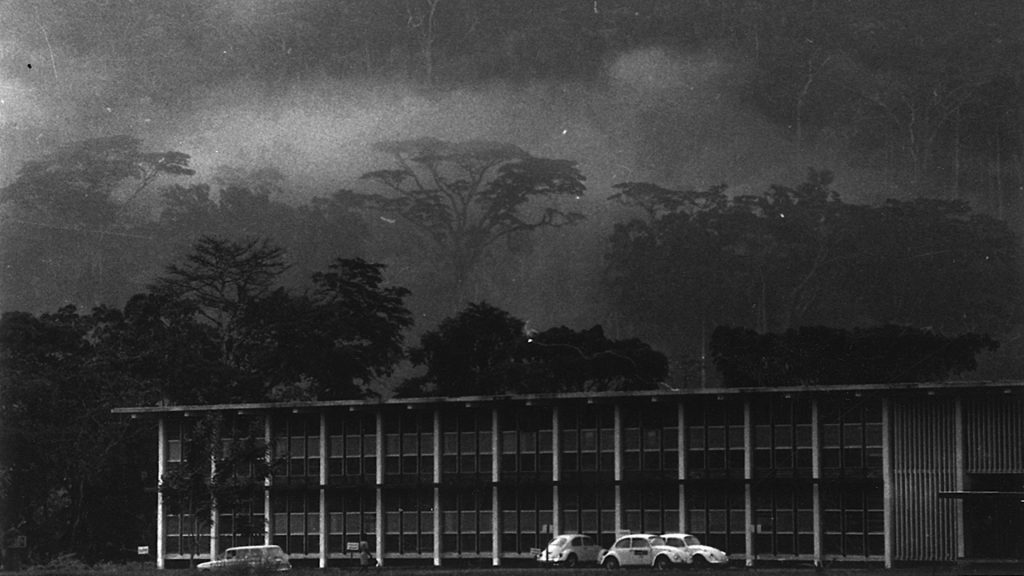
 Around the 23-minute mark in the short film, Uppland, an unidentified voice speaks over a series of historical images of Yekepa, Liberia. Male and American, the speaker is presumably a former resident of the town. Yekepa was a LAMCO company town in Liberia’s Nimba Mountains, home to hundreds of the Swedish mining conglomerate’s employees. “Life was pretty nice there,” the voice says. “But you weren’t really living in a real world.”

 Edward Lawrenson and Killian Doherty’s short film is conceived as an archeological project, an excavation of the physical and psychic ruins of industrial mining in West Africa. Lawrenson, a Scottish filmmaker and writer, and Doherty, a Northern Irish architect, set out for Liberia after Doherty comes across photographs of Yekepa from the 1960s and 70s. Such images are not hard to find. Iron ore mining was a central pillar of Liberia’s post-World War 2 economy. Foreign mining giants like LAMCO, backed by the Liberian governments of William Tubman and then William Tolbert, rapaciously harvested the country’s reserves until the global price crashes of the 1980s. Today the detritus of company towns and massive iron ore pits litter northern and western Liberia. These ruins occupy a prominent place in the lives and memories of Liberians and non-Liberians who inhabited the mines and their supporting towns. The “pretty nice life” that iron ore mining made possible is a complicated and important thread in the story of Liberia. So, too, are the consequences of a political economy that so thoroughly shaped the “real world” of most of Liberia’s inhabitants.

Lawrenson narrates the film and describes the origins of both the town and the project, though fortunately he dispenses with the usual filmmakers’ journey and arrival tropes. The visuals are primarily scenes of ruins: abandoned industrial equipment and infrastructure; housing; and the terraced hillsides and massive pits carved into the mountains. The film’s 30-minutes are divided into four variously timed chapters. The first, Yekepa, is ostensibly anchored by the contemporary town. A small population still lives there, including at the gated campus of ABC University, a Bible college. Old Yekepa, the brief second chapter, is framed by a visit to the abandoned village of Yeke’pa. The Bible college’s carpenter happens to be a community leader among the population displaced by the mining operation, and he leads the filmmakers back to the village’s original site. New Yekepa, the third chapter, travels to the site to which the displaced were relocated. There the residents describe the inadequacies of their compensation and tell their own version of how geologist Sandy Clarke discovered the iron ore deposit and captured the mountain’s guardian spirit. The final chapter, Stockholm, briefly brings the film to the apartment of a retired couple who describe the suburban Stockholm aesthetic of Yekepa and the failure of the company to leave much of anything behind.

Each chapter weaves together historical still and moving images, on-camera interviews, and beautifully shot observational footage. Given that neither Lawrenson nor Doherty are ever named or made visible in the film (Doherty is simply referred to as “the Architect”), Uppland is surprisingly personal and reflexive. Lawrenson speaks frequently in the first person and includes both narratives and visuals that make the filmmaking process an engaging subplot. For example, the filmmakers cleverly include a few seconds of footage of Thomas, a young man assigned to keep an eye on Lawrenson, trying in vain to direct the action of people walking into and out of the camera frame. Uppland avoids most of the pitfalls of the narrated, exploitation documentary genre, its disembodied voice-over never becoming too authoritative, outraged, or self-indulgent—a rare achievement in this ever-expanding field.

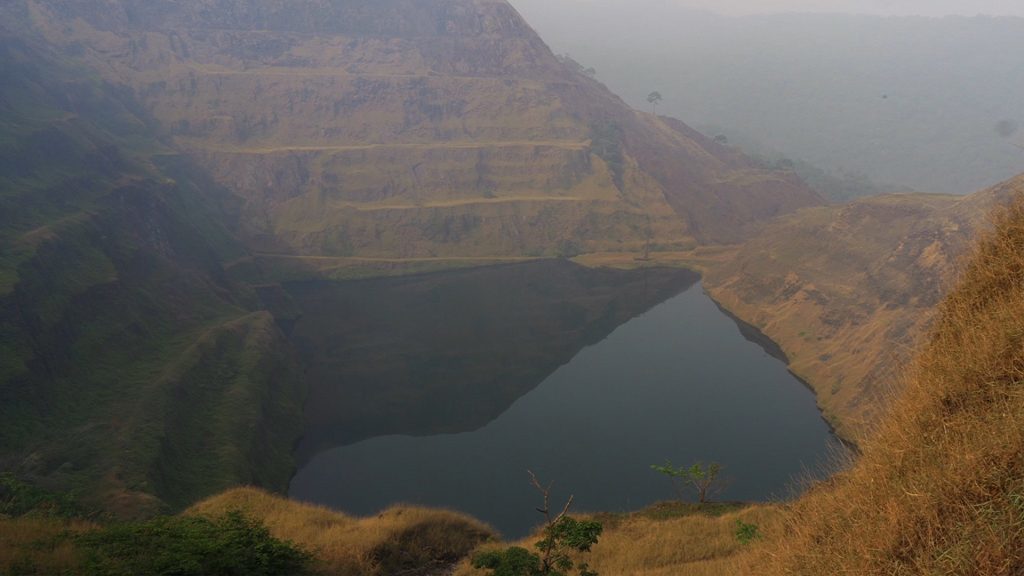
The sum total of the film is nevertheless familiar. It is a galling portrait of the harvesting of African resources and the damage done to both land and people. The mountain that once housed the deposit is now a giant stagnant lake. New Yekepa appears as a soulless, impoverished, and somewhat embittered place. The Swedish retirees, meanwhile, are surrounded by a national museum’s worth of artifacts in their bright, comfortable looking apartment. And everywhere there are rotting husks of metal and concrete, useless now that the mine has closed.

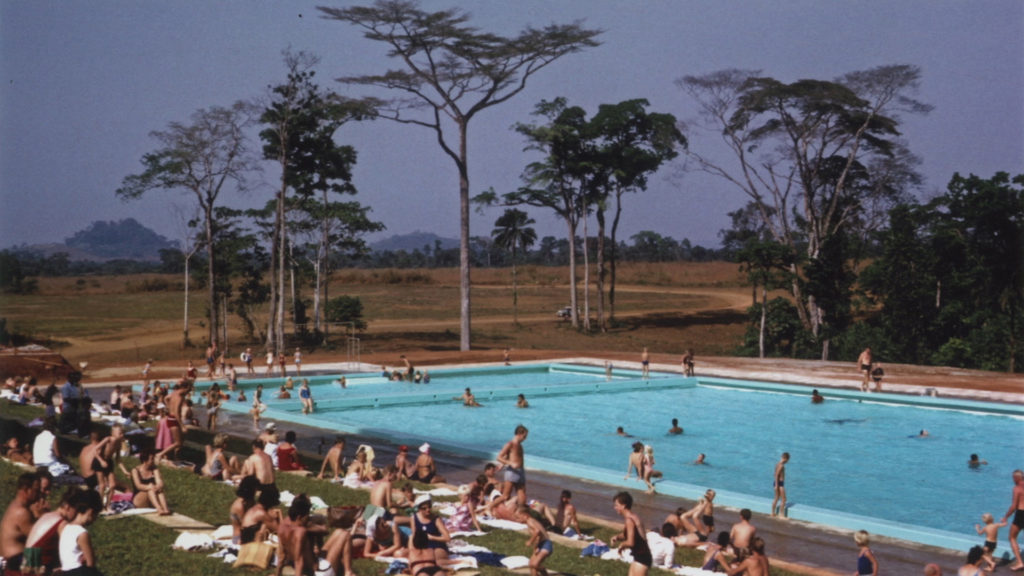
Both visually and narratively, Uppland is too clever and interesting a film to stop at that. “Life was pretty nice there, but you weren’t really living in a real world” is a line that could arguably have been spoken by everyone in the film and everyone behind it. Certainly, this is true of the white foreigners who worked for LAMCO, who appear in their greatest numbers in swim trunks, splashing around in the company’s swimming pool. The Swedish retirees speak of their intentions to leave a sustainable economy at Yekepa, but “it’s a pity” is the best they can offer as commentary on the fact that they failed to do so. The American professor at the Bible college certainly seems to be having a good time, but his alienation from the “real world” around him is absolute. His earnest Old Testament history lesson about the disappearance of manna is deliciously apropos of the surrounding context but obviously lost on the man himself.

That the past was better but never real even for the Liberian residents of Yekepa is painfully clear in a conversation with two men named John, both former local employees of LAMCO. They fondly recall the town’s hospital, schools, and ice cream shops, all of which they claim made the residents of the town feel like they were “living in America” right there in the rainforests of northern Liberia. But they are unreliable narrators. One of the Johns describes the perfect racial harmony and integration of Yekepa, but there are no black bodies in the swimming pool images; a line of school children shows whites in the front and blacks in the back; and footage of a white Swede tending his vegetable garden is contrasted to a young Liberian houseboy stripped to the waist mowing the lawn.

The ruins of Yekepa make everyone look to the past and complicate their relationship to the real present. The residents of New Yekepa implausibly claim that their lives today would be better if only they hadn’t lost the written resettlement contract Clarke gave them when he forced them to move. And as the film abruptly ends, audio clips of President Tubman’s 1962 speech to LAMCO employees extol the virtues of mining, celebrating the company’s commitment to exploiting a wilderness inhabited only by spirits and bringing both wealth and civilization to Liberia’s upplands. The visuals, of course, are of a scarred landscape and still, rusting machinery.

In the film’s penultimate moment Lawrenson describes being approached by security guards as he filmed those ruins. It is cutting testament to the slippery unreality of memory and hope when they ask if he is here to restart the mine. Lawrenson smartly spins the encounter into a comment about his own position; the filmmaker must pack up and depart for Europe before he can engage them in meaningful dialogue, taking away the richness of his film and leaving them with their disappointment and their ruins. But the moment is more poignant than that. Rising world iron ore prices have led a number of multinational companies to revisit Liberia’s abandoned mine sites, and iron ore now accounts for about 30% of Liberia’s foreign export earnings. Small enclaves of foreign workers are building new company towns that are largely off-limits to local residents, who continue to inhabit the ruins of the old company towns. New mining equipment and infrastructure is being imported to do the work, much of it less dependent on human labor and therefore even less dependent on the “real world” of the people who live around it.

What kind of ruins this new mining economy will leave, and how they will be remembered, will no doubt be the subject of a film to come.

Danny Hoffman is Associate Professor of Anthropology at University of Washington.
This text originally appeared on the blog Africa is a country

Media Myopia and the Image of Africa, by Paul Stoller

There seems to be no limit to the media’s unwitting capacity to mischaracterize the African continent. Given the often inaccurate and superficial stories that emerge from Africa, is it any wonder that many people in the U.S., for example, think that Africa is one country? Is it any wonder that many Americans believe that the Africa is routinely ruled by greedy despots who live in extravagant luxury while their people suffer in the grip of poverty?

As I mentioned in several previous blogs on this sad subject, the print and broadcast media have usually constructed an African narrative of endless ethnic warfare, incessant drought, tragic famine, unspeakable epidemics, rampant rape and chilling child abuse. The narrative also underscores dysfunctional family relations in which elderly patriarchs brutalize young women some of whom may be their wives, some of who may be their daughters or nieces. In short, the media narrative about Africa makes it seem like a brutal place where people lead miserable lives, a place that is so destitute and hopeless, that “we” need to “help” them.

Continue reading

The new sterile and faceless Africa?

Finally I got the chance to see Jens Assur’s photo exhibition Africa is a Great Country at Liljewalchs in Stockholm. There have been a lot of discussions concerning the provocative Africa-is-a-country  title and this has partly overshadowed the content. Is the title ironic or not? Colleagues of mine have already discussed this at NAI Forum. Assur himself states, in his introductory text to the exhibition, that it is meant as an irony directed towards Swedes who still talks about travels to “Africa” – as a monolith – and doesn’t break the continent down into the 50 + countries it contains of. But he doesn’t clarify why he pairs “great” with Africa as a country. Is that also an irony? That is probably not his intention; yet it comes out as a not a very thought through title. Or maybe it is; maybe it has been one of the few ways to lure an audience to an otherwise rather dull exhibition?

Continue reading

West Point – Conflicting perceptions of crime, security and Liberian ex-combatants (by Mariam Persson)

Chaos is something we tend to see when we don’t understand how things work. Chaos is what we think we witness when we forget to take our time to listen to people’s stories, and let fear and excitement lead us in our hunt for sensational war stories.

I struggle to keep up with Adam today. He is walking fast and Will and I have to hurry along the narrow alley-ways between the small zinc houses and sheds not to lose sight of him. We have to squeeze ourselves between women cooking for their families, children playing in the small open spaces and chasing each other between the houses. I apologise for being in the way and for just walking in where women are preparing food, people are having their meals or taking a rest. Most people just give me friendly smiles back and continue with their business. A few look a bit surprised to see a stranger there but most don’t bother at all. I try to focus on where Adam is going so he won’t have to wait for us on every corner, but I haven’t seen Will in a long time and we get caught up in our conversation as usual and Adam patiently has to wait. Adam turns left and right along narrow paths between the cramped houses. I turn to Will and joke about whether Adam actually knows where he is going. Will laughs and admits that he has no idea where we are either. But Adam knows his way around here. He used to live here for some years just after the war. For me West Point still is a maze. I had only been in this community a few times since I first started to visit Monrovia some years ago. Situated on a peninsula jutting out into the Atlantic Ocean this township of the Liberian capital wasn’t a place one often just passed by without any particular errand. However, doing research on what I call ‘post-war rebel networks’, ex-combatants who had preserved their links to each other after the war came to an end, it was maybe a bit strange that my research hadn’t brought me to this township that often in the past, judging from its reputation of being inhabited by so many ex-combatants. But my informants had been residing elsewhere. I only recently had begun to spend more time in West Point.

Continue reading

”Our” Swedish golliwog cake

The absurd photos of the Swedish Minister of Culture feeding a cake/victim with its own genitals after first having had it ritually circumcised. The “white” and middle aged audience is all smiles.

It has been all over Swedish and international media during last week and although often discussed in quite confusing and contradictory terms I still think there are some good pieces debating the event. They do a much better work than I would do and I therefore give you my favorite links rather than discussing it myself. Two things are certain: first the images cabled out has spurred a much needed debate on race and racism in Sweden, and secondly despite its original intention the golliwog cake has so far not provoked much discussion on FGM in Africa as it originally intended to do. Continue reading