Author: Mats Utas

Small arms control and the question of the state in West Africa (with particular reference to the Gambia), guest post by Niklas Hultin

The widespread adoption of the global arms trade treaty (ATT) is widely considered a great success for international civil society and the human rights community. The intention of the treaty will make it more difficult for states to channel weapons into the hands of insurgent groups and other non-state actors through a multilateral commitment to uphold certain export/important standards and to avoid the diversion of conventional arms from legitimate actors to illegitimate ones (contrary to the fears of the US National Rifle Association and such groups, it does not constitute a global gun licensing regime or something of that sort).

The merits of this approach are considerable and the activisits who worked tirelessly for over a decade to usher in this treaty deserve credit. That said, from the vantage point of the capacity and practice of African state, one wonders if the intended measures are more aspirational than realistic and reflect an overestimatet appreciation of the institutional and social capacities of African states.
Continue reading

Once a General, always a General?

This is a somewhat adapted English version of my text “Im Frieden hilft der General” published in the latest Issue of Welt-sichten (October 2013, pp. 45-47). see  http://www.welt-sichten.org/personen/18332/mats-utas 

One of the central aspects of Disarmament, Demobilization and Reintegration (DDR) programs in post-conflict settings is to break the ties between rebel commanders and their soldiers so as to make remobilization more difficult and reintegration into civilian life easier. I have over the past 17 years conducted research with ex-combatants in Liberia and Sierra Leone, two small West African countries still recovering from years of brutal rebel warfare. I have in both countries built up close relationships with former combatants and therefore dug deeper into the realities of commander/soldier networks and the socio-political realities wherein they exist. Questions I will ask in this text centers around DDR and the breaking of commander/soldier networks and I will try to answer three interdependent questions: Who benefits from this breaking of networks? And contrary in whose interest is the maintenance of these networks? Is it at all feasible, or even desirable for post-war societies to break these networks?

Continue reading

Reflections on ECAS and Fieldwork in African Conflict areas by Marsha Henry

Attending the European Convention of Africa Studies this past June for the first time, it was encouraging to see several panels devoted to methodological questions raised by conducting research in African conflict areas and violent settings.  The topics discussed in the multiple sessions included, amongst others, how researchers make sense of proximity and distance in relation to field methodologies, participants and epistemologies; how researchers negotiate the unstable and insecure settings; and how the research experience and context affects a researcher’s own identities, narratives and representations.  One roundtable, in particular, brought many key ethical dilemmas and methodological challenges into sharp focus, and provided some opportunities for interdisciplinary discussion and debate.  However, the discussions revealed a number of gaps, which I think are worth exploring in order to push methodological discussions within Africa Studies further.  In particular, I argue that methodological discussions should reflect on the identities of researchers when considering issues of proximity and distance.  Who the researcher is, and how they are socially, culturally and economically located in the world, is of significance in any reflections on the challenges encountered in insecure field sites in Africa.  In doing so, I hope to both acknowledge the genealogy of research privilege that haunts such discussions, and draw attention to the limits of perspectives that emanate from a homogenously racialised and embodied experience that can perpetuate an unacknowledged Euro-centric researcher habitus.

Continue reading

Poor Numbers: The Politics of Improving GDP Statistics in Africa – By Morten Jerven

Last week African Arguments published a story that Prof Morten Jerven, author of Poor Numbers: How We Are Misled by African Development Statistics and What to Do about It, had been blocked from presenting his research on African statistical capacity at the UNECA. This was due to opposition to his ideas from, notably, the South African Statistician General, Pali Lehohla. The speech Jerven intended to give to the UNECA can be read here. Morten Jerven responds below.

Discussing economic statistics and GDP estimates of African economies is clearly important, but it’s also sensitive. Pali Lehohla and his self-proclaimed union of ‘African Statisticians’ are allied in a self-defeating campaign.

My book Poor Numbers has created an unprecedented argument for investing in the statistical capacity of African countries. Why would Lehohla and his silent supporters go against this? The answer is simple. Pali Lehohla and his counterparts are doing well in the current system. Any change to the status quo in the political economy of statistics in Africa is considered a threat.

Continue reading

The Westgate shopping mall attack and Al-Shabaab in Somalia

“The bloody Shabaab attack on Nairobi’s Westgate shopping mall on September 21 was an act of desperation by a jihadi group beset by internal power struggles and plummeting support”, argues Somalia expert Ken Menkhaus in a blog post. The intent according to him is to stir up anti-Somali sentiments amongst Kenyans. Kenyans may thereby turn violent and target exiled Somalis in Kenya. If Somali’s are brutalized in great numbers Al-Shabaab hope to be seen as the true protectors of Somalis – in opposition to the Somali government which is seen as conniving with the Kenyan government. This is indeed a high risk plan by a movement that has over the past few years lost much of its previous power.

Very little is known of Al-Shabaab. There are many “experts” guessing, experts citing other experts’ guesses, thus producing a lot of half-truths. An exception to this is the recent book on Al-Shabaab in Somalia (Hurst 2013). It offers a deep and detailed reading of the movement. Below is a review that I recently did on the book. I am not seeking to legitimate the horrendous crime that the attack on the Westgate mall is, but see it as crucial getting a better understanding of what Al-Shabaab really is and Jarle Hansen’s book really helps us here:

Review of Al-Shabaab in Somalia: the history and ideology of a militant Islamist group, 2005-2012, by Stig Jarle Hansen

Outstanding.
Continue reading

Ivory beyond the LRA: why a broader focus is needed in studying poaching – By Kristof Titeca

Recently, a lot of attention has been paid to the LRA’s involvement in ivory trade. This was sparked off by the Enough report ‘Kony’s ivory’ released in June, which described the LRA’s ivory activities in Garamba Park, North-Eastern DRC. The report was followed by a range of articles highlighting how ‘tusks fund terror’; and further elaborated in other reports. All of these highlight how the LRA “gains vital resources through its participation in the illegal ivory trade” – as the Enough report summarized (p.11). Yet, narrowing down the ivory problem in and around Garamba Park to the LRA is problematic for several reasons. Most importantly, in order to effectively address the ivory issue, it is crucial to understand the functioning of the commodity chain in and around Garamba Park. Below I discuss a few basic points about this commodity chain, based on ongoing field research, in order to contextualize the LRA’s engagement in ivory.

Continue reading

Rape Claims and article 15: Reflections on Researching Sexual Violence in the Armed Conflict of Eastern DRC, by Charlotte Mertens

September 2012. My Congolese friend Marie-Noël, who runs a small, community-based NGO, welcomes us in Ruzizi, a border town between Rwanda and the DRC. We hop in her jeep and head for Bukavu. Five minutes later, the car is stopped. Two men have barricaded the road with a large tree branch. Fidel, our driver, refuses to pay the money they ask for. He shouts at them to let us pass. The men give in, open the barrier and exclaim ‘c’est pour la sécurité régionale!/ it is for our regional security!’, which is met with a roar of laughter on the street. Marie-Noël laughs too. She explains fictional article 15 of the former Zaïrean constitution which means ‘débrouillez-vous/fend for yourself’. Article 15, also known as ‘système D’, came into existence under Mobutu’s dictatorship. It allows the ‘petit prédateur’/little predator (Devisch, 1998) a social space of power ‘in a context where the difference between legality and illegality makes no more sense’ (Jourdan in Vlassenroot & Raeymaekers, 2004). Institutionalised in all levels of society, article 15 allows every civilian to grab whatever his predicament can afford for his daily survival. In the wartorn Kivus, ‘système D’ has become the rule for individual behaviour. I think about the women who claim they have been raped to get access to medical care and wonder whether this occurrence of would-be victims can be considered as a normal expression of  ‘système D’ or ‘survival maximising behaviour’.

Continue reading

Ground zero: Revival of Democratic Mali?

Not long ago Mali was considered a beacon of democracy in West Africa. Then came a military coup, out of the blue to many outsiders, and a rapid mobilization of several armed groups, more or less radical in religious view, that quickly moved to capture much of the north and even started to threaten the capital Bamako. Then came the French to the rescue of the south and somewhat awkwardly also to the rescue of a government the military junta had put in place. France together with forces from Chad and Niger quickly forced the armed groups to retreat into the vast deserts of the north. In the blink of an eye came elections and transition to a civilian democratically elected government. Seldom has a conflict scenario containing such national and regional complexity become so compressed in time. And here we are today at some kind of ground zero.

Continue reading

Media Myopia and the Image of Africa, by Paul Stoller

There seems to be no limit to the media’s unwitting capacity to mischaracterize the African continent. Given the often inaccurate and superficial stories that emerge from Africa, is it any wonder that many people in the U.S., for example, think that Africa is one country? Is it any wonder that many Americans believe that the Africa is routinely ruled by greedy despots who live in extravagant luxury while their people suffer in the grip of poverty?

As I mentioned in several previous blogs on this sad subject, the print and broadcast media have usually constructed an African narrative of endless ethnic warfare, incessant drought, tragic famine, unspeakable epidemics, rampant rape and chilling child abuse. The narrative also underscores dysfunctional family relations in which elderly patriarchs brutalize young women some of whom may be their wives, some of who may be their daughters or nieces. In short, the media narrative about Africa makes it seem like a brutal place where people lead miserable lives, a place that is so destitute and hopeless, that “we” need to “help” them.

Continue reading

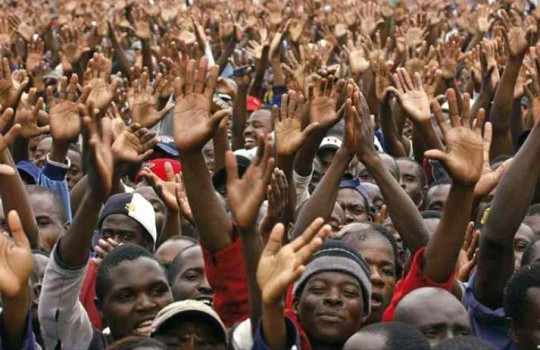
Pamberi Ne Zanu! Pasi Ne Zimbabwe! (Forward with Zanu! Down with Zimbabwe), by Eldridge Adolfo

MDC supporters

MDC supporters

Pamberi ne Zanu! is the chant of the Zanu PF supporters as they celebrate their victory over the MDC. The results in the Presidential race: President Mugabe, 61% against Prime Minister Tsvangirai’s 34%. In parliament Zanu PF won 158 seats to the MDC’s 51. Despite the scale of victory, there were no spontaneous celebrations and a sombre mood has gripped the country as both Zanu PF and MDC-T supporters have become anxious. The debate about the freeness and fairness of this election has taken on a familiar pattern from 2008 where SADC and the AU implicitly support Zanu PF and endorse the elections, while the UK, USA, Australia, Canada and Botswana question its legitimacy in support of the MDC. The MDC is currently preparing a dossier on electoral irregularities which supposedly helped rig the elections in favour of Zanu PF. The election saga is sure to continue for a few more weeks as the MDC is certain to contest the elections through the courts. However, it is highly unlikely that these elections will be re-run and it is with almost all certainty that Zanu PF will form the next government.

Continue reading