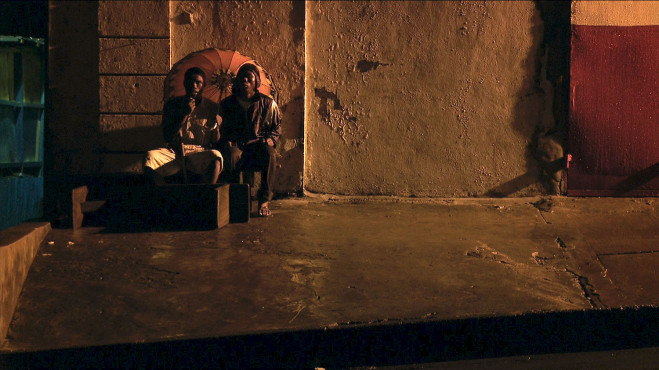
Out of the shadows a massive procession of handicapped young street dwellers appears. We are in downtown Freetown, Sierra Leone, and they move slowly like zombies of the night whilst parts of metal on crutches and wheelchairs glow in the darkness and metallic sounds echo in the otherwise empty street. It’s the opening scene of Shado’man, a film shot in darkness.
Author: Mats Utas
Rejoinder to Utas on the emerging Liberian middle class, by Ilmari Käihkö
In an earlier blog post, Mats Utas discussed the emerging Liberian middle class.[i] I found this text both refreshing and intriguing, and was asked to offer a written response to it. I hope it succeeds in developing some of the original concepts in equally refreshing and intriguing ways.
In his essay, Utas held the sport utility vehicle (SUV) as the perfect symbol of the emerging Liberian middleclass. I completely agree with this comparison (although I would say that this middle class has already emerged). Firstly, the SUV is larger than the yellow commercial taxis that those who don’t own cars need to primarily rely on. The SUV thus not only gives status, but is safer in the dangerous traffic of Liberia. Simultaneously it is important to note that SUVs are still typically cheaper than the jeeps favored by most expatriates and the elites who can afford them – thus the middle. Secondly, as they are typically equipped with larger wheels and four-wheel drive, they are much more reliable when faced with the bad infrastructure of most roads in and especially outside Monrovia. One should remember that some of the emerging “posh” areas are not easily accessible by yellow taxis: there is neither regular service there, nor would the road conditions make reaching some areas easy. Lacking infrastructure thus reinforces the separation between the have’s and the haven-not’s. Continue reading
Liberia, the emerging middleclass and tiny bits of tension
He looks very frustrated behind the steering wheel of his SUV. He is making his way over the sandy road; crisscrossing between the people walking from the beach. There are many close escapes as his car skids in great speed and nearly out of control. Indeed when he reaches the junction he has angered enough people. Traffic is now blocking his way forward and as he tries to make his way around yet another car he must slow down. He is very intoxicated. Maybe he has been fighting his girlfriend? He is forced out of his car. An argument starts and within soon he starts to fight. A bottle cracks on his head and the situation looks ugly. The air is tense. It is in the late afternoon and a national holiday. The whole area is packed with people. Down the road riot police has just entered an area where the beach hotel holds a show. Young people are feverously trying to jump the fence and there is a scrimmage on the inside. The commander of the riot police tells me he will clear the area so we can enter in safety. There is still tension hanging in the Liberian air, but it is a different kind than during the years of civil strife. Liberia has moved on.
Once a combatant, always a combatant? by Ilmari Käihkö
In the recent report of the United Nations (UN) Security Council Panel of Experts on Liberia the authors express a stern warning concerning the dangers posed by former combatants for the cross-border security in the Mano River belt. According to the Panel of Experts, these former combatants in Liberia “present in remote border regions… live in semi-organized autonomous groups outside of any State authority, often under the direct influence of former ‘generals’ who commanded rebel factions during the Liberian civil conflict”.[i]
I acquired the report less than a week after returning from Liberia, where I’ve spent more than ten months during the past two years investigating networks of former combatants as a part of my PhD research. The bulk of my fieldwork has been conducted in the Southeastern Grand Gedeh County, which is also the area the Panel of Experts focus on due to the recent cross-border attacks from Grand Gedeh to Ivory Coast. Because I am most familiar with this setting, and because the report obviously focuses on Grand Gedeh, I will also concentrate on the county.
Ernest’s looking glass, by Anne Menzel
“Development” reflections from a long awaited return to Sierra Leone
Among my friends in Sierra Leone I have a reputation for “not knowing how to walk properly” (“waka fine”) especially at night. One time in April 2009, during field research for my PhD thesis and after a late evening visit to a friend, I even stumbled into a nasty ditch that I “should have grown used to” (so I was told) a long time ago, since I regularly frequented the same street during daylight. I ripped my jeans, received a cut on my ankle and had to suffer the amused assistance of bystanders who pulled me out of the ditch. According to next day’s gossip I managed not to cry but was so ashamed of my clumsiness that I begged my friendly helpers to please keep quiet about the incident. However, my Western inability to gracefully cope with Bo Town’s road conditions and nearly constant blackout was just too delightful.
Economy of the street
We just launched a new website with images and texts from Freetown, Sierra Leone. The site is a platform for both a photo exhibition: Pentagon (photos and texts from my fieldwork) and a film: Jew-Man Business (directed by Maya Christensen, filmed by Christian Vium and produced by me). The new website has been created by Hanna Berhanusdotter who has been an academic intern at NAI. Please have a look: http://www.economyofthestreet.com/
Beyond the paradox: African youth research and the policy debate, by Joschka Philipps
During the past decade, African youth have become a hot topic in academic, public, and policy debates. The plethora of discussions, papers, policy notes, media reports, and conference panels is diverse, and yet often united by an intriguing concern with African youth’s paradoxical nature. Titles of prominent Africanist works read “Makers and Breakers” (Honwana and de Boeck 2005), “Vanguards or Vandals” (Abbink and van Kessel 2005), “Promise or Peril” (Muhula 2007), and “Hooligans and Heroes” (Perullo 2005). Development agencies, too, have repeatedly contrasted youth opportunities with youth risks, emphasizing that “young people can be a source of growth and development for their countries, but [also] a source of inequality, poverty, exclusion, […] crime and violence” (Cunningham et al. 2008:9).
The world downside up, by Lisa Åkesson
Mainstream European media portrays Angola as a country characterized by extraordinary economic growth, widespread corruption, a questionable democracy, a state totally dominated by the ruling MPLA party and glaring inequalities between the poor and the rich. This is a valid picture, but there are other stories to be told. If I compare the capital city of Luanda of today with the Luanda I used to know when I worked here more than twenty years ago, the first thing that comes to my mind is the absence of watchful soldiers and heavy military vehicles. Since 2002 peace has been stable. This means that mothers do not have to worry about their 16 years old sons being sent to the frontier. It also means that millions of persons no longer flee across the country to Luanda. Instead citizens of Luanda take the opportunity to visit relatives in other provinces, and goods and commodities circulate more easily. World Bank statistics indicate that in 1992, one of the worst years of the war, life expectancy at birth in Angola was as low as 41 years. Since then this figure has increased by 25% to 51 years in 2012. There are still enormous problems in the health and education sectors, but the peace in itself has brought a better life to many people after more than three decades years of war. An important reason behind the stability of the peace is the government’s direct access to natural resources, primarily in the form of oil and diamonds, which has made it possible for them to buy the loyalty of former rebel soldiers and their officers. Low ranking former UNITA rebels have been given income opportunities, sometimes as guards in private security companies, and in comparison with their past as UNITA soldiers, most of them live better today. Former UNITA generals have been afforded with a slice of the country’s wealth, for instance in the form of concessions to diamond mines, and they have been incorporated into the national army. Another important reason behind the stability is that the MPLA government has been wise enough to avoid publicly humiliating the defeated UNITA militaries. Instead, the MPLA rhetoric has focused on the party’s capacity to bring peace to the people.
‘Blood Beer’ or Brewing Benefits? The Paradox of Heineken in the Congo, A guest post by Jason Miklian and Peer Schouten
As the sun goes down in the Democratic Republic of Congo, the sound of tropical birds and insects is slowly overtaken by the groaning hums of an army of small Chinese-made generators. They each light up a few light bulbs and a transistor, creating the much-valued ambiance for which Congo is well-known—an ambiance that is consistently lubricated with fair amounts of Congo’s finest beer, the eternal leader Primus. Sweet-voiced Lingala phrases and guitar riffs from the blown speakers pay playful homage to the bliss that the beer has brought the country; as the melodies bounce off the faintly illuminated hand-painted Primus ads all over the country, they form a pleasant multisensory immersion into Congo’s soul. Just like you can get a Coca-Cola everywhere in the world, so you can get a Primus everywhere in Congo. In addition to its contracts with celebrity singers, the brewery has exclusive deals with 68.857 bars in Congo, which carry Primus-branded tables, chairs, and ashtrays. Hand-painted signs for Primus seem to paper every surface in the DRC, making Bralima’s slogan Toujours Leader! (‘Always the Leader!’) into the most-read phrase in the country.
Continue reading
Beyond African ’growth’: some comments on the Swedish media debate, by Linda Engström
On Saturday the 26th October, the Swedish National Radio broadcasts its traditional 20 minutes of economy news – ‘Ekonomiekot’. The reporter and editor Pär Ivarsson interviews national economist Peter Stein, and Stefan Kullander, Sales manager for Africa at the company ABB in Sweden. The topic of today’s program is the economic growth of Africa.
There are many things that strike me, listening to this program. Below, I have listed my four main points of critique that I hope could contribute to that ‘Ekonomiekot’ partly revises its take on economic growth, development and ‘Africa’.
First of all, the recent and frequent reports on outstanding economic growth in Africa have quickly turned this into mainstream ‘knowledge’. But, earlier this year, the Norwegian scholar Morten Jerven published his book ‘Poor Numbers – How we are misled about African development statistics and what to do about it’. Looking carefully at what is behind these numbers he concludes that “the quantitative basis for knowledge about African economic development is very fragile”. In Ekonomiekot, for example, Ghana is pinpointed as one of the more successful countries regarding economic growth. According to Jerven, Ghana’s increase in GDP depend to a large extent to use of better data and better methods for accounting. Tanzania is also mentioned, which is the country where I myself conduct field work. Certainly, there has been progress in some regions of Tanzania. However, the contrasts between a rich elite and a poor peasantry is striking, especially if you spend time in rural areas. According to some experts – inequality is only increasing.