Author: Mats Utas

Comparing elections in Sierra Leone and Ghana (guest post by Jonathan Bhalla)

Multi-party elections were a prominent feature of Africa’s political landscape in 2012, with twenty-three countries conducting polls – whether presidential, legislative or municipal. News coverage in the mainstream media has, at times, been framed in clichés and stereotypes. On the eve of the Sierra Leonean elections, the BBC published an article which opened: “Sierra Leone may be about to prove it has grown up”. The preoccupation is often with little more than who is likely to win and whether there will be violence. Rapid and diverse political transitions taking place across the continent are seldom reflected upon in any depth.

I have a longstanding interest in the politics of Sierra Leone, and so followed the elections on 17th November 2012 closely – albeit from a distance. I found a number of striking similarities with the polls in Ghana, which took place a few weeks later on 7-8th December, particularly interesting.
Continue reading

Why History Repeats Itself in Eastern DR Congo (guest post by Timothy Raeymaekers)

Observers often agree that ‘history repeats itself’[1] in Eastern Congo – from the slavery conditions imposed by Belgian King Leopold over Mobutu’s predatory state, to today’s armed militias. The reason why these ghosts come haunting Congo’s present is primarily related to unending competition over the ‘right to protect’ unfree populations; under the circumstances, this protection rather refers to a double-edged commodity that means extortion for most and a negotiated form of peace for some. The existence of such regionalized markets for protection in Congo’s eastern borderlands results in a situation whereby violent accumulation often outlives ideal statehood: soldiers, armed rebels, police and ‘non-state’ authorities fight for the right to exploit local communities and accumulate capital through extra-economic means. One the one hand, this pushes people further into poverty and undermines their efforts to earn a living; on the other, it leads to more stationary forms of predation as a result of post-war integration of such protection rackets into national state government.

Continue reading

Mali : the unexpected crisis, a year later…. (guest post by Marc-André Boisvert)

When I moved to Bamako a bit more than a year ago, the international community praised Mali for being a beacon of democracy and stability.

I did not see that. I am not pretending that I knew that almost two-third of the country would fall under the control of rebels link to Al-Qaeda, nor that the military will take over in one of the most useless coup in West Africa, ousting President Amadou Toumani Touré (locally known under the acronym ATT).

What I knew was Malians did not see their country as the model that the international community kept referring to. They talked about corruption, lack of real democracy and injustice.

Nevertheless, there was such a consensus of Mali being the good Western-friendly pupil that I started to believe in it myself. Then the double crisis hit.

Continue reading

Military intervention brings no simple solution to conflict in Mali (guest post by Olli Teirilä)

The latest conflict in Mali’s troubled history is coming to a breakpoint, or at least some kind of a turning point. While in the north of the country the Tuareg rebels continue their recently accelerated fighting against the Islamists of MUJAO, AQMI and the new-found Malian Ansar al-Sharia, in New York the United Nations’ Security Council is still weighing the details and options of an ECOWAS led military intervention.

Continue reading

Narratives of Injustice: The Counting of Votes in Aboabo, Ghana (guest post by Ulrik Jennische)

The Election Day in Ghana has passed. The incumbent president John D. Mahama and his National Democratic Congress, NDC, have been declared winner by the Electoral Commission, EC. Celebrations have been held across the country.

But the electoral process is not over. The leading opposition New Patriotic Party, NPP, with its ‘flagbearer’ Nana Akufo-Addo is contesting the result, claiming their victory has been stolen by the NDC and EC. They have decided to gather their evidence and go to court, testing the judicial side of the Ghanaian democracy.

Due to malfunctioning verification machines the election day of last Friday the 7th had to be stretched to the following Saturday as well. However, already on Friday results were coming in that leaned toward a NDC victory. Still, NPP representatives held a press conference on Saturday afternoon claiming that reports they received from their polling agents all over the country predicted their much wanted victory. On Sunday EC declared NDC the winner. Speculations are rife. Were the reports given to NPP false, or has NDC been able to defy the new biometric verification machines and somehow added NDC votes to the ballot boxes? Or have NPP early on realized the outcome of the voting, and hence spreading suspicions of irregularities, hoping for a second chance? Nevertheless, their early press conference was criticized from NDC as well as the Ghana National Peace Council.

Continue reading

Ghana votes #2: machines and patience

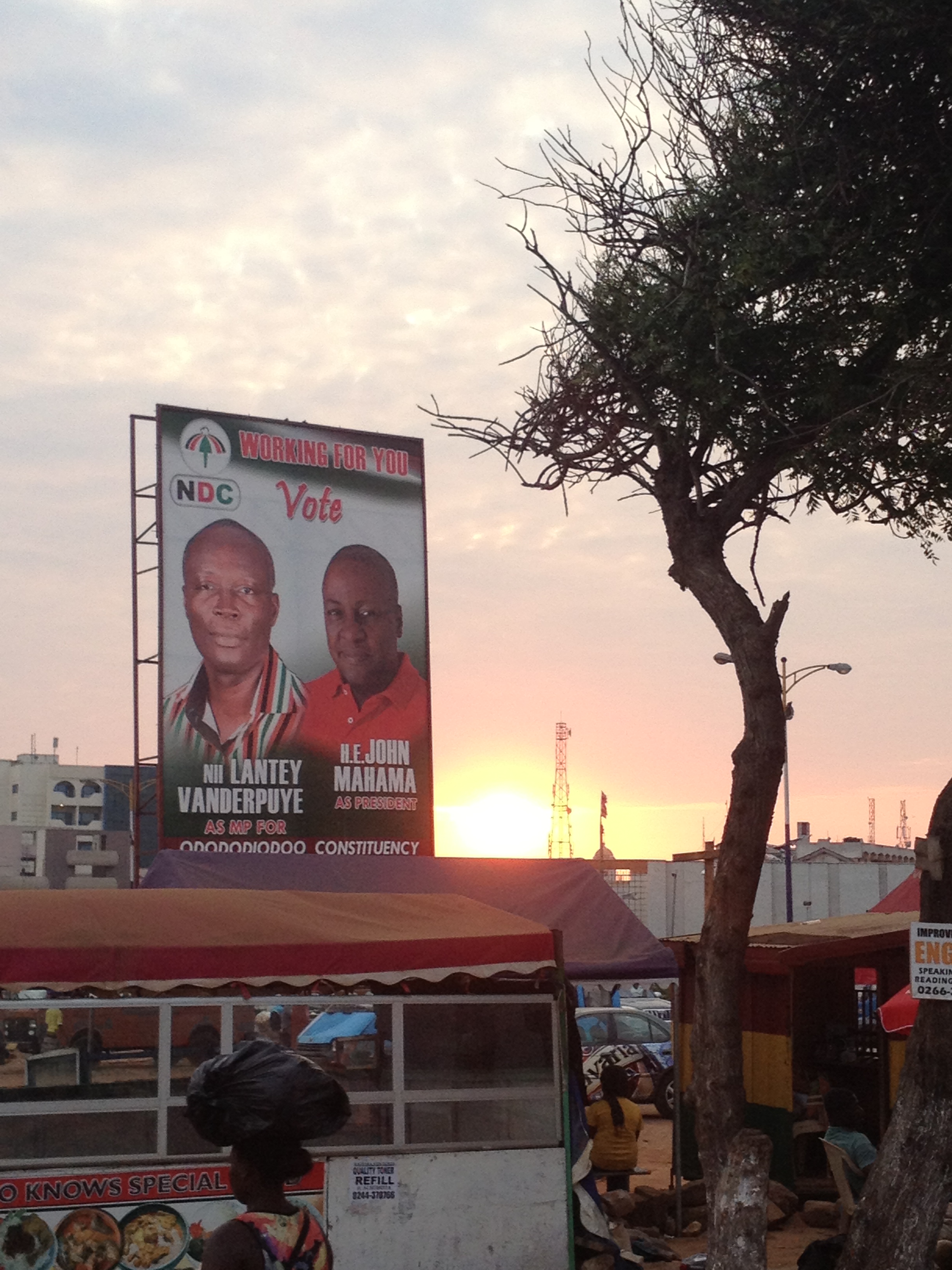
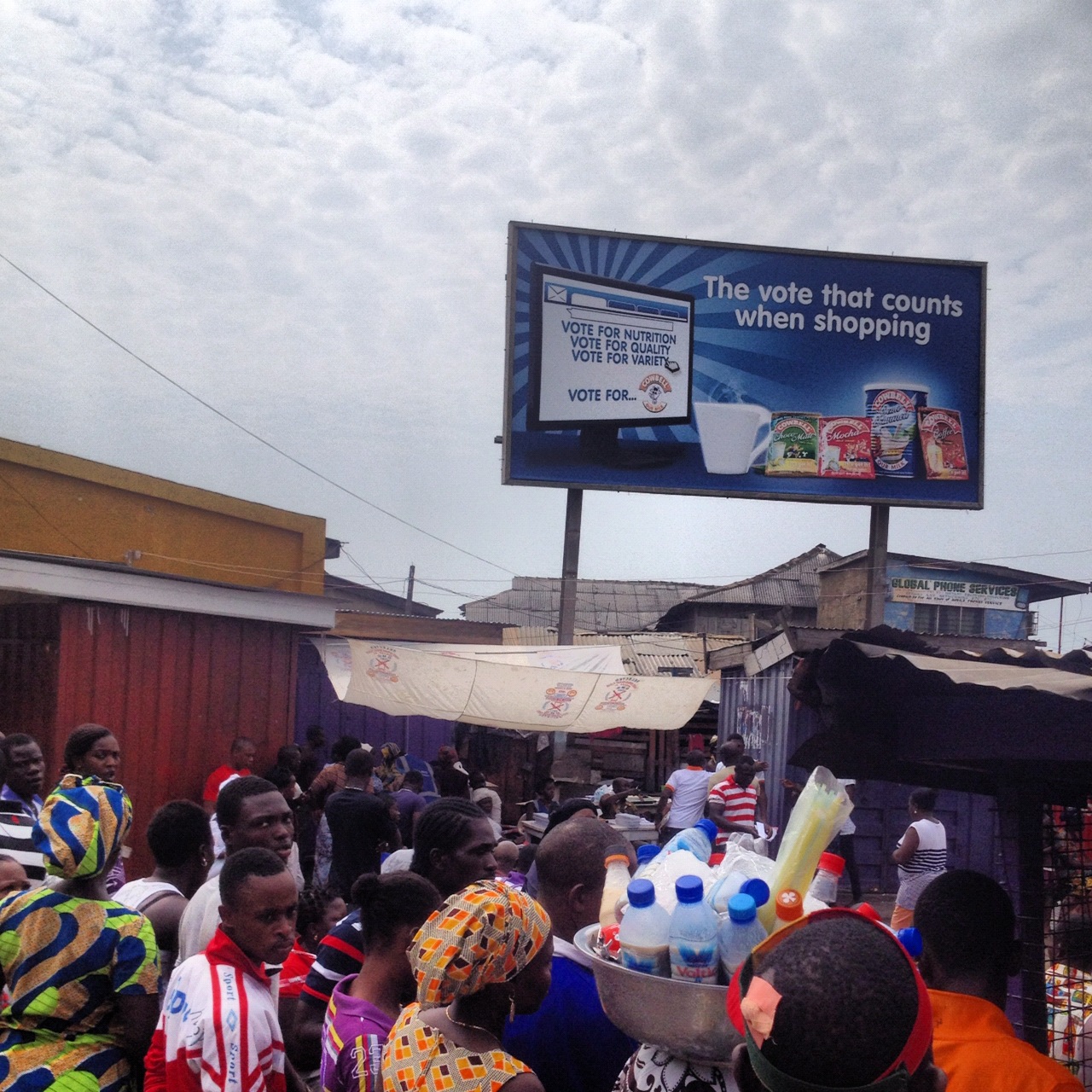
Polling station in Ussher Town under a billboard suggesting a different kind of vote

Polling station in Ussher Town under a billboard suggesting a different kind of vote

Yesterday I spent much of the day walking between polling stations: first in James and Ussher towns (downtown Accra) where things seemed to be working really well and then in Ashaiman. The latter location is a market town located close to the port of Tema. It contains of many poor settlements and had its share of violence during the last elections. At the first ten stations the voting was flowing smoothly and people were very satisfied. In the late afternoon I however visited several polling stations where the “machines”, as people said, had stopped functioning. The new biometric system requires electronic fingerprints for voters to vote and without a functioning finger print scanner they cannot vote. In some places people waited for hours with little information of when they could vote. Election functionaries in these locations knew little more than the voters and expressed great frustration over the “machines”. In one case the machine had simply frozen and could not be restarted, in the other cases they did not work after batteries had been replaced. One functionary told me that in all of Ashaiman they had just one spare fingerprint device and of all the defunct polling stations I visited none had gotten any technical support (in fact many voters thought that I was the technician that would fix their “machines”). At five o’clock when the polling stations were officially supposed to close voters and functionaries had still not received information of how to proceed. Only after dark they learnt that they would be allowed to vote the following day.

Continue reading

Ghana votes 2012

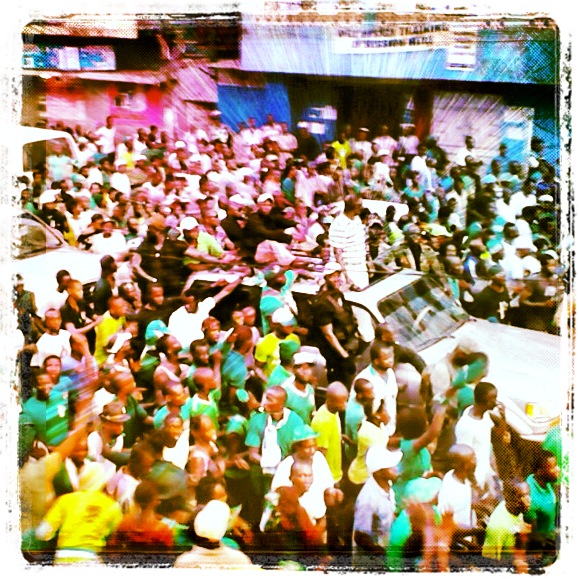
I must say that I have been slightly disappointed with the political temperature in Accra. The few days I have spent in Accra have showed nothing like the political spirit of Sierra Leone, or even Liberia. But Wednesday turned out to be the real campaigning day in Accra and there was suddenly nothing wrong with elections frenzy and party spirit. Small rallies of supporters in party attire with banners and flags roamed downtown; a few groups of young men ran along the streets, but most of the campaigning takes place in caravans of cars, with supporters leaning out through the windows shouting party slogans and blowing vuvuzelas. Typically a group of motorbike riders would come first, driving at maximum speed, blowing their horns, ignoring traffic rules; at times against busy traffic on one-way streets. A posh car or two, and then tro-tro’s (minibuses) and taxis would follow. In the evening heads of parties and local MPs held meetings at various places and crisscrossed through town creating a joyful chaos. Supporters of the parties met up in friendly clashes where abusive language was used but violence was not in the air. Mockery is a common form of campaigning and a friend of mine saw a tro-tro driver in one of the NDC crowds stopping in the middle of the road just to throw himself on the ground with feet and hands up in the air. This act was with reference to an NPP meeting a few days ago in Kumasi when a stage broke down under the weight of presidential candidate Akufo-Addo and other NPP seniors who subsequently fell to the ground with hands and feet in the air. There is clearly room for comedy. Thursday has been much more quite with no real rallies, although lots of talks about politics. Friday is time to vote. Continue reading

”Ampa Ampoh!”: Sierra Leone after the announcement of the 2012 election results (guest post by Mimmi Söderberg Kovacs)

SLPP rally with candidate Maada Bio. Courtesy by Mimmi Söderberg Kovacs

SLPP rally with candidate Maada Bio. Courtesy of Mimmi Söderberg Kovacs

Late in the afternoon of Friday 24 November, as the sun was setting over the busy streets of downtown Freetown, the National Election Commission (NEC) of Sierra Leone called a press conference to announce the results of the Presidential Elections, ending a week of uncertainty and speculations. As anticipated by many, the sitting President Ernest Bai Koroma of the All People’s Congress (APC) secured a second term in power with almost 59 percent of the votes cast, thereby avoiding a run-off against the main opposition leader, the former military junta leader Julius Maada Bio of the Sierra Leone People’s Party (SLPP), who received 37, 4 percent. None of the other candidates were able to secure more than 1,5 precent, confirming the growing polarisation of the political landscape in post-war Sierra Leone. The turnout was high, with a national average of 87 percent. Continue reading