Author: Mats Utas

Protests against Morsi (by Maria Malmström)

Massive protests have taken place in several Egyptian cities against the president’s moves last Thursday to grant himself extensive new powers. Read more on BBC.

NAI researcher Maria Malmström talks to anthropologist Samuel Schielke about the protests in Egypt.

− The latest events have positive potential to strengthen the presence and power of a strong opposition. But they also have destructive potential in an increasingly polarised political situation. Supporters of the Muslim Brotherhood I met last month often expressed the feeling that they are under attack from all sides
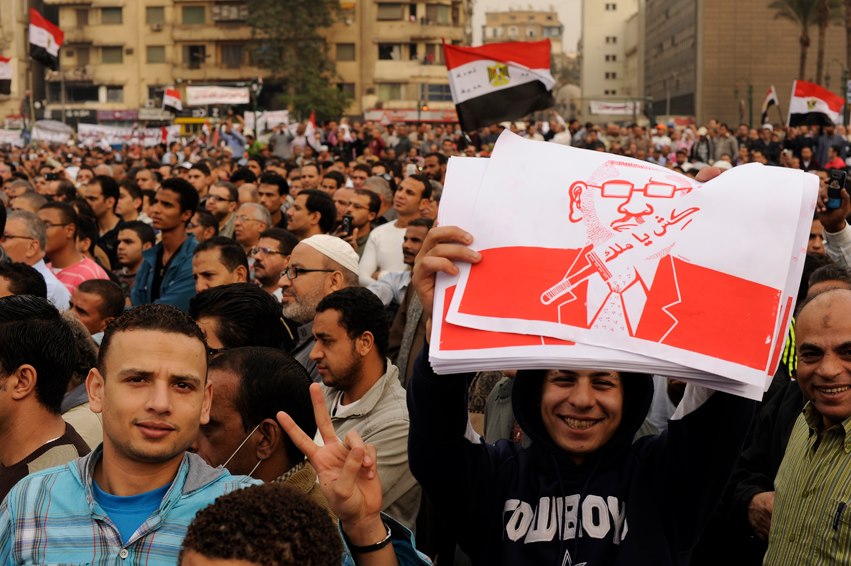
Tahrir against Morsi’s decree. Courtesy of Hanna Sistek

by forces that hate Islam. They are bound to see themselves as victims of today’s events, and this carries the risk of radicalising them, making them only more determined to push matters their way, whatever the cost, says Samuel Schielke.

– The collective anger that the vast majority of people in Egypt have been feeling since last Thursday can be a unifying force that all parts of the political opposition can rally around. Furthermore, one thing seems clear, Egyptians of today – both pro- and anti-Morsi – will not accept a new dictator, says NAI researcher Maria Malmström. Continue reading

Congo crisis shows bankruptcy international military policies (guest post by Maria Eriksson Baaz and Judith Verweijen)

There is undoubtedly a need for a political solution to the ongoing Congo crisis, which recently reached new depths with the fall of Goma. Yet viable solutions to intricate, multi-layered conflict dynamics are difficult to reach when one party, in this case the Congolese Government, is brought to its knees following humiliating military defeats. The probability of a sustainable compromise that will reduce violence in the Kivus is difficult to envisage in the face of an insurgency led by skilled military entrepreneurs, with crucial military and diplomatic backing from neighbouring countries.  Certainly, the M23 has advanced some legitimate claims that are shared by both the Tutsi minority they claim to represent and wider layers of the population tired of the Kabila’s Government’s inept governance. However, it is unlikely that its leaders, given their current military advantage, will accept any deal which does not reward their ambitions. In sum, the rebel take-over of Goma has decreased the possibility to break with a vicious cycle  in which insurgent violence is time and again politically rewarded. Continue reading

The Waiting Continues in Sierra Leone (guest post by Johanna Söderström)

Now, a few days after the election on November 17, everyone is waiting for the National Electoral Commission (NEC) to announce the final results. Rumors of when NEC is going to announce the results spread like wildfire across Freetown, where people are eagerly anticipating the results. Whether via radio, tv or text messages each press conference by NEC is believed to be the big one, where the results will be called by NEC’s chairperson Christiana Thorpe. But so far everyone is still waiting.

SLPP supporters giving the red card to APC – “you are out!”

Continue reading

Soldiering Democracy: the 2012 elections in Sierra Leone (guest post by Maya Christensen)

“We want a transparent election with no violence” was a statement shared by people in the streets of Freetown when they went to vote for the presidential and parliamentary elections yesterday (November 17). With no cars allowed in the street and with the threat of being arrested if gathering in groups or if engaging in any form of political campaigning, Freetown street life was marked by an unusual quietness. Before daybreak people were queuing waiting for the polling stations to open and voter turnout was reported high all over the country. With the exception of a few incidents, the election has been reported generally peaceful so far. Continue reading

Meles Zenawi and Africa’s Second Fiddles (guest post by Declan Galvin)

The Death of a Big Man

It was reported that Ethiopian Prime Minister Meles Zenawi died on August 20th at the age of 57, a relatively young age for an African dictator. Zenawi had been the de facto leader of Ethiopia since the coup he led dislodging Mengistu Haile Mariam in 1991. Zenawi is known for his repressive and intolerant leadership style that jailed dissident journalists, killed hundreds of opposition members and protesters, and forced numerous Ethiopians into exile. While his human rights record leaves much to be desired, Zenawi’s economic successes and policies are hard to ignore with realistic claims of 11% annual growth since 2004, a revived agricultural sector, and a (mostly) honest and well intended use of donor funds.

Some commentators have expressed concerns that the fragility of Ethiopia, which Zenawi managed to hold together, could leave a power vacuum—especially considering the irredentist ambitions of Somalia and persistent grievances emanating from Eretria. However, Jason Mosley, an Associate Fellow at the Chatham House, correctly stated that while Zenawi’s party is by no means “monolithic” and that plans were evidently in motion for a leadership transition in the near future, but it is likely that Zenawi was planning to solidify himself as the head of his the state anyway. Mosley comments further that few historical precedents exist in Ethiopia to help guide this transition process along, complicating the situation further. Continue reading

Boko Haram and the Nigerian state (Guest post by Henrik Angerbrandt)

Jama’atu Ahlis Sunna Lidda’awati Wal-Jihad (People Committed to the Propagation of the Prophet’s Teachings and Jihad) – more known as Boko Haram – came in the centre of attention in Nigeria in mid-2009 when they clashed with police squad ’Operation Flush’ in Borno State capital, Maiduguri, resulting in more than 800 deaths. The leader, Muhammad Yusuf, was arrested and killed while in police custody. This followed a pattern of how the Nigerian state has approached similar radical Islamist groups before. This time, however, the strategy resulted in a spiral of violence between Boko Haram, the police, and security forces that is taking an ever more vicious face. Continue reading

A monster with a big diet: South African narratives of fear and crime (Guest post by Claudia Forster-Towne)

In speaking about South Africans and their emotions in my previous post it became clear (thanks to the wise words of Mats) that there is a need to discuss the fear experienced (real or perceived) by South Africans in their day to day lives.

Yes, South Africa (SA) is a violent place. Crime levels are high, as can be proven by a plethora of statistics and lived experiences. Recently the OSAC Report on Crime in SA labeled the situation as ‘critical’ in Johannesburg, Pretoria, Durban, and Cape Town. Crime Stats SA ‘boasts’ a series of facts relating to crime in South Africa such as “Over 161,000 people have been murdered in South Africa since 2004” and “5900 crimes are reported to the South African Police Service (SAPS) everyday”. Personally I do not know a single person that has not been a victim of some or other crime, several of them particularly violent including armed robbery and kidnapping. Continue reading

”Even my grandmother would go fighting” (Guest Post by Ilmari Käihkö)

Sitting between houses in a yard close to one of the busiest roads in Monrovia we were seven: six former ”generals”  – a common term used to refer to any rebel commander – of the rebel group LURD and me. Not one of us seems to have much to do, and we spend the whole day under the same tree. One of the generals I know due to a lucky coincidence first leading me to a close relative of his, who in turn led me to him. Through this man I met a few of the other generals. Still a few of the generals present are new faces to me. This seems to matter little, as friendship extend easy to even my new acquaintances. Discussion flows, and my presence is accepted by all of them. By the end of the day I am amazed by the everyday life of my informants, and the ways it differs from the combatants I’ve lived together with in Grand Gedeh County. Continue reading

Bleak prospects in Ivory Coast: the Third Ivorian War (Guest post by Ilmari Käihkö)

As this researcher packed his things and returned to Monrovia the prospects in Ivory Coast require one more look. While I still regard Ble Goude’s victorious prophecy that I discussed in my previous post false in the sense that toppling Ouattara’s government will prove impossible, there is yet still a possibility that the same prophecy will be fulfilled: if victory is sought in an impossible situation the trick to succeed is to redefine victory. After all, is this not what everybody does? (For one fine contemporary example witness the downgrading of ambition of the US-led ISAF-coalition in Afghanistan) Continue reading