In most post-conflict countries much is at stake and tensions are high during elections. The Liberian 2011 elections were no exception. The difference between winning and losing can be huge, because in Liberia the winner takes it all. But here I’m not talking about the presidential candidates, the winner incumbent president Ellen Johnson Sirleaf or her main antagonist Winston Tubman. The political elite will always find ways to survive no matter the electoral turnout. Here I’m talking about the followers, Liberians (in this case, ex-combatants) far from the privileged elite who gave their loyalty to the competing candidates with hopes and dreams about a better future. Two years earlier, in July 2009, the formal closure of the Demobilisation, Disarmament, Rehabilitation and Reintegration process had been announced – which if successful – would have implied former combatants’ reintegration into civil society and the dismantling of rebel networks. But the election period was yet another evidence of remaining rebel structures still used for political purposes, despite all official initiatives of demobilisation and reintegration. It revealed how very important it is for many ex-combatants to become what they regard as ‘politically active’, but more so, it highlighted the importance of supporting the ‘right’ candidate, to wit, the next president. While elections can be advantageous for ex-combatants, giving loyalty to the losing candidate can be devastating. The experiences of Alex and Michael illustrate this. Michael, a former LURD commander, managed to secure important political connections leading all the way up to president Johnson Sirleaf. Alex, a former vigilante leader, established a network of ex-combatants later mobilised by Tubman during his election campaign. For Alex and Michael and ex-combatants around them, with few opportunities in a post-war society, the elections were crucial. But while their political engagement was on the one side very beneficial it was for the losing side disastrous. Continue reading
Author: Mats Utas
Harvesting the rotten fruits of repeated rebel military integration: some reflections on the new rebellion in eastern DRC. Guest post by Maria Eriksson Baaz and Judith Verweijen
In recent months, we have seen renewed large-scale fighting and a new wave of displaced in the Kivu provinces of eastern DRC. The current upheaval started in April, when an important faction of the former CNDP rebel group, who had integrated into the Congolese military (FARDC) in 2009, deserted and launched a new rebellion in North Kivu. This group took the name of “M23” after the peace accord between the CNDP and the DR Government signed on March 23 2009. In various offensives over the last months, the M23 have occupied substantial parts of Rutshuru territory, revealing once more the operational weaknesses of the military from which they defected. Continue reading
“We will be victorious” guest post by Ilmari Käihkö
“We will be victorious” is a famous statement made by the former Ivorian Youth Minister Charles Ble Goude before the elections in Ivory Coast in 2011. This statement soon became iconic when the group Les Galliets adopted it as an intro to its militaristic and anti-imperialistic pro-Gbagbo electoral song called C’est Mais.
As we now know with hindsight, Gbagbo was not victorious in the elections, and equally failed to cling to power in their aftermath. While Gbagbo is awaiting the beginning of his trial at Hague, Ble Goude himself is sought after following cross-border raids to Ivory Coast. Nevertheless, the song remains as popular as ever among the supporters of the former president, many of whom currently reside in the refugee camps and their environs in the Grand Gedeh county of the neighboring Liberia. Continue reading
Review of Christine Ryan: Children of War: Child Soldiers as Victims and Participants in the Sudan Civil War
There is quite a lot written about child soldiers in rebel wars in particular on the African continent. As Ryan clearly points out, and writes against, the bulk takes a victim perspective of child soldiers. A few studies, including my own on Liberia, have started on neutral grounds and have been able to show that a simple victim perspective has more to do with faulty research methods than realities on the ground. A nice thing with Ryan’s study is that the rebel army which she has studied, SPLA, won the war and eventually transformed into government of South Sudan. Child soldiers within this rebel army have thus lesser motives of downplaying their agency, as is often the case of other rebel armies in African warzones. This has rendered a whole range of alternative answers to reasons for joining the rebel army at a young age, beyond forceful conscription, and also motives for purporting soldier life. Continue reading
The Big Man book
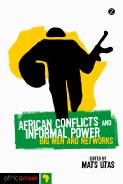
Richard Mallett has reviewed our book African Conflicts and Informal Power (Zed books 2012).
http://africanarguments.org/2012/07/13/big-men-african-conflicts-and-informal-power-a-review-by-richard-mallett-odi/
“As a final observation, African Conflicts and Informal Power is perhaps above all else a testament to the strength and value of well executed…, in-depth qualitative research in expanding and refining our understanding of the drivers, nature and consequences of war. Whether the approach be ethnography or political sociology, this volume demonstrates why robust qualitative inquiry is so indispensable when it comes to deciphering conflict and discovering what is really there.”
Post-Kaddafi repercussions in the Sahel: the Mali emergency, questions of radicalization and emerging West African discourses of “clashing civilizations”
In western media there has over the last days been an uproar against Ansar Dine who are seen destroying world heritage sites in Timbuktu. Destroying buildings give more attention than killing people in Northern Mali and it is far from the first time that radical Muslims use this trick to speak to the world. Yet still it is an unfortunate outcome of an uneven world when buildings are worth much more than human beings. In late June about 20 scholars from West Africa, Europe and North America gathered at the Kofi Annan Peacekeeping Training Centre (KAIPTC) in Accra to discuss the increasing political unrest in the Sahel. The conference was a joint venture between The KAIPTC and the Nordic Africa Institute (NAI). Continue reading
Update on the situation in Eastern Liberia and Western Ivory Coast (guest post by Ilmari Käihkö)
Following the attack from Liberian soil to Ivory Coast that resulted in the deaths of seven peacekeepers from Niger working under the United Nations flag as well as a number of Ivorian civilians and military an update is in order. While my previous post explained the general situation, the targeting of UN peacekeepers requires some further explanation.
I got the news about the attack immediately from my supervisor in Sweden, who had learned about it from the Swedish television on the morning after it had been executed. During the day I must have asked around 50 people about their reactions and thoughts concerning the incident. Not one was aware that it had even taken place. Only on the second day information had begun to trickle down to Zwedru, mainly from the Ivory Coast. Continue reading
Something’s stirring in the east; something’s stirring in the west (Guest post by Ilmari Käihkö)
The Ivorian refugees in Grand Gedeh are a common sight both in the county capital as well as the many surrounding villages. Even more importantly, the border between Ivory Coast and Liberia is porous and poorly patrolled by the Liberian authorities. Both Ivorians and Liberians cross at will, just as they have for a long time. This is especially the case with the Krahn, the most predominant ethnic group in Grand Gedeh, who are spread evenly across the border (in the Ivory Coast they are called Guere).
There are about 69,000 Ivorian refugees in Liberia, most of them in Grand Gedeh. Additionally an uncounted number of Liberians returned to Liberia following the Ivorian crisis and the influx of “northerners”, often erroneously nicknamed “Burkinabe”, supporters of President Alassane Ouattara to the western parts of Ivory Coast. These refugees and exiles are now sitting around in camps, villages and the county capital Zwedru, many of them spending their days loitering or sleeping. Their mood is one of depression and frustration – not many have high expectations of returning back home anytime soon, if ever. Continue reading
50 years.
Charles Taylor will spend the rest of his life in prison (unless someone decides to assist his escape again :)) for aiding and abetting war crimes in Sierra Leone. As a comparison Issa Sesay, one of the senior commanders of RUF, was sentenced by the same court to 52 years. Most commentators have raised words of optimism saying that the trial will send signals to other warlords that they will eventually be dealt with if they don’t “behave”. Maybe so, but I doubt. Anyone who decides to lead armed incursions or make military coups is quite aware of the stakes and prepared to take the risks. After all it is a prerequisite that they gamble rather offensive with their own life by leading such endeavors. However what may be the outcome is that a set of future military leaders (and some currently in power) must think twice with whom they form alliances and be aware that it should rather not be someone who is on bad footing with the mighty West.
Two short observations to be made: firstly, I guess we will see some shifts in political alliances on the Liberian arena. They may not happen overnight, and they may not be directly visible to all observers – after all Liberian politics by and large happens behind the scenes. And secondly, I hope that Charles Taylor will spend some of his time in jail writing, or narrating to others, his proper version of the Liberian civil war. What else should he do with all his time?
Gerhard Anders has also written some closing remarks on the Taylor saga: