Liberia’s bi-cameral legislature comprises of 73 members of the lower house, called the House of Representatives and 30 members of the upper house, called the Senate. In 2014, Liberians will go to the polls to elect 15 of the 30 Senators for a tenure of nine years. These ‘mid-term’ elections are a constitutional requirement that ensures that all the Senate seats are not vacant at the same time. In this piece, I argue that elections should be a growth industry where best ideas and character flourish above cash and false promises. Continue reading
Category: Elections
Sweeping for Change in the Burkinabe Revolution, by Jesper Bjarnesen
As the dramatic scenes of public protests have given way to political negotiations of the terms of a transition towards new elections in Burkina Faso, the initial reports on events unfolding hour by hour are gradually being replaced by reflections on the overall implications of the overthrow of Blaise Compaoré. Questions are now being asked about the possible spill-over effects of the popular uprising – the possibility of an “African spring”, mirroring the wave of uprisings in Northern Africa in 2011. We might also begin to ask more anthropological questions of the potential for more enduring social and political change in Burkina Faso. Which changes in terms of political participation can the uprising be expected to have? Which actors were the driving forces for the public protests that brought Compaoré’s reign to an end, and are they included in the current negotiations? What has the monopolisation of power by the CDP at the national level meant for ordinary citizens? This brief text suggests some possible answers. Continue reading
Pamberi Ne Zanu! Pasi Ne Zimbabwe! (Forward with Zanu! Down with Zimbabwe), by Eldridge Adolfo
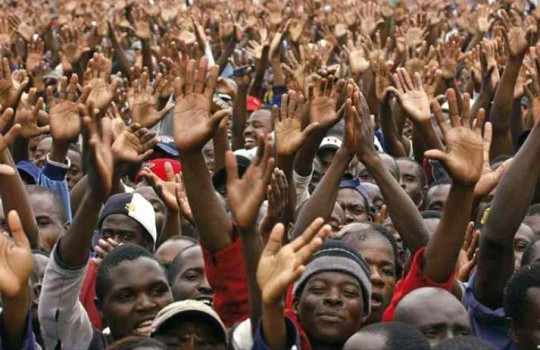
MDC supporters
Pamberi ne Zanu! is the chant of the Zanu PF supporters as they celebrate their victory over the MDC. The results in the Presidential race: President Mugabe, 61% against Prime Minister Tsvangirai’s 34%. In parliament Zanu PF won 158 seats to the MDC’s 51. Despite the scale of victory, there were no spontaneous celebrations and a sombre mood has gripped the country as both Zanu PF and MDC-T supporters have become anxious. The debate about the freeness and fairness of this election has taken on a familiar pattern from 2008 where SADC and the AU implicitly support Zanu PF and endorse the elections, while the UK, USA, Australia, Canada and Botswana question its legitimacy in support of the MDC. The MDC is currently preparing a dossier on electoral irregularities which supposedly helped rig the elections in favour of Zanu PF. The election saga is sure to continue for a few more weeks as the MDC is certain to contest the elections through the courts. However, it is highly unlikely that these elections will be re-run and it is with almost all certainty that Zanu PF will form the next government.
The Kenyan 2013 elections: some preliminary observations, by Anders Sjögren
After five days of waiting following the general Kenyan elections which took place on 4th March 2013, the Chairman of the Independent Electoral and Boundaries Commission (IEBC) Isaak Hassan, on the 9th March declared Uhuru Kenyatta of the Jubilee Alliance the winner and President elect. According to IEBC figures, Uhuru got 50,07 % of the votes – just slightly more than 4000 votes above the threshold of the required simple majority. Contrary to repeatedly stated fears, these elections were by and large free from violence. Thus, there was no repeat of January 2008. The process however did invoke strong memories of December 2007 – this was another failed election.
A few hours after the declaration of Uhuru as the winner, his closest competitor, Raila Odinga of the Coalition for Reform and Democracy (CORD) gave a speech in which he rejected the results, due to various forms of alleged vote rigging. CORD will now take its complaints to the Supreme Court, which has fourteen days to reach a decision. Until the Court has pronounced itself, it is probably wise to be careful in analysing the results, as the authenticity of this is uncertain. However, even preliminary observations suggest that this was a poorly organised and managed election. Not only did the tallying process suffer from major technical and administrative failures, there are also strong indications of quite a number of irregularities and breaking of electoral laws.
Comparing elections in Sierra Leone and Ghana (guest post by Jonathan Bhalla)
Multi-party elections were a prominent feature of Africa’s political landscape in 2012, with twenty-three countries conducting polls – whether presidential, legislative or municipal. News coverage in the mainstream media has, at times, been framed in clichés and stereotypes. On the eve of the Sierra Leonean elections, the BBC published an article which opened: “Sierra Leone may be about to prove it has grown up”. The preoccupation is often with little more than who is likely to win and whether there will be violence. Rapid and diverse political transitions taking place across the continent are seldom reflected upon in any depth.
I have a longstanding interest in the politics of Sierra Leone, and so followed the elections on 17th November 2012 closely – albeit from a distance. I found a number of striking similarities with the polls in Ghana, which took place a few weeks later on 7-8th December, particularly interesting.
Narratives of Injustice: The Counting of Votes in Aboabo, Ghana (guest post by Ulrik Jennische)
The Election Day in Ghana has passed. The incumbent president John D. Mahama and his National Democratic Congress, NDC, have been declared winner by the Electoral Commission, EC. Celebrations have been held across the country.
But the electoral process is not over. The leading opposition New Patriotic Party, NPP, with its ‘flagbearer’ Nana Akufo-Addo is contesting the result, claiming their victory has been stolen by the NDC and EC. They have decided to gather their evidence and go to court, testing the judicial side of the Ghanaian democracy.
Due to malfunctioning verification machines the election day of last Friday the 7th had to be stretched to the following Saturday as well. However, already on Friday results were coming in that leaned toward a NDC victory. Still, NPP representatives held a press conference on Saturday afternoon claiming that reports they received from their polling agents all over the country predicted their much wanted victory. On Sunday EC declared NDC the winner. Speculations are rife. Were the reports given to NPP false, or has NDC been able to defy the new biometric verification machines and somehow added NDC votes to the ballot boxes? Or have NPP early on realized the outcome of the voting, and hence spreading suspicions of irregularities, hoping for a second chance? Nevertheless, their early press conference was criticized from NDC as well as the Ghana National Peace Council.
Ghana votes #2: machines and patience

Polling station in Ussher Town under a billboard suggesting a different kind of vote
Yesterday I spent much of the day walking between polling stations: first in James and Ussher towns (downtown Accra) where things seemed to be working really well and then in Ashaiman. The latter location is a market town located close to the port of Tema. It contains of many poor settlements and had its share of violence during the last elections. At the first ten stations the voting was flowing smoothly and people were very satisfied. In the late afternoon I however visited several polling stations where the “machines”, as people said, had stopped functioning. The new biometric system requires electronic fingerprints for voters to vote and without a functioning finger print scanner they cannot vote. In some places people waited for hours with little information of when they could vote. Election functionaries in these locations knew little more than the voters and expressed great frustration over the “machines”. In one case the machine had simply frozen and could not be restarted, in the other cases they did not work after batteries had been replaced. One functionary told me that in all of Ashaiman they had just one spare fingerprint device and of all the defunct polling stations I visited none had gotten any technical support (in fact many voters thought that I was the technician that would fix their “machines”). At five o’clock when the polling stations were officially supposed to close voters and functionaries had still not received information of how to proceed. Only after dark they learnt that they would be allowed to vote the following day.
Changing picture: same MP candidate, new president, extra expenses
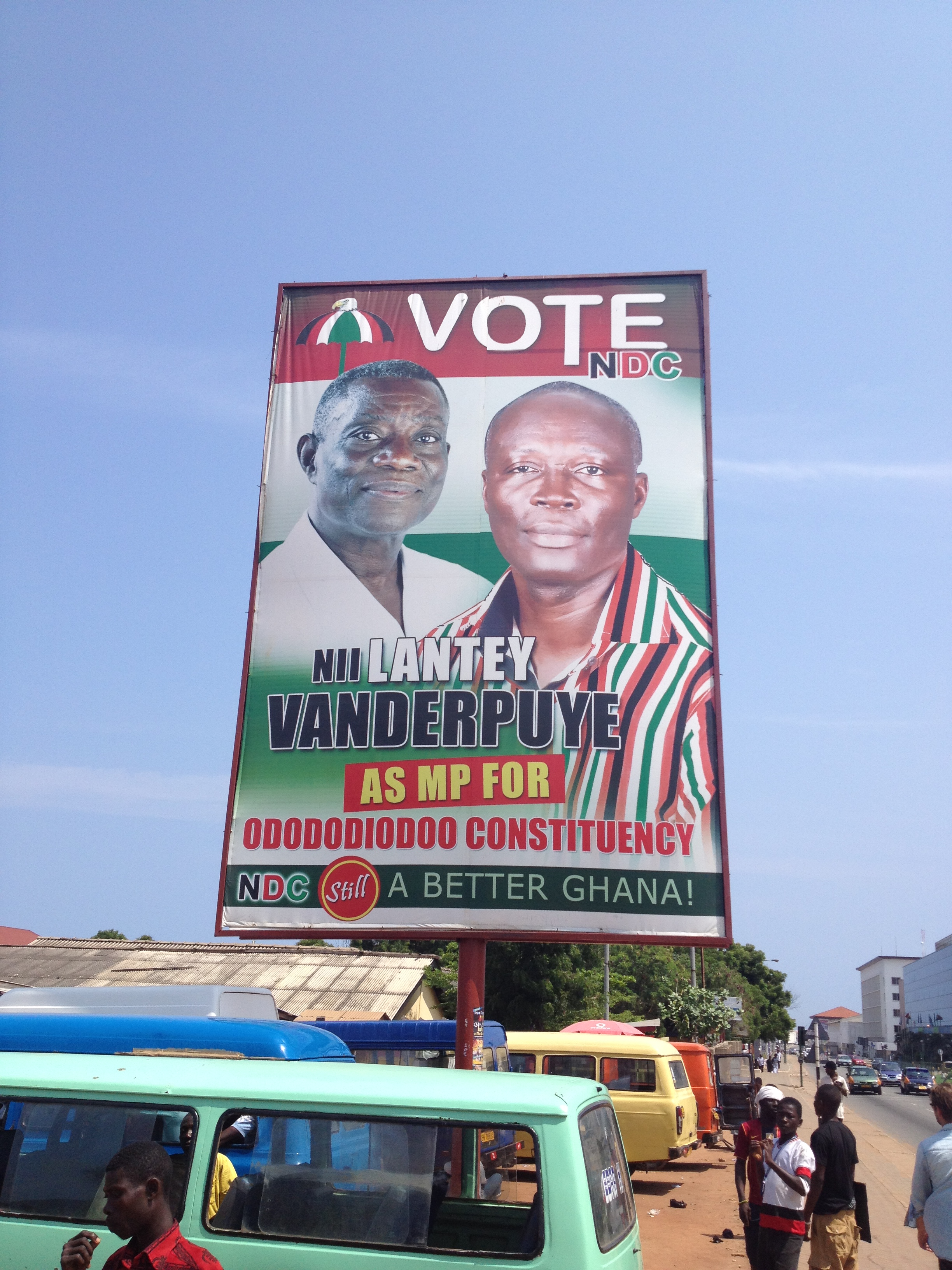
Mr. Vanderpuye, NDC MP candidate for Odododiodioo constituency, with late president Atta Mills…… (picture from June 2012)
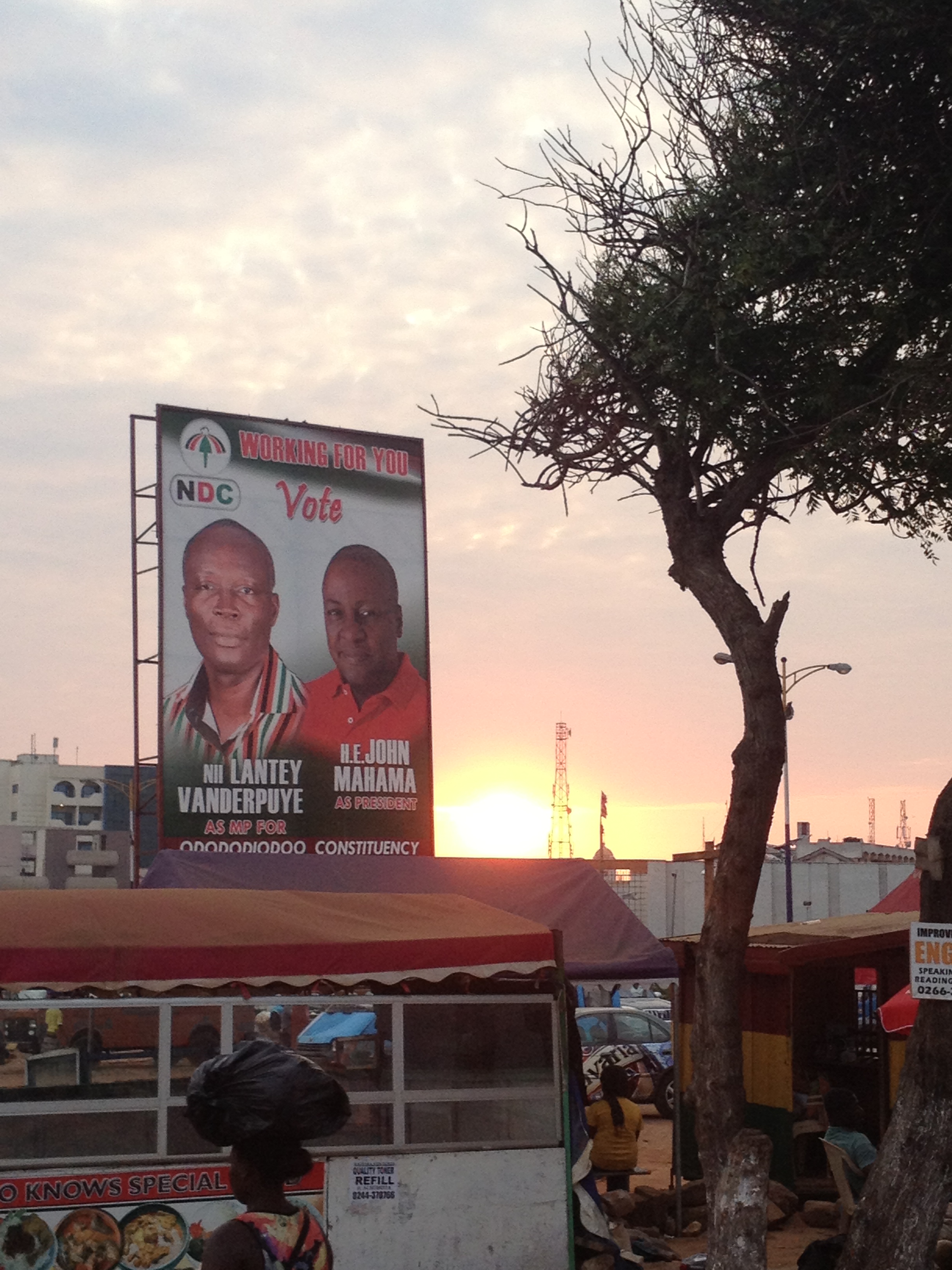
…. had to spend a lot of extra money to replace Atta Mills with new President John Mahama on his massive election posters (picture from December 2012)
Ghana votes 2012
I must say that I have been slightly disappointed with the political temperature in Accra. The few days I have spent in Accra have showed nothing like the political spirit of Sierra Leone, or even Liberia. But Wednesday turned out to be the real campaigning day in Accra and there was suddenly nothing wrong with elections frenzy and party spirit. Small rallies of supporters in party attire with banners and flags roamed downtown; a few groups of young men ran along the streets, but most of the campaigning takes place in caravans of cars, with supporters leaning out through the windows shouting party slogans and blowing vuvuzelas. Typically a group of motorbike riders would come first, driving at maximum speed, blowing their horns, ignoring traffic rules; at times against busy traffic on one-way streets. A posh car or two, and then tro-tro’s (minibuses) and taxis would follow. In the evening heads of parties and local MPs held meetings at various places and crisscrossed through town creating a joyful chaos. Supporters of the parties met up in friendly clashes where abusive language was used but violence was not in the air. Mockery is a common form of campaigning and a friend of mine saw a tro-tro driver in one of the NDC crowds stopping in the middle of the road just to throw himself on the ground with feet and hands up in the air. This act was with reference to an NPP meeting a few days ago in Kumasi when a stage broke down under the weight of presidential candidate Akufo-Addo and other NPP seniors who subsequently fell to the ground with hands and feet in the air. There is clearly room for comedy. Thursday has been much more quite with no real rallies, although lots of talks about politics. Friday is time to vote. Continue reading
Zimbabwe: The Elections that Nobody Wants (guest post by Eldridge Vigil Adolfo)
As elections loom over Zimbabwe in 2013, there is still no resolution to the longstanding political stalemate. The three political parties that formed a Government of National Unity (GNU) in 2008 have not implemented the reforms that would have prepared the country for elections. Continue reading