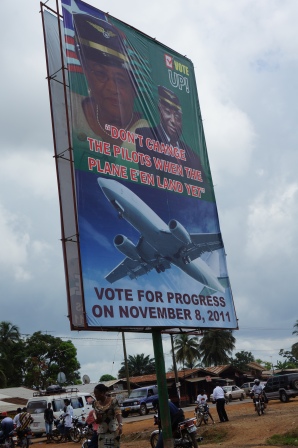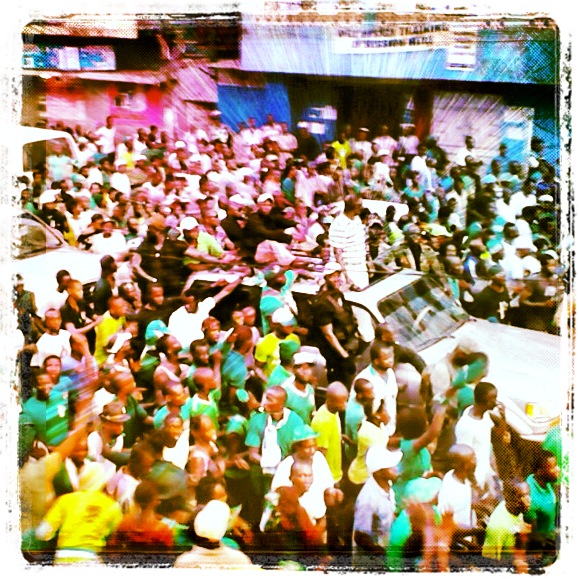
Late in the afternoon of Friday 24 November, as the sun was setting over the busy streets of downtown Freetown, the National Election Commission (NEC) of Sierra Leone called a press conference to announce the results of the Presidential Elections, ending a week of uncertainty and speculations. As anticipated by many, the sitting President Ernest Bai Koroma of the All People’s Congress (APC) secured a second term in power with almost 59 percent of the votes cast, thereby avoiding a run-off against the main opposition leader, the former military junta leader Julius Maada Bio of the Sierra Leone People’s Party (SLPP), who received 37, 4 percent. None of the other candidates were able to secure more than 1,5 precent, confirming the growing polarisation of the political landscape in post-war Sierra Leone. The turnout was high, with a national average of 87 percent. Continue reading
Category: Elections
The Waiting Continues in Sierra Leone (guest post by Johanna Söderström)
Now, a few days after the election on November 17, everyone is waiting for the National Electoral Commission (NEC) to announce the final results. Rumors of when NEC is going to announce the results spread like wildfire across Freetown, where people are eagerly anticipating the results. Whether via radio, tv or text messages each press conference by NEC is believed to be the big one, where the results will be called by NEC’s chairperson Christiana Thorpe. But so far everyone is still waiting.
Continue readingSoldiering Democracy: the 2012 elections in Sierra Leone (guest post by Maya Christensen)
“We want a transparent election with no violence” was a statement shared by people in the streets of Freetown when they went to vote for the presidential and parliamentary elections yesterday (November 17). With no cars allowed in the street and with the threat of being arrested if gathering in groups or if engaging in any form of political campaigning, Freetown street life was marked by an unusual quietness. Before daybreak people were queuing waiting for the polling stations to open and voter turnout was reported high all over the country. With the exception of a few incidents, the election has been reported generally peaceful so far. Continue reading
Liberia post-election: on CDC popularity and odd election results
As I have written previously, informed by my previous trip at the time of the elections in October/November last year, the situation after the CDC boycott of the second round of elections, where UP subsequently won a comfortable victory, has in Monrovia been quite tense. Returning in late March it is good to see that people now, a few months down the road, are getting on with their ordinary lives again (but democratic elections has such an impasse on Liberia arresting most activities within the state for a timeframe of close to six months and thus have considerable impact on the national economy). Although I personally felt that CDC made some very irresponsible and strategically bad moves, especially the boycott of the runoff, they still remain much popular, maybe even more today, amongst ordinary people. The main reason for CDC coming out strong is that they are viewed as the party opposed to the resource-grabbing and wealth-keeping UP government. Continue reading
Hunting generals and a few other things
“Look there is a general”, shouts our assistant, and we all get out of the car to extend greetings with a rather surprised former general with mild looking eyes. We are in Zwedru, the capital of Grand Gedeh County in Eastern Liberia, for a few days doing research former commanders and their roles in the post-war and former generals of MODEL are not too hard to find in Zwedru. However they are afraid to talk as it has been rumored for some time that there are training camps in the county and the police have arrested some former combatants allegedly have something to do with that. “But why should we train?” some former generals ask, “we are already properly trained”. Last year’s election in Liberia created some tensions in the country, between the ruling UP party and the oppositional party CDC. Grand Gedeh is a CDC stronghold. Grand Gedehians also point out that they were loyal and militarily active in pushing Charles Taylor and his regime out of the country but have not received any thanks and benefits from the current government. Their county remains very much marginal in Liberian politics as well as economy. To make the situation more delicate many inhabitants spent long stints of the war years on the other side of the border in Côte d’Ivoire (C.I.) or have relatives there. The change of government in C.I., a government that many Grand Gedehians supported, meant that both Liberians and Ivoirians residing on the Ivorian side had to run away from property and livelihood to take refuge on Liberian territory. Today they say that Burkinabes, but in reality it is people from the north of C.I, have taken over the prosperous plantation economy in C.I., whilst about 69.000 refugees of Ivorian origin and a large but unknown number of Liberians were forced into Liberia. This is naturally creating tension. These are some of the topics that I intend to publish on my blog over the next few days. Findings are temporary and originate from my last research trip in Liberia.
Post election – The Liberia situation
Most CDC supporters followed the recommendation of their party leader and restrained from voting on November 8. The election results show this with all clarity. After counting all the votes NEC showed that Johnson Sirleaf and the Unity Party had received more than 90%. Johnson Sirleaf has declared that she wants an inclusive government working for national unity, and there is clearly a need for this after the election period laying bare such cracks of conflict. Socio-political cracks are twofold: first between different regions within the country, and secondly between those who have and those who have not. These rifts are not new, but where rather central tenets of the civil war as well. For long term stability the Liberian government must in a comprehensive way deal with these issues – something that the UP has during their last period in office by and large failed to do. A further problem appears to be a centralisation of power to the UP. In fact they managed to “buy” up most of the smaller parties, with supporters and all, after the first round, and made deep inroads in the CDC opposition. This appears to be an obstacle for real democratic transition, and critical voices in Monrovia have started talking about the return of the one party state. Continue reading
Election Riots
The police used their big Guinea whips yesterday (see my previous entry). On November 7, CDC organised a “peaceful” party march intended to show their continued discontent urging people to boycott the election today. It appears to have turned ugly quite quick. The police tried to prevent the protestors to leave the party compound in Tubman Boulevard and started using teargas on the CDCians. The CDC supporters threw rocks and looted private property. The police fired live bullets into the crowd leaving at least one person dead and several wounded (there are a few clips uploaded on youtube). At some stage peacekeeping forces got involved. Continue reading
Off stage politics
The politics of confusion has been ruling Liberia over the last week. Where we in ordinary terms would expect to see a fury of activities with election rallies, heated debates and people in party hats and t-shirts parading the city, there has been little of that. Instead over the last few days CDC supporters with capacity to influence the electorate have openly given their support to the UP in what looks like jumping off a sinking ship in an election that has for outside observers turned into a political charade by the CDC. Meanwhile UP people have been going around in CDC strongholds of Monrovia and beyond with ample promises of local development projects. Continue reading
Under the cotton tree
Driving out of Monrovia, southwards, it is easily observed that most infrastructural improvements are largely limited to the capital. They are trying to refurbish the road to Buchanan, but there is still a long way to go. People complain about the slow pace. In Buchanan, which used to be the second city of Liberia, very little has changed since I was here five years ago. The main thoroughfare is still extremely potholed and must be carefully navigated by drivers and pedestrians alike, at night the place is spookily dark. In Buchanan just as in Monrovia there are numerous posters and banners with election messages; almost all of them for the Unity Party (UP) and with the face of President Johnson Sirleaf. However, when I talk to people in the streets here, a clear majority seems in favor of the opposition party CDC. Continue reading