Category: Excombatants

Ethnography and journalism in times of war

This text is a slightly adapted keynote/film introductory note I gave at a conference when the Department of Media and Social Sciences at the University of Stavanger celebrated its 50th anniversary, April 28, 2022. After the speech, our film Jew Man Business was screened.

In many ways, ethnography is akin to journalism. The researcher or journalist visits a somewhat unfamiliar place and tries to understand what is happening. In my research, I have focused on understanding civil wars: why people fight, how they survive, and how they rebuild their lives in the fragile aftermath of conflict. Foreign correspondents, stringers, documentary photographers, and documentary filmmakers often go to the same places, speak with some of the same people, and ask similar questions. In this talk, I will share some of my experiences from the ethnographic fieldwork I have conducted over the past 25 years. I will also present a shorter film we made to contrast with the many journalistic works and documentaries on civil wars in Liberia and Sierra Leone. Although I believe some journalists are careless and sometimes question their ethics, rather than a critique, this talk aims to find common ground between modern anthropology and journalism.

I have studied civil wars since I first got stuck in one in 1996. It was in Liberia. At the time, I was conducting three months of fieldwork in neighbouring Côte d’Ivoire, focusing on refugees from the ongoing civil war in Liberia. As I had subsequently intended to study refugees returning to Liberia, I seized the opportunity to travel overland to Monrovia, the Liberian capital, with an NGO vehicle. There had been no fighting for some time. However, on the way down, we encountered innumerable checkpoints manned by young, sometimes very young, rebel soldiers from various military factions. Approaching Saniquellie in Nimba County, we were stopped at a checkpoint by a group of young soldiers.

Saniquellie 1996

They were all smiles. I couldn’t resist stepping out of the white car and asking for a photo. They happily posed. At the time, I didn’t realise it, but the yellow T-shirt with the print “patience my ass” became significant for my research on child and youth fighters, as it turned out that many joined war factions in a more voluntarily fashion than media and other written accounts suggest. They were frustrated by the system, experiencing social blockages or a sense of social death. They were running low on patience. For many, fighting was a “patience my ass” move, a way of forcing themselves out of the margins and into the centre of society. In hindsight, it was a move that, for a clear majority of rank-and-file soldiers, did not succeed.

My primary focus during a one-year field study in 1997-98 in Monrovia and Ganta, Nimba County, was on what motivated young people to join rebel groups and the tactics they used to reintegrate into civil life.

However, the year before that, I became stranded in Monrovia and had to be airlifted out of the country. Two days after the encounter at the Saniquellie checkpoint, the war reignited. Had I known what I know now, I would have recognised the apparent signs of troop build-up and the movement of personnel, though travelling as civilians and unarmed, along the road we took. I would have understood the increased tension at the checkpoints. The following year, when I returned to Liberia, a young man, whom I knew from a refugee school on the Ivorian side of the border, told me he had seen me, and even attempted to catch a ride with our vehicle when he was moving along the road towards Monrovia to once again fight in the war. I did not see him, nor was I aware of the troop movements. I was a naive newcomer to war.

The day after I entered Monrovia, rebel forces clashed in what became the worst fighting in the capital during the entire civil war. It was gruesome, and from the balcony of a downtown flat I was stuck in, I could see mainly youths shooting at each other. I would say that most soldiers were between 16 and 21 years old.

After two days of intense fighting, a pause occurred, and I managed to make my way up the street to the US embassy. Inside, however, it was not much safer. Rebels jumped the poorly guarded walls and fought each other on the premises. When I went for a shower, I looked out the window and, to my surprise, a rebel soldier was hiding, pressed up against my window. When he saw me, he raised his finger to his mouth, “Shhh.” I closed the curtains and let the warm water rinse my body, as if the war was not there. A few nights later, we boarded a helicopter. I had a Liberian child on my lap, and he peed in his pants as we left Monrovia. Rebels were shooting at us, and a machine gun at the rear of our helicopter returned fire—bullets directed towards a pitch-black capital. We were mainly expats, but there were a few Liberians with American citizenship.

This highlights my privileged position. When conditions become difficult, people like me can usually find a way out. No one at the U.S. embassy was aware of my identity or the reason for my visit. Neither did they appear particularly interested, but they still allowed me in. The colour of my skin acted as my passport. Most Liberians, however, remained on the ground, fighting for their survival; tens of thousands lost their lives in the weeks that followed.

When I returned to Monrovia eight months later, elections had taken place. Charles Taylor, the warlord of the most significant rebel movement, had won convincingly and was installed as president. A reminder that democratic elections do not always guarantee democracy.

I began to spend time with former youth soldiers in downtown Monrovia. They were pretty excited to discover that I had been in Monrovia during the previous year’s war. If only in a cursory way, I had experienced their war, and it turned out to be a vital door-opener. I asked them about their whereabouts the previous year. As they were among the groups controlling the downtown area, they shared stories of how, whenever there was a lull in the fighting, they were approached by Western journalists. Some of them had been guides for these journalists. From the start, the journalists only dared to walk a few blocks. They stayed on a line, guarded by the rebel soldiers. They took photographs of the same few objects, the same ruins, and sometimes the same human remains. And they were fed the same few stories. Given the limited access, I have always wondered what it truly means to report unbiased and balanced news from a place like this. Is it even remotely possible?

Many of the soldiers who guided the journalists came to regret this. Indeed, they had been given tokens for their work, but journalists often promised them that upon their return, they would help them get on with their lives, pay for an education, or merely buy a mattress they could sleep on. The group I came to work with lived in a concrete shell of an old factory. During the rainy season, it got cold, and a foam mattress between them and the cold ground would make all the difference. However, few journalists ever returned, and not a single one kept their promises. Broken contracts between them and journalists made my work difficult. Why would they trust me? And from my point of view, what stories would they feed me with?

Rebel guides took the photojournalists on a safari-like walk through the urban wasteland when there was no fighting. To visualise war, the ex-combatants I worked with recalled that they were at times asked to perform active war. Many photographers and filmmakers were not on the front lines; instead, they stayed at a hotel near the U.S. Embassy, which was considered a safe haven. It was simply too dangerous out there. Instead, they worked post-fact by recreating scenes. Rebel soldiers assist them in staging the war for the cameras.

I cannot say how frequently such acts happened, but when I mentioned this fact a few years ago while giving a lecture to a group of UN peacekeepers, one participant in particular nodded in agreement. Later, he sent me a PowerPoint presentation that had circulated among his colleagues, which included 15 slides with “rigged” photos from fighting in Monrovia. Here are some:

Many poses or fighting styles mimic those seen in action films and are, quite frankly, not very effective in real war. In the background of the first picture, you can see other photographers taking photos. One is directed towards the same rebel soldier, whilst the other is taking a photo of a guy pointing his gun directly into the ground.

Another interesting point is that soldiers often appear very young—sometimes too young to handle a Kalashnikov, given its weight and strength. A boy around 13 or 14 might be able to hold a lighter Italian or Israeli machine gun, but not these types. This is what experts have told me. A more plausible explanation for the photos is that many of the younger individuals in the frames were Children Associated with Armed Forces (so-called CAFs), but not actual fighters. They performed various support roles for older soldiers. They cleaned and carried guns when there was no fighting. Therefore, during lulls in the battle, they posed with guns in front of international photojournalists, reinforcing stereotypes of child soldiers being exploited in African civil wars.

On the streets of Monrovia, I heard numerous stories of children trying to survive by telling violent tales to journalists. One was a young boy, whom I also saw in several news reports. As a reflection of the world’s absurdity, I saw him on a printed card from an international aid agency working against the war. It showed him on the ground; he looks stressed and agitated, as he displays his “warface.” In his hands, he holds a Kalashnikov. At the time, everyone in downtown Monrovia was familiar with the boy. He was poor and homeless, living day to day. Yet, everyone agreed that he never fought. Nonetheless, he mastered the art of telling his war story through words and body language.

Several of the guys whom journalists had approached told me that it was the journalist, or more probably the local fixer of the journalist, who arranged weapons for the photo shoots. They hired it from an ill-paid soldier or the like, thereby becoming an intricate part of a post-war economy.

So, if we go back to the pictures, we can’t simply conclude that they are genuine. The third picture in this batch is definitely not. It has been used to illustrate child soldiers in the media, predominantly on social media. Still, it is taken from a fiction film called Johnny Mad Dog, directed by Jean-Stéphane Sauvaire. He has made several fiction movies that are very close to being documentaries, and in this film, he trained local youth to become actors.

A few years ago, I collaborated with Clair MacDougall, a journalist who had lived in Monrovia for many years, on a project about some of the actors in this film and how they navigated Monrovia in the aftermath of the Johnny Mad Dog movie, rather than the war itself. One of the main characters, who never fought in the war, often portrayed himself as a former child soldier—another unusual legacy of a fictional film. In the end, we never managed to write up the research, but this case is another clear example of how young people invent rebel personas to cope in the post-war period.

Images travel! In another weird twist, an image from the film (on the right-hand side) became the cover of a book from Brazil.

I wrote to the author to ask him about the background of the image, and he had found it in a local gallery. While requesting permission to use it on his book cover, he never considered asking the artist where it originated. He took it for granted that it was from a favela in Rio de Janeiro.

I will return to Liberia soon, but first, I want to discuss the fieldwork I did next. After finishing my PhD, I moved there and started spending time on this street corner in downtown Freetown, the capital of neighbouring Sierra Leone.

Pentagon Corner 2005
Israel Corner 2005

One corner of the intersection was called Pentagon, another was named Israel (second picture), and the Pentagon residents carried out their more legal activities in Pentagon—mainly washing cars—while they engaged in illegal activities, such as selling and taking drugs, in Israel. A third corner was dubbed Baghdad. Overall, a rather striking reminder of world politics.

I spent two years hanging out on that street corner—any hour of the week, any time of the day. Ten to fifteen people, mostly former combatants, became my main interlocutors. Since then, we have stayed in touch. I have followed them through their post-war traumas, understood their war dilemmas, and seen how they have struggled to survive and reconnect with society. They once said they felt stuck and believed they would never progress, but now I meet a group of middle-aged men, many of whom have children and stable jobs. On the other hand, many of them are no longer with us. The post-war period proved to be almost as perilous and uncertain as the war itself.

I risk losing you here, but I want to discuss ethnography, anthropological work, and the danger of appearing anecdotal. I mentioned I worked with 10-15 people. That’s not many. Can you truly generalise from such a small group? Can it be compared to a survey of 2-3000 former combatants? Reflecting on the two years of street ethnography, I would say that my sample included far more than just 2-3000. Roaming the streets with Pentagon guys visiting all parts of the town, and taking my old, battered jeep to remote interior areas, where we visited their families and old combatant friends, I suggest that the material I have gathered carries more weight than just 2-3000 one-off interviews. It has both breadth and depth that surpass what most quantitative research can ever envisage. And now, it spans twenty years as well, as the cherry on top. On the contrary, I question some of the findings produced by quantitative researchers regarding the civil wars in both Liberia and Sierra Leone. Quite often, their findings do not add up.

When I began my ethnographic fieldwork with the Pentagon guys, I recorded life story interviews with them. After two years, I followed up, but most of their responses had changed. Once they got to know me and realised that I could be trusted and would not misuse their stories, they became more open and adjusted their narratives to something closer to “truth”. Besides the usual scientific rigour, ethnographic fieldwork relies on three main pillars: time, trust, and a good contextual understanding – the latter partly gained by reading historical and sociological books; however, these are scarce when it comes to small African countries. Gaining a profound knowledge of history and contemporary society requires being there. Understanding the sociology of war takes time; there are no shortcuts to this complex subject.

When researching sensitive areas such as participation in rebel armies, acts of killing, maiming, raping, pillaging, and destruction, it should be pretty clear that those you speak to may not readily admit to having committed such acts. Instead, they are more likely to share their victim stories. My “claim to academic fame” is the concept of victimcy. I define it as a tactic or agency of presenting oneself as a victim. When I began my research on child soldiers in Liberia, I met many young people who were surprisingly willing to discuss their wartime experiences with me. Some of them, like Benjamin Bonecrusher in Ganta, told me long stories about how brutal he was during the war, but as time went by, and I even became friends with his dad, he agreed that he had never fought. Benjamin and his peers were on a mission to gain an education, and they often pretended to be combatants, while in reality, they were not, to evoke sympathy and help them move forward in life. Others, of course, did fight.

When I first spoke to former combatants, their accounts of how they joined were very similar. They had either been forcibly taken by rebel soldiers at gunpoint or faced a choice: shoot a relative or an elder in their village, or join the ranks. More often than not, they were then loaded onto the back of a truck and taken away from their villages. They received brief training before being sent to the battlefield. It all seemed rather straightforward. Indeed, it fit so well with what I already knew—what we in the Global North believe to be true. Every single person I talked to had been forcefully recruited.

Over the next few months of my fieldwork, however, the stories began to shift, and in time. Stories changed gradually, and they rarely acknowledged that what they first told me was false. But there was no need to. It is easy to understand that you will not, in front of a total stranger, blurt out that “I killed and maimed and I volunteered to do so.”

In the end, not a single person I worked with maintained their stories of being forcefully recruited. Yet I still do not suggest that all people readily joined the carnage of war. Because they did not, but if they were forced into battle, it was instead due to structural forces. This is what I have been busy uncovering in my research. Part of the reason stems from a deep societal roar of dissatisfaction leading to a “patience my ass” move, and I am paraphrasing the yellow T-shirt, where you try to topple a dysfunctional system. Or you fight your way out of the margins. But many joined to protect what is theirs— their family’s, their kin’s, or their community’s.

I searched my photo archive for a series of pictures but couldn’t find them. The photos are again from the Pentagon street corner in Freetown, on a muddy stretch of road. A young man poses in a smart white suit. He looks pretty out of place. In the second photo, I photograph him from behind, and then it becomes clear that the back of the suit is entirely missing; it’s held together with a single string. Research is like that; it is often not as it first appears, and sometimes, what you don’t see at first is the most important.

To me, this highlights the value of ethnography. We often say that anthropologists understand what people do, not just what they say they do. First and foremost, people do not always want to disclose everything to a stranger or researcher immediately. Why would they? However, there is another aspect: research participants themselves often overlook aspects that we are interested in knowing. It often takes time to put words to experiences, and sometimes it takes a considerable amount of time. I believe you have all experienced this. When participating in a survey, there are questions you can’t fully relate to or even understand, but you still tend to tick a box. Do you prefer not to tick the “I don’t know” box? I tend to avoid that. I often wonder about these results, and I think this applies to much of a survey’s interview material.

A few years ago, a survey agency phoned me and asked if I could spare 20 minutes to answer some questions. It was one of those surveys about media behaviour, advertising, and consumption, etc., etc. I replied, “Yes, but is it okay if I lie?” The person on the other end of the line got very upset. I guess she would have been more than happy if I had just answered the questions and lied quietly here and there. Ignorance is bliss.

What you see is not always what you get. Remember the guy in the suit.

Kroo Bay 2006

What does this image tell you?

I have worked extensively with photography over the years. I have also taught visual anthropology and sensorial ethnography, although I do not consider myself a visual anthropologist. The film Jew Man Business, which I will show in a few minutes, bears the subtitle “a documentary,” a designation we added to indicate that the film does not conform to the norms of visual anthropology. However, the film is intended to tell a different kind of war story – or perhaps more precisely, a post-war story. It is a response to the numerous documentaries made about the civil wars in Liberia and Sierra Leone, specifically, but also across the world.

Film language is inherently based on simplifications, narration, and images that can be related to; otherwise, it would not communicate effectively with the audience. Our “Northern-produced” documentaries on Liberia and Sierra Leone depict their wars, but with images adapted to fit our imagination. In many ways, such documentaries are extensions of colonial and missionary accounts. It is the strange and the violent—the oftentimes “uncivilized” and the ungodly. The plastic mask in this image—the last image—is most likely first sold in a European shop, carrying a set of meanings that transform in an African setting. It doesn’t matter that it is used in a carnival in Sierra Leone. We imagine the image elsewhere: as part of a brutal war, fought by people with logics and means radically different from ours.

The simplicity of the African ‘other’ also appears in ideas about dancing. Africans dance in rain or shine, or play, for that matter. One of the most experienced Swedish Africa correspondents noted in a report on the war in Liberia that “When there are no ongoing battles, they play war.” On the screen, there were images of young Liberians shooting at each other. These images, like those I showed earlier, were acted out, I argue, but they didn’t “play” because a sudden playfulness overcame them; they performed in front of a Northern media audience, hoping to gain some financial benefit from it. 

The exotic often featured in documentary and journalistic media, as well as in many academic writings, blocks our understanding of what truly happens on the ground. In our film, we aimed to focus on the familiar rather than the exotic. We sought to portray our experiences of former combatants and street dwellers as deeply human, or perhaps even superhuman. Therefore, by employing tropes such as love and hope instead of aggression and despair, we introduce new perspectives to the audience, I hope.

Yet, having said that, it still largely depends on the audience. When I have shown the film to African audiences, there have been many laughs. However, when it has been screened for Northern emergency and development workers, there is instead a lot of “å det är så synd om dom” – feeling pity for them. Considering your backgrounds as journalists and media scholars, it will be interesting to see how you react.


Surfing the sublime – on leisure and warfare

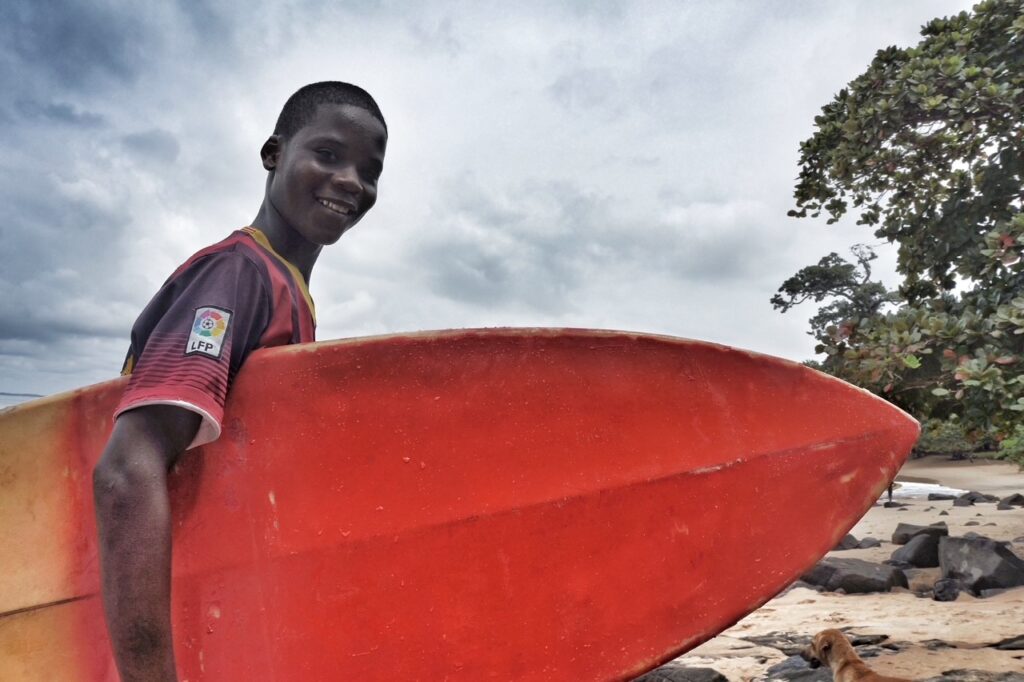
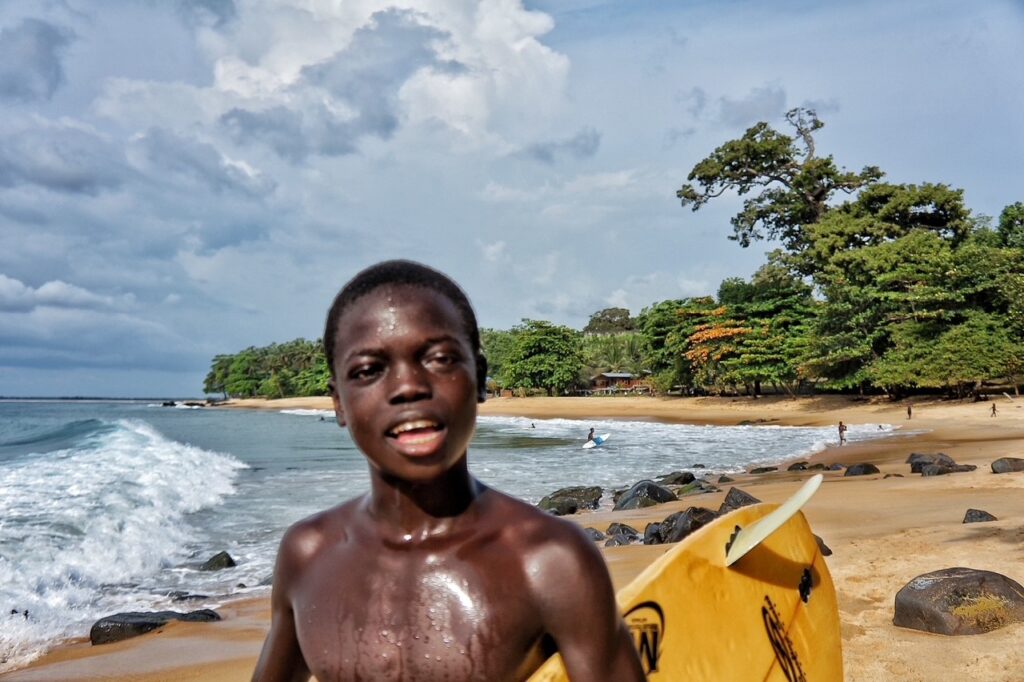
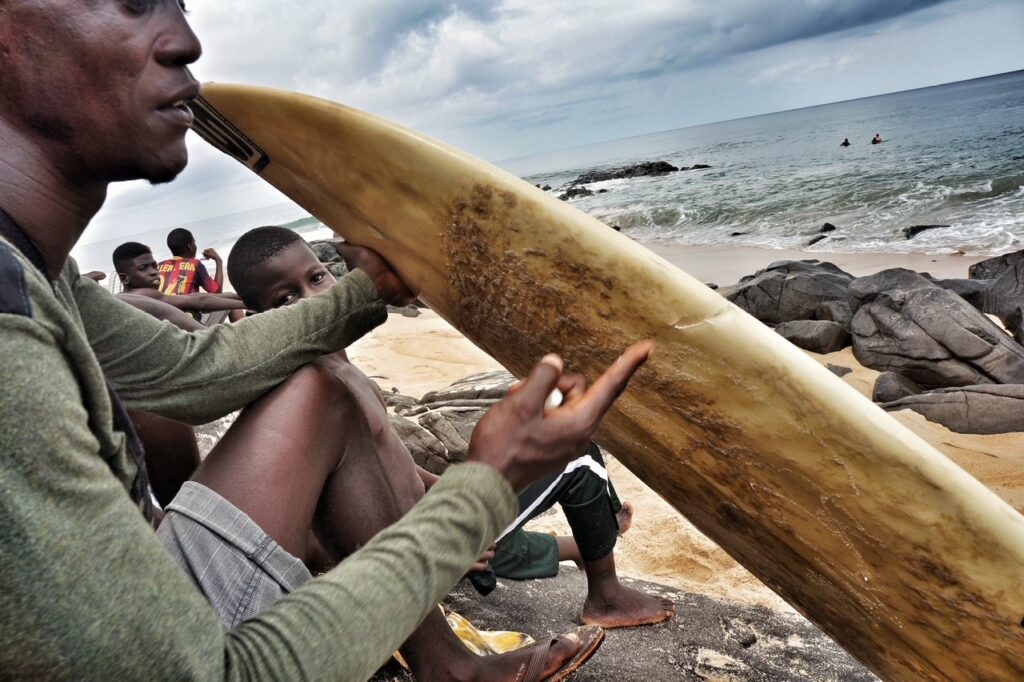
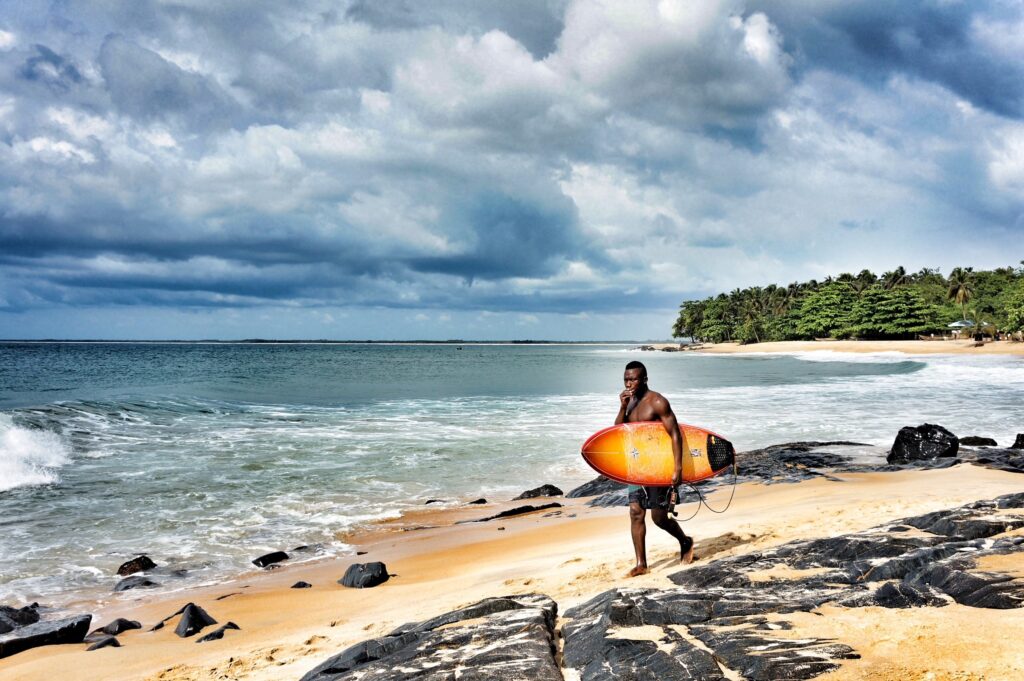
Robertsport, Liberia 2016

Preamble, Sumba, March 2025

My desk is facing the beach and ocean. I am currently on the small Indonesian island of Sumba, and my Californian neighbour is hitting the waves with his board. Back in 2017, I worked on a text about surfing, trying to compare the surfboard with the gun given to poor young men in West African civil wars. I even interviewed young surfers in the sleepy town of Robertsport, Liberia. It was a bit of a crazy comparison, but they often end up being the coolest, or so I thought then. I never finished the text, and as with the many other half-written ones on my hard drive, I probably never will. But re-reading it, I thought I should share it here the way it was and also take the opportunity to show some of the pictures I took back at Robertsport. My friend sociologist Ugo, who first inspired me to think about surfing, finished his research on the matter and published a great book with the University of Chicago Press (see readings by the end of this text). Although I took a surf lesson in Sierra Leone a few years ago, I still need to learn to surf!

This paper is based on two similar observations in the same country, but twenty years and worlds apart. It is a paper about the ludic and the vexing, about the fancy and fierce, about flow and the sublime.

During the spring (2017), I taught a master’s course with Ugo Corte, an Italian sociologist. Together with a bunch of students, we explored literature about the sensorial in anthropology and sociology. Ugo is, amongst others, doing research on big wave surfing in Hawaii, and to find a common denominator, I, when I was in Liberia last fall, decided to spend a few days amongst Liberian surfers in the tiny fishing town Robertsport. What follows is an altered version of the presentation I gave the master’s students.

In the full version of the paper, I will start with two questions: What is the gun to marginal youth in wartime Liberia? And what is the surfboard to marginal youth in post-war Liberia? I then want to pair these findings with the concepts of sublimity and flow, which are activity-prone concepts. While Csikszentmihalyi’s Flow is pretty straightforward, I intend to dwell a bit more on the Kantian sublime. I do so by using Brian Larkin’s Signal and Noise. I do acknowledge his rather unique way of using the concept. Thus, I will contrast/compare this with Richard Klein’s pomo classic Cigarettes are Sublime and how Simmel and Lyotard use the idea. I re-read Klein this summer, but my holiday was too short and sweet to allow me to develop this sufficiently. The simple aim I have here today is to convince you that there is potential research merit, i.e. it is not just a theoretical exercise, combining gun and surfboard in a sublime flow of war and post-war Liberia.

So Kant’s basic definition is that objects become sublime only because we judge them in reference to other objects (Larkin p. 35). Kant divided the sublime into two parts: the mathematically sublime, based in a sense of magnitude, and the dynamically sublime, the feeling of overwhelming physical powerlessness individuals feel in the face of something overpowering and terrible, which is fueling ambivalence “a simultaneous appreciation of beauty, awe, and terror”(Larkin p. 36).

Larkin focuses on the sublimity of technology and the awe that colonial technology spurred among Nigerians. The obvious technologies of the time were the train and the mobile cinema. David Nye, quoted by Larkin, proposes that “the technological sublime does not endorse human limitations; rather, it manifests a split between those who understand and control machines and those who do not” (Larkin, p. 39).

In Larkin’s work, he looks at colonial technologies from the point of view of the marginal colonial subject, but I propose a similar framework today for Liberia, a country that was de facto never colonized. Modern technologies such as the gun and the surfboard are related to awe. Still, I argue that in addition to technological awe, they may be considered sublime in the Kantian sense, as gun and board are also technologies for mastering, at least playing, flirting with, or surviving (at times sensing flow) of the otherwise overpowering and terrible.

In the water, youngsters eagerly wait to catch the right wave. Once they land with surfboards on the beach, they return to the cape and paddle out again. A theatre is going on for the entire day, and boys and young men battle over who may use the few available boards. Liberian youth are indeed, just as we are, also homo ludens, but this is actually a frenzy I have rarely seen in the country. When I asked them about surfing, they told me about experiencing the flow of life.

Almost twenty years before this experience, I recorded similar sentiments of flow amongst young Liberian rebel soldiers when they described attacking enemies on the battlefield.

When I started researching young combatants, it was 1997 in Monrovia. The rebel leader Charles Taylor had just won democratic elections to the great dismay of the West and the global humanitarians. My first field spot was called the Palace – a palace of misery. An abandoned concrete structure, an old factory quite centrally situated in downtown Monrovia. In the Palace, former combatants squatted and survived in the margins of the marginal in all senses: politically, economically and socially. By the majority, they were seen as scum of society, the utmost lumpen of lumpens. That international aid workers who resided nearby bizarrely enough believed them to be cannibals only further reiterated their marginality.

My second field spot was in the Liberian interior where I worked with a group of former combatants leading slightly better lives. They were sons and daughters of the soil. In the aftermath of the first Liberian war, they fought hard to get re-integrated: they earned money that they used for school fees, they visited the villages where they came from and brought gifts to restore social relationships, and in all ways possible, tried to repair what was broken and regain what was lost. To them, the whole war had been about locating opportunities and fighting their way out of the rural margins and often precarious social relations.

My third and longest fieldwork lasted two years as I hung out on a street corner in Freetown, Sierra Leone. Here, I more than ever took part in everyday life, and I believe that I, in a very detailed way, got to understand their life realms, both in hindsight with regard to their experiences as fighters during the war in the country and also their survival in post-war settings.

But my work was hardly embodied. I did not experience the war as a rebel soldier. I did not kill, I did not maim people, I did not loot or burn down people’s property. I did not dodge bullets, and I did not starve in the jungle. My commander didn’t mock-execute me because I did not share my loot. I did not, for the first time, experience the power of deciding who should live or die, the rush of rape etc.

And on the post-war street corner? I did not sleep outdoors in the pouring rain. Fight for food on a daily basis. I did not smoke crack cocaine. I did not experience jail first-hand. My friend was not slashed to death with a knife in a meaningless turf war. And I did not experience the demeaning moments of letting another man sleep with my girlfriend because I could not afford to feed her.

I could talk at length about how a marginal rebel soldier feels during the war to make sense of the flow they sometimes experience on the battlefield, but it has been done elsewhere. Yet still, think for a second how it would be to live in a very poor country, run by a very small elite, controlling most political and economic resources. You grow up with poor parents in a gerontocratic village. Most certainly, your parents can’t afford to educate you; the land you will farm is somebody else’s – it is not yours. When war comes, either the elders in your village decide that you must join the rebel movement to protect land and people, or you are more conscious and run away because you see the war as a means to liberate yourself.

It was a kind of patience-my-ass-move. I took a picture of a boy in a t-shirt with that print at a checkpoint manned by the rebel movement NPFL in Saniquelle in 1996. At the time, I did not know it, but this fuck-all mentality, a mentality implying the need to take whatever chance there is to get somewhere in this world, came out strong in many of the life stories told by former combatants both in Liberia and Sierra Leone.

Being from the margins of the very margin meant for quite many that the gun, to some extent, was the first piece of modernity they ever laid hands on. Others have accounted for the fantasy energy young combatants felt when given a gun – the gun itself was a sublime object. The power of the gun only accentuated this. What you could get by holding a gun was sensational: all the food you could eat, a car, make the elders kneel in front of you, a house, you could have a bed, where you could even host your first girlfriend or command a woman to have sex with you. It was sensational. It was a rush. It was power. It was living with speed. It was flow.

Back then, I named my PhD thesis “Sweet Battlefields” after an ex-fighter in one of my interviews told me that “there is nothing as sweet as being on the battlefield when fighting is going fine”. What he alluded to then, something I also heard from many others, was a double feeling of flow. Flow is, according to Csikszentmihalyi, “[t]he holistic sensation that people feel when they act with total involvement” (p. 36). And to the fighter flow was experienced and embodied, partly directly, momentarily on the battlefield when fighting was going fine, but more often, it was part of the edgework of being a rebel which they lived and embodied (and certainly missed in the aftermath as they were momentarily remarginalised). The gun is utility, sublimely beautiful, although involving both fear and blockage (Klein p. 63).

Ugo points out that a big wave surfboard is sometimes called a gun, or an elephant gun, to be more precise.  Although waves are radically smaller on the Liberian coastline than off Hawaii, and you certainly don’t need a gun, I will shift time and space, traverse back to the present day and to ocean, swell and surf.

I propose a link between surfboards and guns in a slightly different way than the idea of guns amongst big-wave surfers offshore in Hawaii. I do so by suggesting that to youth in the Liberian margins, both objects are “totems of technology” breeding on “fantasy energy” (Larkin p. 126). To the marginal comrades in the sleepy town of Robertsport, surfing creates a similar flow as war, and the surfboard is a modern object of technology (ibid. 20-21) akin to the gun.

There is generally a lot of foot-dragging and slow movements among marginal youth in West Africa. It is as if their whole bodies protest against the dominant society (in the sense proposed by James Scott). Indeed, if paid opportunities turn up, young bodies may pick up speed. But it is rare, so when I watch surfers quickly getting out of the water and running back to get in, I react: this drama is a Liberian rarity. This is flow. I ask them how they feel when they surf; indeed, they contrast surfing to the hardships of everyday life. When they wait for the right wave and ride it, they are the masters, and on the beach, the elite from the capital sits in the shade, watching in awe. Tables are turned for as long as they are in the water.

“People who don’t know it say we make magic”, one of the young surfers states.

In Mark Stranger’s book Surfing Life, he discusses the surfer as an adventurer in Simmel’s tradition. They are “aesthetically oriented leisure-time risk-takers”, pseudo-adventurers only mimicking real “heroic life” (p. 160). One may argue that this is also at stake in Robertsport. Leisure has replaced warfare, and controlling waves have replaced social navigation of war; “the surfer appreciates nature in a stormy sea” and “finds purpose in this sublime chaos” (p. 163).

“The appreciation of the sublime is facilitated by the experience of flow and the meanings attributed to it in surfing culture”, states Stranger and continues to say that “the ecstatic feelings of universal oneness that an appreciation of the sublime can induce are intensely experienced in the transcendence of self-immanent in flow” (ibid.). But maybe this is only post-modern mimicking. After all, as Simmel states, the real adventurers’ thrill of risk-taking involves: “complete self-abandonment to the powers and accidents of the world, which can delight us, but in the same breath destroy us” (p. 193). This sounds more like the sublime flow of the Kalashnikov-toting youth of the civil war than of the beach boy surf dude of the post-war. The gun in a sweet battle, but not the surfboard in a good swell, is a “negative pleasure” in Kant’s eyes.

Readings

Csikszentmihalyi. 2000 [1975]. Flow

Kant. 1952. The critique of judgement

Corte. 2022. Dangerous fun

Klein. 1994. Cigarettes are Sublime

Larkin. 2008. Signal and noise

Lyotard. 1994. Lesson on the analytic of the sublime

Simmel. 1971. The adventurer

Scott. 1985. Weapons of the weak

Stranger. 2011. Surfing life

Utas, 2003. Sweet battlefields

Burundi, I, and the year of 2015, by Gudrun Sif Fridriksdottir

“I miss dancing” a friend of mine says sometime in late June. “What?” I reply, thinking I must have misheard him. “I miss dancing”, he hesitates a bit “…and information [independent media]”. I can’t help laughing “Well one is very important for democracy, the other … not so much” I claim. But then again he has a point. At this stage Bujumbura has been in turmoil for almost two months, he lives in a turbulent neighbourhood, I don’t, but we are all already very tired. People just want their regular lives back, and being able to enjoy life, not just live it. Unfortunately this is not to happen in 2015. Continue reading

The Ties that Bind: Ex-Military Command Structures as a Foundation for Peace or Source for Insecurity? by Anders Themnér

The presence of large groups of ex-combatants is often seen as a major challenge to post-civil war stability. Experiences of ex-fighters engaging in different forms of violence have prompted policy-makers and scholars (and to be frank, at times also myself) to ‘securitize’ the ex-combatant issue. This has particularly been true concerning the phenomenon of informal military networks. The sight of ex-fighters interacting with their former commanders, often on a daily basis, is commonly seen as a direct threat to the post-war order, especially since such ties should – according to official disarmament, demobilization and reintegration (DDR) jargon – cease to exist. It is true that ex-combatant networks can, and have been, employed for detrimental purposes. Officially dismantled command structures have, for instance, been used for wartime purposes in Macedonia, Mali, the Republic of Congo and Tajikistan; electoral violence in Aceh (Indonesia), Niger Delta (Nigeria) and Sierra Leone; riots in Liberia and Mozambique; and organized violence in Columbia, Mozambique and Sierra Leone. However, recent research has also highlighted how ex-command structures provide vital social services that can further peace and stability. Informal military networks do, for instance, constitute an important source of employment, friendship and security for many ex-combatants. Continue reading

How seven Norwegian small warships ended up in the hands of a former Niger Delta militant, by Morten Böås

Norway is rarely an issue of debate in Nigeria, but on Sunday 14th December 2014, every major online newspaper in the country published articles about the sale of Norwegian warships to a security company controlled by a former Niger Delta militant. The main issues raised was not only why Norway had sold seven warships to former Niger Delta militant, but equally important what consequences this would have for the tense and possibly violent elections 14th February next year. Continue reading

Once a combatant, always a combatant? by Ilmari Käihkö

In the recent report of the United Nations (UN) Security Council Panel of Experts on Liberia the authors express a stern warning concerning the dangers posed by former combatants for the cross-border security in the Mano River belt. According to the Panel of Experts, these former combatants in Liberia “present in remote border regions… live in semi-organized autonomous groups outside of any State authority, often under the direct influence of former ‘generals’ who commanded rebel factions during the Liberian civil conflict”.[i]

I acquired the report less than a week after returning from Liberia, where I’ve spent more than ten months during the past two years investigating networks of former combatants as a part of my PhD research. The bulk of my fieldwork has been conducted in the Southeastern Grand Gedeh County, which is also the area the Panel of Experts focus on due to the recent cross-border attacks from Grand Gedeh to Ivory Coast. Because I am most familiar with this setting, and because the report obviously focuses on Grand Gedeh, I will also concentrate on the county.

Continue reading

Economy of the street

c9c233_296a56047d6d4e95a6a03217ab047e1e.png_srz_295_225_75_22_0.50_1.20_0[1]We just launched a new website with images and texts from Freetown, Sierra Leone. The site is a platform for both a photo exhibition: Pentagon (photos and texts from my fieldwork) and a film: Jew-Man Business (directed by Maya Christensen, filmed by Christian Vium and produced by me). The new website has been created by Hanna Berhanusdotter who has been an academic intern at NAI. Please have a look: http://www.economyofthestreet.com/

Continue reading

Once a General, always a General?

This is a somewhat adapted English version of my text “Im Frieden hilft der General” published in the latest Issue of Welt-sichten (October 2013, pp. 45-47). see  http://www.welt-sichten.org/personen/18332/mats-utas 

One of the central aspects of Disarmament, Demobilization and Reintegration (DDR) programs in post-conflict settings is to break the ties between rebel commanders and their soldiers so as to make remobilization more difficult and reintegration into civilian life easier. I have over the past 17 years conducted research with ex-combatants in Liberia and Sierra Leone, two small West African countries still recovering from years of brutal rebel warfare. I have in both countries built up close relationships with former combatants and therefore dug deeper into the realities of commander/soldier networks and the socio-political realities wherein they exist. Questions I will ask in this text centers around DDR and the breaking of commander/soldier networks and I will try to answer three interdependent questions: Who benefits from this breaking of networks? And contrary in whose interest is the maintenance of these networks? Is it at all feasible, or even desirable for post-war societies to break these networks?

Continue reading

Generals for good? Do-good generals and the structural endurance of wartime networks

In the aftermath of civil wars there is a general belief that old command structures of former rebel movements and militias is a serious threat to newfound stability. Indeed there is enough evidence around pointing out how easily remobilized such networks are. There is however a tendency of viewing this mobilization as the very logic of the networks themselves – as if their very raison d’être is to create eternal conflict. The problem with this hackneyed focus on armed groups is that we are letting the leading political characters that acted behind the façade of the armed groups off the hook. In any DDR process a lot of effort is placed on dismantling chains of command, command and control etc., of armed groups. Despite this, ten years after the end of the second Liberian war contacts between commanders and their former soldiers still prevail, yet most commonly for non-military reasons. Indeed some networks of ex-combatants have disappeared but many others remain. It appears that what the DDR process chiefly managed to do was to drive the networks underground and out of sight of the international community.

Continue reading

West Point – Conflicting perceptions of crime, security and Liberian ex-combatants (by Mariam Persson)

Chaos is something we tend to see when we don’t understand how things work. Chaos is what we think we witness when we forget to take our time to listen to people’s stories, and let fear and excitement lead us in our hunt for sensational war stories.

I struggle to keep up with Adam today. He is walking fast and Will and I have to hurry along the narrow alley-ways between the small zinc houses and sheds not to lose sight of him. We have to squeeze ourselves between women cooking for their families, children playing in the small open spaces and chasing each other between the houses. I apologise for being in the way and for just walking in where women are preparing food, people are having their meals or taking a rest. Most people just give me friendly smiles back and continue with their business. A few look a bit surprised to see a stranger there but most don’t bother at all. I try to focus on where Adam is going so he won’t have to wait for us on every corner, but I haven’t seen Will in a long time and we get caught up in our conversation as usual and Adam patiently has to wait. Adam turns left and right along narrow paths between the cramped houses. I turn to Will and joke about whether Adam actually knows where he is going. Will laughs and admits that he has no idea where we are either. But Adam knows his way around here. He used to live here for some years just after the war. For me West Point still is a maze. I had only been in this community a few times since I first started to visit Monrovia some years ago. Situated on a peninsula jutting out into the Atlantic Ocean this township of the Liberian capital wasn’t a place one often just passed by without any particular errand. However, doing research on what I call ‘post-war rebel networks’, ex-combatants who had preserved their links to each other after the war came to an end, it was maybe a bit strange that my research hadn’t brought me to this township that often in the past, judging from its reputation of being inhabited by so many ex-combatants. But my informants had been residing elsewhere. I only recently had begun to spend more time in West Point.

Continue reading