Category: Post Conflict

50 years.

Charles Taylor will spend the rest of his life in prison (unless someone decides to assist his escape again :)) for aiding and abetting war crimes in Sierra Leone. As a comparison Issa Sesay, one of the senior commanders of RUF, was sentenced by the same court to 52 years. Most commentators have raised words of optimism saying that the trial will send signals to other warlords that they will eventually be dealt with if they don’t “behave”. Maybe so, but I doubt. Anyone who decides to lead armed incursions or make military coups is quite aware of the stakes and prepared to take the risks. After all it is a prerequisite that they gamble rather offensive with their own life by leading such endeavors. However what may be the outcome is that a set of future military leaders (and some currently in power) must think twice with whom they form alliances and be aware that it should rather not be someone who is on bad footing with the mighty West.

Two short observations to be made: firstly, I guess we will see some shifts in political alliances on the Liberian arena. They may not happen overnight, and they may not be directly visible to all observers – after all Liberian politics by and large happens behind the scenes. And secondly, I hope that Charles Taylor will spend some of his time in jail writing, or narrating to others, his proper version of the Liberian civil war. What else should he do with all his time?

Gerhard Anders has also written some closing remarks on the Taylor saga:
http://centreofafricanstudies.wordpress.com/2012/06/01/a-sense-of-an-ending-notes-on-the-sentencing-in-the-trial-against-charles-taylor-2/

The impact of the judgement against Taylor: A dispatch from Sierra Leone and Liberia (Guest post)

by Gerhard Anders, Centre of African Studies, University of Edinburgh

Representatives of international organizations, humanitarian NGOs and Western governments have hailed the guilty verdict against Charles Taylor as an important milestone in the global fight against impunity. With this judgement the Special Court for Sierra Leone, established in 2002 at the request of the government of Sierra Leone, concludes the international effort to hold accountable those ‘bearing greatest responsibility’ for war crimes committed between November 1996 and 2002 in Sierra Leone. In the streets of Freetown, most people greeted the news of the judgement with an indifferent shrug whilst critical voices where heard in parts of neighbouring Liberia. In contrast to the self-congratulatory praise by humanitarian activists and Western governments, people in Sierra Leone and Liberia hold much more differentiated views on the trial against Charles Taylor. To a large degree these are shaped by the current political and economic situation in both countries. Continue reading

Youth as a social age

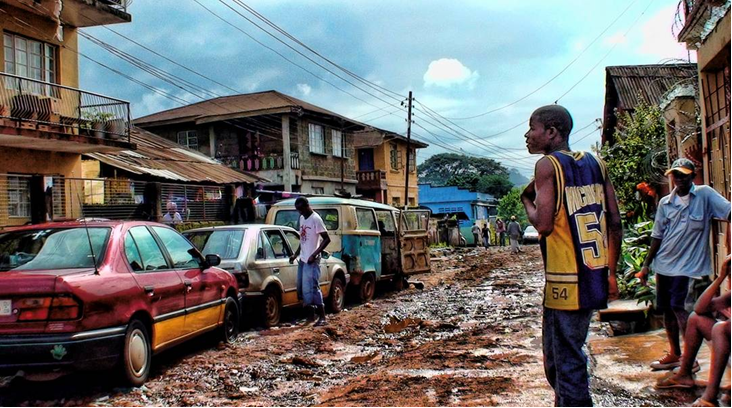
Youths hanging out in Freetown, Sierra Leone. Photo: Mats Utas


URBAN YOUTH AND POST-CONFLICT AFRICA: ON RESEARCH AND POLICY PRIORITIES 

Two tales from Freetown, Sierra Leone, drawn from my two years of fieldwork there illustrates how marginalized men are often regarded as youths if they aren’t married or have no proper jobs, no matter what their actual age.

Justice, I call him so because he is obsessed with justice, or maybe rather the lack of it in current day Sierra Leone. Justice quite often comes down to the street corner with minor bruises and scratch marks in his face or on his arms. People tend to laugh at him because it is his girlfriend doing this damage to him. She is a few years younger than Justice, who is in his mid-twenties. Justice is a typical Freetown street-dweller, although not one of the poorest as he, at least, has a roof over his head. His girlfriend is a prostitute that we hardly see, but we talk about her quite often. Justice does not want her to ply the streets at night, but when he tries to force her to stay home at night she fights him. It is not easy to keep a girlfriend if you are poor he says. Among the young men in the street corner we talk a lot about this. Many say they cannot afford to keep a girlfriend at all and furthermore knows that if someone with more economic leverage comes a long one’s girlfriend is frequently lost without battle. They also talk about the humiliating and unsettling fact that if they have a girlfriend she is most often a prostitute. It is painful to share your girlfriend with other men they all agree upon. To make things worse such girlfriends also have more money than them a fact that helps to turn traditional gender roles upside down, making the young men in the street corner into dependents. With reference to this, those in the street corner who fought in the Sierra Leonean civil war often dream about the days of the war when they “controlled” their girlfriends and frequently could afford to entertain several at the same time. Today however they have been remarginalized into what they see as a chronic state of youthhood. Continue reading

Wicked CT – In memoriam

Yesterday the Special Court for Sierra Leone found Charles Taylor guilty of aiding the RUF during the Sierra Leonean Civil War. The court case that has taken five years is the last of a court that has previously sentenced 9 Sierra Leonean rebel and military leaders with long prison sentences. Taylor has 14 days to appeal and his sentence should be given on May 30.

Not too long ago I was in a Monrovian bar owned by a friend of mine. I complained about a drink where they used American ginger beer instead of making their own “local” version. Local ginger beer is a sweet, nice and affable drink compared to its unpleasant American brother. Nothing comes out of complaining so instead I arranged with the barman that he should buy some ginger and lime and we would meet before opening the following day. So we did and together we made ginger beer and with the skills of the barman created a very tasty drink. We named it CT after Charles Taylor. Charles Taylor was often nicknamed ginger because of his light skin. I hope that costumers ordering a CT do understand that it is an irony – the name was not given to celebrate Charles Taylor, but as a comment on the enigmatic presence of Charles Taylor in Liberia close to ten years after he left the country in 2003. Continue reading

Hunting generals in Grand Gedeh

One of the fascinating things with a society like the Liberian is that with quite little effort you can meet with people all the way up in the hierarchies. This goes for former rebel groups as well. Some of the top brass officers did not shy away from meeting us in Monrovia. In Grand Gedeh it proved a bit more difficult.  Allegations of training camps, where old and new soldiers were supposedly gathering to prepare for incursions in either Liberia or neighboring Ivory Cost had recently led to the arrests of some former MODEL people. Even if nobody seemed to really know which country was meant to be targeted, everybody knew and talked about it when we reached to Zwedru, the county capital of Grand Gedeh. Obviously it made former generals slightly apprehensive talking to us. Some even said that when they heard that we were looking for them they initially ran away because of fear. In their eyes a European researcher is likely to be connected to the Liberian government, at least from their perspective both appear equally remote and intruding. However after entering into conversation and when we were given time to explain ourselves most let go of their doubts. One thing however that they really wanted us to highlight was that there are no training camps in Grand Gedeh and, for rather obvious reasons, there is no need to train for already trained and seasoned rebel soldiers. Having heard ample training camp rumors before, for instance in Sierra Leone, and knowing how soldiers are mobilized into rebel armies, I agree with them, camps is if anything an obstacle for efficient mobilization of troops in a semi-policed setting like Grand Gedeh, unless the government itself has their stake in it. The presence of camps in Grand Gedeh today is highly unlikely. Yet one should be reminded of the volatile situation on the Ivorian side of the border and from the Liberian side small armed groups have crossed the border into Ivory Coast and attacked villages. Such cross-border attacks are however extremely rare and also most surely appear in isolation. Continue reading

Liberia post-election: on CDC popularity and odd election results

As I have written previously, informed by my previous trip at the time of the elections in October/November last year, the situation after the CDC boycott of the second round of elections, where UP subsequently won a comfortable victory, has in Monrovia been quite tense. Returning in late March it is good to see that people now, a few months down the road, are getting on with their ordinary lives again (but democratic elections has such an impasse on Liberia arresting most activities within the state for a timeframe of close to six months and thus have considerable impact on the national economy). Although I personally felt that CDC made some very irresponsible and strategically bad moves, especially the boycott of the runoff, they still remain much popular, maybe even more today, amongst ordinary people. The main reason for CDC coming out strong is that they are viewed as the party opposed to the resource-grabbing and wealth-keeping UP government. Continue reading

Hunting generals and a few other things

“Look there is a general”, shouts our assistant, and we all get out of the car to extend greetings with a rather surprised former general with mild looking eyes. We are in Zwedru, the capital of Grand Gedeh County in Eastern Liberia, for a few days doing research former commanders and their roles in the post-war and former generals of MODEL are not too hard to find in Zwedru. However they are afraid to talk as it has been rumored for some time that there are training camps in the county and the police have arrested some former combatants allegedly have something to do with that. “But why should we train?” some former generals ask, “we are already properly trained”. Last year’s election in Liberia created some tensions in the country, between the ruling UP party and the oppositional party CDC. Grand Gedeh is a CDC stronghold. Grand Gedehians also point out that they were loyal and militarily active in pushing Charles Taylor and his regime out of the country but have not received any thanks and benefits from the current government. Their county remains very much marginal in Liberian politics as well as economy. To make the situation more delicate many inhabitants spent long stints of the war years on the other side of the border in Côte d’Ivoire (C.I.) or have relatives there. The change of government in C.I., a government that many Grand Gedehians supported, meant that both Liberians and Ivoirians residing on the Ivorian side had to run away from property and livelihood to take refuge on Liberian territory. Today they say that Burkinabes, but in reality it is people from the north of C.I, have taken over the prosperous plantation economy in C.I., whilst about 69.000 refugees of Ivorian origin and a large but unknown number of Liberians were forced into Liberia. This is naturally creating tension. These are some of the topics that I intend to publish on my blog over the next few days. Findings are temporary and originate from my last research trip in Liberia.

Post election – The Liberia situation

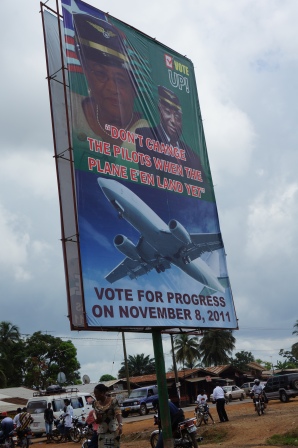
Funny election poster

Most CDC supporters followed the recommendation of their party leader and restrained from voting on November 8. The election results show this with all clarity. After counting all the votes  NEC  showed that Johnson Sirleaf and the Unity Party had received more than 90%. Johnson Sirleaf has declared that she wants an inclusive government working for national unity, and there is clearly a need for this after the election period laying bare such cracks of conflict. Socio-political cracks are twofold: first between different regions within the country, and secondly between those who have and those who have not. These rifts are not new, but where rather central tenets of the civil war as well. For long term stability the Liberian government must in a comprehensive way deal with these issues – something that the UP has during their last period in office by and large failed to do. A further problem appears to be a centralisation of power to the UP. In fact they managed to “buy” up most of the smaller parties, with supporters and all, after the first round, and made deep inroads in the CDC opposition. This appears to be an obstacle for real democratic transition, and critical voices in Monrovia have started talking about the return of the one party state. Continue reading

Monrovia October 27, 2011

I arrived late last night. It is strange to me to see Monrovia lit up with street lights and with such an improved infrastructure. There is even public transportation now for example with busses from ELWA-junction to Buchanan with marked bus stops – although they wait until buses are filled up before they leave ELWA. President Ellen Johnson Sirleaf has gotten herself a nice election banner stating that she is the receiver of the Nobel peace prize and what would be more natural than placing it in front of the United Nations Mission in Liberia (UNMIL) HQ. Otherwise life is continuing as usual: when the water truck fills up the water tank at the hotel, there are women and kids from the neighborhood with buckets and pans filling them with water from the leaking hosepipe. Even though infrastructure is improving life is still hard for ordinary people and clean water is in demand. Continue reading

Off to Liberia

What is the role of former military commanders in Liberian politics? With this question in my mind I am today leaving for Liberia on a ten-day field study. The second round of the presidential election is of course a great opportunity to study the role of ex-military networks in the democratic process.

Ellen Johnson Sirleaf seems to be heading for a certain victory in the election’s second round after former warlord Prince Johnson openly stated his support for the sitting president. Under any circumstances most of his supporters would place their vote on Johnson Sirleaf. Prince Johnson enjoys strong support in the Nimba county whose population during the civil war was engaged in a conflict with a population group from southern Liberia. Johnson Sirleaf’s opponent Winston Tubman, with support mainly in the south, is viewed as a dangerous force by many people in the north. Continue reading