Liberia’s bi-cameral legislature comprises of 73 members of the lower house, called the House of Representatives and 30 members of the upper house, called the Senate. In 2014, Liberians will go to the polls to elect 15 of the 30 Senators for a tenure of nine years. These ‘mid-term’ elections are a constitutional requirement that ensures that all the Senate seats are not vacant at the same time. In this piece, I argue that elections should be a growth industry where best ideas and character flourish above cash and false promises. Continue reading
Tag: Liberia
The “War” on Ebola, by Gudrun Sif Fridriksdottir
In the limited attention the international media has paid to Liberian, Sierra Leonean and Guinean people’s experiences and thoughts on Ebola an interesting metaphor has frequently come up – that of comparing Ebola to war.
“The Ebola outbreak has been like someone firing live bullets” – Emmett P Chea, Liberia (http://www.bbc.com/news/29331061). “Just imagine living somewhere where you are being invisibly terrorized” – Lucy Sherman, Liberian in the US (http://www.abcactionnews.com/news/hillsborough-regional-news/ebola-worries-from-home-follow-ut-student)
This has been in the context of either comparing the virus to war generally, as above, or comparing it specifically to the civil wars that Liberians and Sierra Leoneans have endured. Continue reading
Can Sirleaf survive ebola? Political legitimacy and government response to the ebola crisis in Liberia, by Mary Moran
The following is the complete address given by Colgate’s Mary Moran, professor of anthropology and Africana and Latin American studies, at Duke University in September. It was written for oral presentation, is unrevised, and should not be cited or circulated without permission.
When I submitted the title for this talk about two weeks ago, I was very much thinking of the term “survive” in its metaphorical sense. Liberia’s President Ellen Johnson Sirleaf, the first woman elected president of an African nation, faces the greatest challenge of her career, and unprecedented criticism both at home and abroad for failing to rebuild the national health care infrastructure and for her handling of the present crisis, including calls for her resignation (VOA news, Sept. 2, 2014).
I am a political anthropologist, not a medical one, and my intention here today is to try to place the government and public response to ebola in Liberia squarely in its local, historical and social/cultural context. But metaphor became concrete reality with a Front Page Africa headline on Sept. 10, “Ebola Hits Seat of Liberian Presidency; 1 Dead, 1 Quarantined” reporting that an administrative assistant to the Foreign Minister had died from ebola while her husband, also infected, was a staffer in the President’s office, two floors above in the same building. Continue reading
The Rain after the Drought: Ebola, International Assistance and Community Initiatives in Liberia, by Charles Lawrence
Monrovia: October 3, 2014
Not so many years ago, I was part of a team monitoring and preparing humanitarian interventions to address the effects of drought in a certain region in eastern Africa. In our meeting room in London, we assessed the needs based on the latest information; our goal was to preposition lifesaving supplies and experts for rapid deployment. Then news about the rains emerged. This I greeted with optimistic fists. The crops will emerge again, waterholes will be filled, and the cattle will have their grazing fields.
The communities that have lived through several experiences of drought were less enthusiastic, members of the response team that had worked in drought affected regions were cautiously optimistic. Their experiences told them something that we would later come to understand. Continue reading
Ten Things that Anthropologists Can Do to Fight the West African Ebola Epidemic, By Sharon Abramowitz
Like other anthropologists who have woken up mid-career and found the countries where they’ve lived and worked awash in mass deaths (and let’s be real… that’s quite a lot of us), my initial response to the Ebola outbreak in West Africa was to hope that the experts had the situation under control, and bury my head in the sand.
Soon, the epidemic outpaced the global health response, and the calls for help grew more urgent, but anthropologists’ phones have stayed startlingly quiet. While leaders at the Centers for Disease Control (CDC), Médecins Sans Frontières (MSF), and the World Health Organization explained how factors like culture, weak governance systems, human behavior, and social organization made the outbreak unintelligible to the global health community, academics who work in the region like Danny Hoffman, Rosalind Shaw, Mats Utas, Chris Coulter, Mary Moran, Susan Shepler, Adia Benton, Mike McGovern, Sasha Newell, Gwen Heaner, and Marianne Ferme, not to mention anthropologist from the global south like Sylvain Landry Faye, have remained untapped as resources for understanding and creating innovative new approaches to attacking the Ebola outbreak at its source.
Continue reading
Reading the International Crisis Group or why think tank reports have to be taken with a pinch of salt, by Berit Bliesemann de Guevara
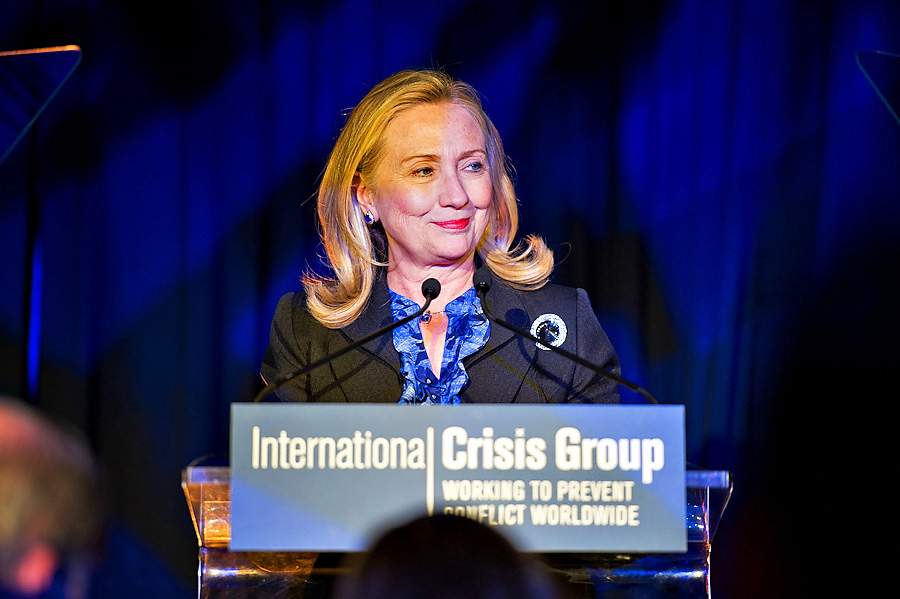
Hillary Clinton at ICG Annual Award ceremony (Picture borrowed from glkcreative.com)
Recently the New York Times caused turmoil among prestigious and influential US think tanks when it published an investigative article about concealed connections between these non-profit research organisations and a broad range of foreign countries, among them Norway, Japan, Saudi Arabia and Qatar (NYT online, 6/9/2014). The article revealed that leading think tanks like the Center for Global Development, the Brookings Institution and the Atlantic Council are receiving funding from foreign governments in exchange for influence on the organisations’ recommendations to US policy-makers. The article criticized this practice for its lack of transparency and the supposed loss of intellectual freedom and objectivity. ‘The money is increasingly transforming the once-staid think-tank world into a muscular arm of foreign governments’ lobbying in Washington’, the authors cautioned. The attacked think tanks rejected the accusations, pointing to ‘credibility’ and ‘scholarly independence’ as their major ‘currency’, although one interviewee admitted that self-censorship could be a future problem because in times of dwindling funding sources, saving one’s job could well trump the urge to be critical.
Beyond the health crisis: Ebola hits Liberia’s economy hard, by Patrick Hettinger
With over 400 deaths in Liberia and more than 1,000 across West Africa, the Ebola epidemic has been the deadliest in history and has spread fear and panic across the region. But beyond the terrifying health crisis, the Ebola outbreak threatens to reverse much of the economic and social progress Liberia has made over its decade of peace. While GDP growth had averaged over 8% since 2011, it was already forecast to slow down to 5.9% in 2014 due to slower growth in iron ore production, weak timber and rubber exports growth, and the gradual drawdown of the United Nations force (UNMIL). However, restrictions on transportation and commerce, the withdrawal of international workers, a slowdown of investment, and a panicked population will further reduce growth this year. Containing the crisis rapidly will be critical to preserve the progress made, and to reduce risks to the short- and medium-term outlook.
“It don’t take a semiotician…” Or, what we talk about when we talk about bush meat, by Adia Benton
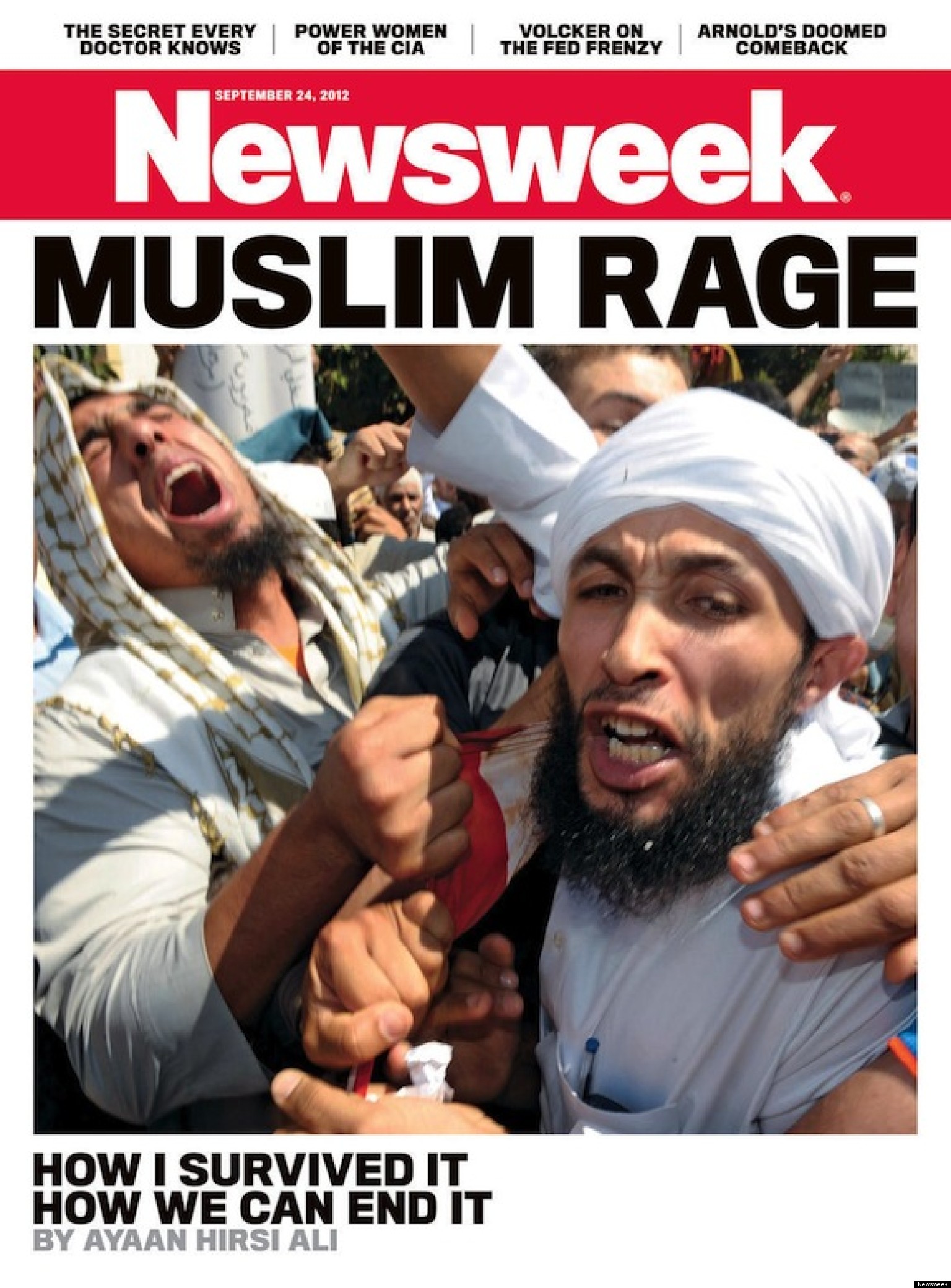
This weekend, Newsweek published a relatively controversial article about the recent Ebola outbreak in West Africa. Here’s the cover:

Let’s just say it’s not exactly an original piece of journalism either.
I found myself frustrated not only by the cover and the article, but also by the editor-in-chief’s condescending response to his critics:
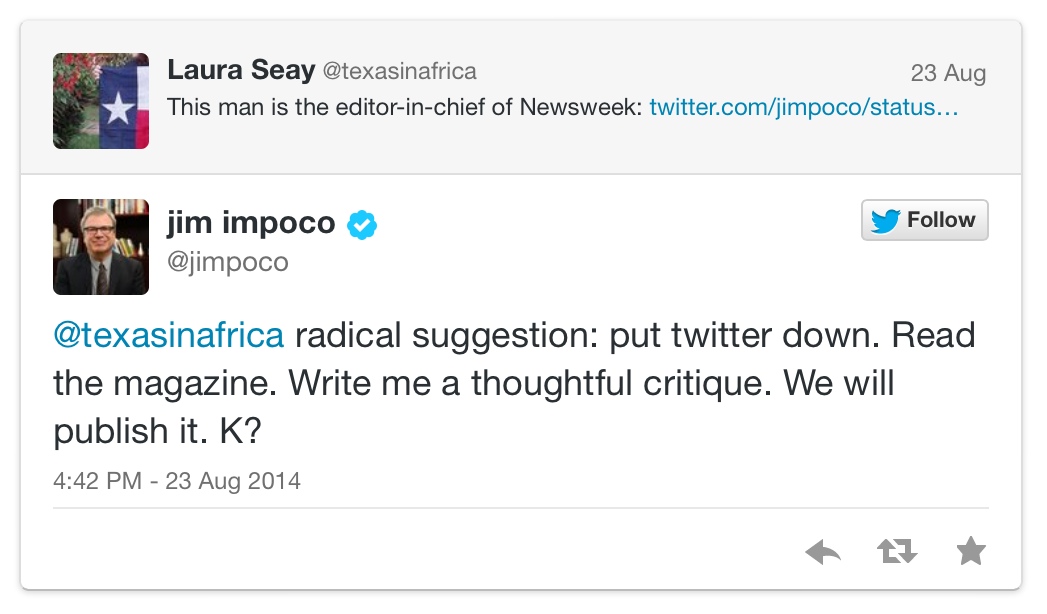
Not exactly the kind of response you want from an editor-in-chief, right? I vented to Facebook friends about the magazine cover, the thin claims of the article and its editor-in-chief’s rude response to critical tweets. One of my friends pointed out that the magazine has been propagating race-baiting click bait for a while now. (Yes, I used the word ‘bait’ twice, and we, the scholars, have bitten). So it shouldn’t be surprising to see the old trope of apes standing in for black folks or sexually charged Grubb Street prognostications regarding ‘back door’ entry of Ebola into the US gracing its front pages. (As one tweeter noted, It doesn’t take a semiotician to see what’s going on here).

The Complexity of Ebola & Its Misrepresentation in the West, by Theresa Ammann
After two months, I left Liberia and my Liberian host-family shortly before what has now officially been termed Ebola Outbreak #2, full of worries what was yet to come. When ebola first entered Liberia in March, I was bewildered at the initial response of the Government of Liberia (GoL) and the inaction of the International community, so much that the later rapid escalation of Outbreak #2 did not come as a surprise. To me, the ebola outbreak has become a marker of the fragility of the Liberian state and the biased mentality of International decision-makers and media. While ebola will lead to many far-reaching consequences that one can only speculate about at this point, one thing is for sure, the historically deeply-entrenched Liberian distrust in public authorities will only be worsened by this.
Ebola, mistrust and humanitarian mobility? by Adia Benton
In a recent response to questions about the role of the war and the attacks on foreign health workers, I wrote:
…. if war has changed anything, the incredible influx of humanitarian interventions and aid workers during the war and its immediate aftermath — where outsiders and their local cronies seemed to benefit openly from others’ suffering — has also engendered suspicion that has helped fuel the backlash against local and international health workers.
Here, I am expanding on this claim, which is intended to complement Susan Shepler’s piece about mistrust of the ‘vampire state’.