One of the fascinating things with a society like the Liberian is that with quite little effort you can meet with people all the way up in the hierarchies. This goes for former rebel groups as well. Some of the top brass officers did not shy away from meeting us in Monrovia. In Grand Gedeh it proved a bit more difficult. Allegations of training camps, where old and new soldiers were supposedly gathering to prepare for incursions in either Liberia or neighboring Ivory Cost had recently led to the arrests of some former MODEL people. Even if nobody seemed to really know which country was meant to be targeted, everybody knew and talked about it when we reached to Zwedru, the county capital of Grand Gedeh. Obviously it made former generals slightly apprehensive talking to us. Some even said that when they heard that we were looking for them they initially ran away because of fear. In their eyes a European researcher is likely to be connected to the Liberian government, at least from their perspective both appear equally remote and intruding. However after entering into conversation and when we were given time to explain ourselves most let go of their doubts. One thing however that they really wanted us to highlight was that there are no training camps in Grand Gedeh and, for rather obvious reasons, there is no need to train for already trained and seasoned rebel soldiers. Having heard ample training camp rumors before, for instance in Sierra Leone, and knowing how soldiers are mobilized into rebel armies, I agree with them, camps is if anything an obstacle for efficient mobilization of troops in a semi-policed setting like Grand Gedeh, unless the government itself has their stake in it. The presence of camps in Grand Gedeh today is highly unlikely. Yet one should be reminded of the volatile situation on the Ivorian side of the border and from the Liberian side small armed groups have crossed the border into Ivory Coast and attacked villages. Such cross-border attacks are however extremely rare and also most surely appear in isolation. Continue reading
Tag: Liberia
Liberia post-election: on CDC popularity and odd election results
As I have written previously, informed by my previous trip at the time of the elections in October/November last year, the situation after the CDC boycott of the second round of elections, where UP subsequently won a comfortable victory, has in Monrovia been quite tense. Returning in late March it is good to see that people now, a few months down the road, are getting on with their ordinary lives again (but democratic elections has such an impasse on Liberia arresting most activities within the state for a timeframe of close to six months and thus have considerable impact on the national economy). Although I personally felt that CDC made some very irresponsible and strategically bad moves, especially the boycott of the runoff, they still remain much popular, maybe even more today, amongst ordinary people. The main reason for CDC coming out strong is that they are viewed as the party opposed to the resource-grabbing and wealth-keeping UP government. Continue reading
Hunting generals and a few other things
“Look there is a general”, shouts our assistant, and we all get out of the car to extend greetings with a rather surprised former general with mild looking eyes. We are in Zwedru, the capital of Grand Gedeh County in Eastern Liberia, for a few days doing research former commanders and their roles in the post-war and former generals of MODEL are not too hard to find in Zwedru. However they are afraid to talk as it has been rumored for some time that there are training camps in the county and the police have arrested some former combatants allegedly have something to do with that. “But why should we train?” some former generals ask, “we are already properly trained”. Last year’s election in Liberia created some tensions in the country, between the ruling UP party and the oppositional party CDC. Grand Gedeh is a CDC stronghold. Grand Gedehians also point out that they were loyal and militarily active in pushing Charles Taylor and his regime out of the country but have not received any thanks and benefits from the current government. Their county remains very much marginal in Liberian politics as well as economy. To make the situation more delicate many inhabitants spent long stints of the war years on the other side of the border in Côte d’Ivoire (C.I.) or have relatives there. The change of government in C.I., a government that many Grand Gedehians supported, meant that both Liberians and Ivoirians residing on the Ivorian side had to run away from property and livelihood to take refuge on Liberian territory. Today they say that Burkinabes, but in reality it is people from the north of C.I, have taken over the prosperous plantation economy in C.I., whilst about 69.000 refugees of Ivorian origin and a large but unknown number of Liberians were forced into Liberia. This is naturally creating tension. These are some of the topics that I intend to publish on my blog over the next few days. Findings are temporary and originate from my last research trip in Liberia.
On Sporadic Radicalism
Last week I participated in the third Marrakech Security Forum which this year focused on “Issues and security consequences of transition in North Africa”. It also included several panels on the consequences for the Sahel region, as well as the problem of drugs trafficking in West Africa. In this well-ordered event organized by Federation Africaine Des etudes Strategiques/Centre Marocain des Etudes Strategiques there were participants from some 50 countries, about 120 men but only 10 women, clearly indicating the male biased interest in the security business. Participants came chiefly from the MENA region but to quite some extent also from francophone Africa south of the Sahara. It was a crowd of senior diplomats, high rank militaries and professors. It appeared that everyone was a director of one institute or another other. There were naturally also a number of Europeans and Americans. Many of the more than hundred, too brief, presentations were quite general statements on the political situation in North Africa and in the Sahel region. Interestingly U.S. officials and academics choose to humbly downplay the U.S. role in Africa in the years to come, except for in a few strategic countries. French officials raised concern over the situation in Algeria and also talked about the situation in the Sahel as “war” and showed concern for the increasing interconnectedness of militant Islamist groups in the region and all the way down to Nigeria. Participants from Africa South of the Sahara gave quite divergent views on the possibilities of an “African spring”, but the Sahelialists were equally afraid of developments around AQIM, Boko Haram and other radical groups. Continue reading
‘war as a violent mode of participating in today’s global economy’: reading danny hoffman’s war machines
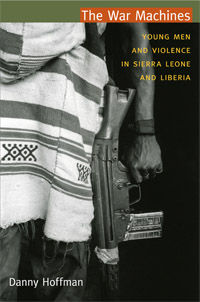 Below is my review of Danny Hoffman’s fantastic book The War Machines: young men and violence in Sierra Leone and Liberia recently published by Duke University Press.
Malaria in insecure spaces. The first time I heard of Danny Hoffman was at an international conference and it was a fantastic story. Some of the senior academics shook their heads at the risks he had taken, blaming it on his “youth”, but I was rather impressed. My reading was that surviving this situation was dependent on his skillful building of trust and mutual respect with his research subjects: rebel soldiers. Hoffman had caught a serious stroke of malaria whilst being in the deep Sierra Leonean bush with rebel soldiers. He was saved by rebels who carried him across the border to Liberia for medical attention; clearly risking their lives, but thereby saving his. Continue reading
Post election – The Liberia situation
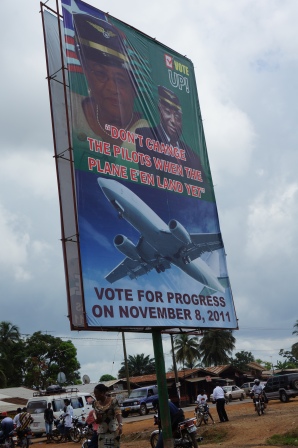
Funny election poster
Most CDC supporters followed the recommendation of their party leader and restrained from voting on November 8. The election results show this with all clarity. After counting all the votes NEC showed that Johnson Sirleaf and the Unity Party had received more than 90%. Johnson Sirleaf has declared that she wants an inclusive government working for national unity, and there is clearly a need for this after the election period laying bare such cracks of conflict. Socio-political cracks are twofold: first between different regions within the country, and secondly between those who have and those who have not. These rifts are not new, but where rather central tenets of the civil war as well. For long term stability the Liberian government must in a comprehensive way deal with these issues – something that the UP has during their last period in office by and large failed to do. A further problem appears to be a centralisation of power to the UP. In fact they managed to “buy” up most of the smaller parties, with supporters and all, after the first round, and made deep inroads in the CDC opposition. This appears to be an obstacle for real democratic transition, and critical voices in Monrovia have started talking about the return of the one party state. Continue reading
Election Riots
The police used their big Guinea whips yesterday (see my previous entry). On November 7, CDC organised a “peaceful” party march intended to show their continued discontent urging people to boycott the election today. It appears to have turned ugly quite quick. The police tried to prevent the protestors to leave the party compound in Tubman Boulevard and started using teargas on the CDCians. The CDC supporters threw rocks and looted private property. The police fired live bullets into the crowd leaving at least one person dead and several wounded (there are a few clips uploaded on youtube). At some stage peacekeeping forces got involved. Continue reading
Off stage politics
The politics of confusion has been ruling Liberia over the last week. Where we in ordinary terms would expect to see a fury of activities with election rallies, heated debates and people in party hats and t-shirts parading the city, there has been little of that. Instead over the last few days CDC supporters with capacity to influence the electorate have openly given their support to the UP in what looks like jumping off a sinking ship in an election that has for outside observers turned into a political charade by the CDC. Meanwhile UP people have been going around in CDC strongholds of Monrovia and beyond with ample promises of local development projects. Continue reading
Red Eyes
Observers of the wars in Liberia and Sierra Leone typically pointed out how extremely red the eyes of rebel soldiers were. Explanatory factors were typically excessive abuse of alcohol and drugs. I have, in an article on the West Side Boys published in Journal Modern African Studies (46: 3, 2008), written about the concept of making yourself fearful as a deliberate tactic amongst the militia. Here is how a junior commander of the group explained it:
You use Liberian slang, you get a lot of beard, you plait [your hair], you fearful yourself, you know eh? You pull your clothes, wear hot pants and people will know that it is bush he comes from – he is different from those in town. So when you stand up and open fire the people will be afraid. Pa-pa-pa-pa. Yes, you will fearful yourself, so people will say this bad man; I am afraid of him. As you see our car people will say: ‘ah – this is the West Side Boys. They have arrived – they are fearful.’ They will know when we come down from the West Side because they will see a lot of fearful old tubes and old things and so-so fearful weapons. We don’t dress correct. We wear combat uniforms; we wear t-shirts; all kinds of dressing. We fearful ourselves, in that way when you see our bushiness you will be afraid.
In Liberia we have seen similar tactical dressing during the war; from fighting “butt naked”, in life-jackets to donning wedding-dresses, all in order to fearful yourself. I have never really reflected over the red eyes, but when a former commander of one of the Liberian rebel groups yesterday told me that there is a particular leaf in the jungle that you use to fearful yourself, it made perfect sense – the leaf is used to make one’s eyes red.
Anthony, Jesus and the US embassy
I was thinking of my old friend Anthony today when I passed the US embassy. The embassy is increasingly taking over the hill of Mamba Point, the highpoint of downtown Monrovia. I have no idea where Anthony is today, but here I narrate a dream he once had. Entering an imagined Western space would to Anthony [anno 1998], and many other young Liberians, put an end to social suffering, a gaining of personal freedom and indisputable status of next to divine character. Remember that this is a year after the end of the first war and in a city very much in fear of renewed war with the warlord democrat Charles Taylor ruling the country. Continue reading